







Message from the President- OPA

Dear Members, and the General Public,
Sri Lanka stands at a critical juncture, having faced unprecedented challenges, from the COVID-19 pandemic and economic crisis to natural disasters that tested our resilience and unity. These experiences have reshaped our understanding of responsibility, leadership, and collective action as a nation.
At this time, informed dialogue and responsible engagement are vital. We commend the National Issues Committee, together with the Publications Committee, for producing this newsletter and for their continued commitment to addressing matters of national importance.
National issues affect every citizen and demand participation from all sectors of society. As professionals, we have a responsibility to offer clarity, ethical judgment, and expertise-driven solutions. As the apex body of the professional community, the Organisation of Professional Associations of Sri Lanka (OPA) is committed to ensuring that professional voices positively influence national outcomes.
This newsletter is more than a publication, it is an invitation to engage critically, think responsibly, and act in the national interest. I encourage all members to actively support the work of the National Issues Committee and contribute meaningfully to discussions that shape our nation's future.
I extend my best wishes to the National Issues Committee and the Publications Committee and trust that this newsletter will serve as a valuable resource for reflection, learning, and action.
Jayantha Gallehewa
President
Organization of Professional Associations
Message from General Secretary - OPA

Dear Members and the General Public,
I extend my warmest greetings and best wishes to all members of the Organization of Professional Associations (OPA) and to our wider readership. May the year ahead bring progress, stability, and shared success.
It gives me great pleasure, in my capacity as general Secretary, OPA, to assist the inaugural issue of the National Issues Newsletter of the OPA, published under the name NIC Newsline. This second edition represents more than the launch of a publication, it marks the beginning of a dedicated forum aimed at encouraging informed discussion on key national issues and the evolving socio-economic landscape of our country.
The OPA has always stood for the responsible use of professional knowledge in the national interest. In today’s complex environment, informed voices and constructive engagement are more important than ever. Through this newsletter, we seek to connect professional insight with public dialogue, support evidence-based discussions, and contribute meaningfully to policy formulation and national development initiatives.
NIC Newsline is envisioned as a space where ideas are shared, perspectives are challenged, and practical solutions are explored. I trust that this publication will encourage professionals to stay informed, think critically, and actively participate in addressing the challenges facing our nation.
It is my sincere hope that this newsletter will evolve into a trusted platform for examining national concerns and identifying ways in which professionals can collectively contribute to Sri Lanka’s progress and long-term development.
Eng. Ravi Rupasinghe
General Secretary,
Organization of Professional Associations
Message from the Chairman, NIC - OPA

Dear Members and the General Public,
It is with great pleasure that I share a few thoughts with our professional community through this edition of Newsline.
Sri Lanka continues to navigate a period of significant economic, social, and geopolitical transformation. In such a context, the role of professionals has become more important than ever before. Beyond our individual disciplines and institutions, professionals have a collective responsibility to contribute towards national stability, sustainable development, ethical governance, and informed public discourse.
The National Issues Committee of the OPA remains committed to creating a platform for constructive engagement on matters of national importance. During recent months, the Committee has actively focused on areas such as energy security, economic resilience, governance, financial integrity, supply chain sustainability, and the evolving global environment that impacts Sri Lanka. Through seminars, stakeholder discussions, and policy-oriented dialogue, we seek to bring together expertise from diverse professions for the greater national interest.
One of the greatest strengths of the OPA is its ability to harness multidisciplinary knowledge. Complex national challenges cannot be addressed in isolation. They require collaboration, innovation, and long-term thinking. As professionals, we must continue to advocate evidence-based solutions while upholding the values of integrity, accountability, and public service.
I wish to place on record my sincere appreciation to all member associations, resource persons, and stakeholders who continuously support the initiatives of the National Issues Committee. Your contribution strengthens the voice of the professional community and helps position the OPA as a credible forum for national dialogue.
As we move forward, let us continue to work together with optimism and commitment towards building a resilient, inclusive, and sustainable Sri Lanka.
Wishing all our members and readers continued success and good health.
Bhanu Wijayaratne
Chairman, National Issues Committee
Vice President,
Organization of Professional Associations
NEWSLETTERS - 2026
Advertisement

Advertisement
NIC News Gallery
Economics / Finance


275/75, Prof. Stanley Wijesundera Mawatha,
Colombo 07.
Mr. Bhanu Wijerathna, Chairman : Tel. 077 377 0434
Mr. Priyantha Wickramarathna, Convener : 072 71 64 900
Mr. Priyantha Sahabandu, Co-Chairman - Working Committee on Fundraising, NIC : 077 731 5605

Presentation of Papers to the Presidential Secretariat


Recent Economic Indicators
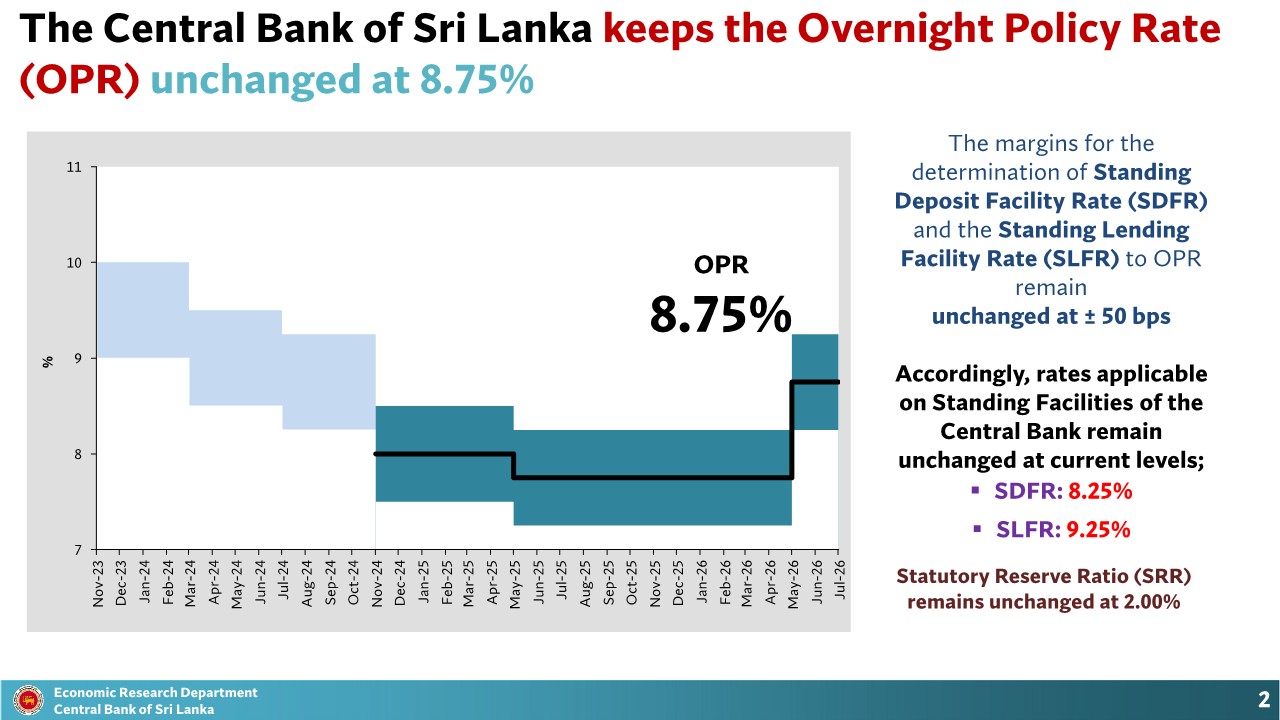
In its latest monetary policy decision, the Central Bank of Sri Lanka has kept the Overnight Policy Rate (OPR) unchanged at 8.75%, opting for a pause after the sharp 177-basis-point hike implemented in May 2026 to anchor inflationary pressures. This hold reflects the central bank's assessment that the prior tightening is gradually transmitting through the financial system—as evidenced by the upward adjustments in market lending and deposit rates, treasury bill yields, and the Average Weighted Call Money Rate—while also acknowledging the moderating trend in government securities yields following the initial overshoot and the improvement in overnight liquidity conditions observed in July 2026. The decision strikes a delicate balance: on one hand, headline inflation has accelerated to 6.8% in June, driven by surging energy and food costs amid Middle East geopolitical tensions, and remains forecast to stay above the 5% target in the near term; on the other hand, leading economic indicators such as the Purchasing Managers' Indices and industrial production signal sustained recovery momentum, and private sector credit is expanding notably, which could be choked off by further tightening. Additionally, the central bank must weigh the external vulnerabilities from a widening current account deficit, fueled by higher fuel import costs and declining net foreign assets due to foreign exchange interventions, against the risk of de-anchoring inflation expectations. By holding rates steady, the central bank is signaling that it sees the current policy stance as sufficiently restrictive to guide inflation back toward the 5% medium-term target over time, while allowing room for the economy to absorb the cumulative impact of past hikes and for global oil price shocks to stabilize, thereby avoiding unnecessary damage to the nascent recovery.
Read More →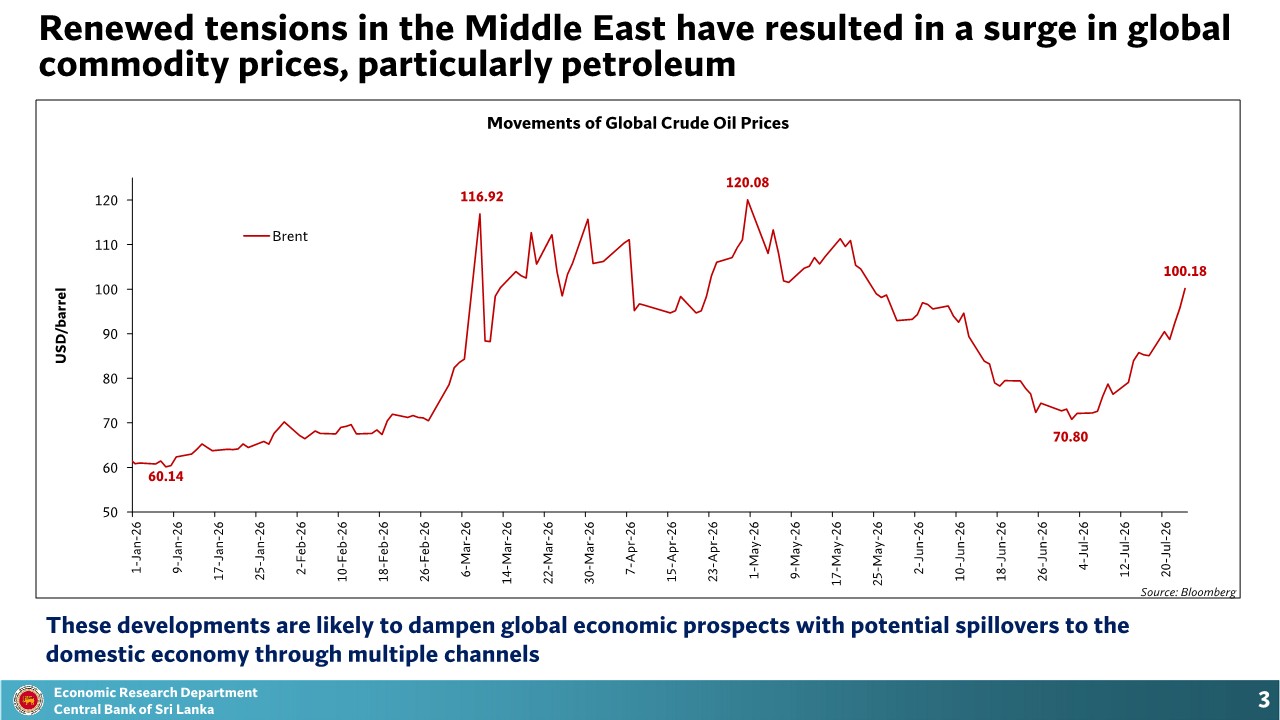
Renewed geopolitical tensions in the Middle East have triggered a sharp surge in global commodity prices, most notably petroleum, with Brent crude oil prices spiking from around $70.80 per barrel in early January 2026 to approximately $100.18 by mid-April, and briefly touching $116.92 before pulling back slightly, as illustrated by the volatile upward trajectory in the chart. This dramatic escalation in energy costs carries significant implications for Sri Lanka's already fragile external position, as the country is a net importer of fuel—a factor that has directly widened the merchandise trade deficit and contributed to the current account deficit observed since April 2026. Beyond the immediate impact on the import bill, these global developments are likely to dampen global economic prospects by stoking inflationary pressures, reducing disposable incomes in major trading partners, and potentially slowing demand for Sri Lankan exports such as textiles, tea, and rubber. Domestically, the spillover channels are multiple: higher petroleum prices feed directly into transportation, manufacturing, and utility costs, exacerbating the already elevated headline inflation that reached 6.8% in June 2026; they also pressure the exchange rate by increasing demand for foreign currency to finance imports, thereby straining the central bank's foreign exchange reserves and necessitating further intervention, as seen in the recent decline in net foreign assets. Additionally, the resulting tighter global financial conditions could raise Sri Lanka's external borrowing costs and complicate debt servicing, while also weighing on business confidence and household purchasing power, potentially offsetting some of the positive momentum signaled by the purchasing managers' indices and industrial production data. This confluence of external shocks reinforces the central bank's cautious stance on monetary policy, as it must navigate the dual challenge of anchoring inflation expectations while safeguarding the fragile economic recovery from these adverse terms-of-trade shocks.
Read More →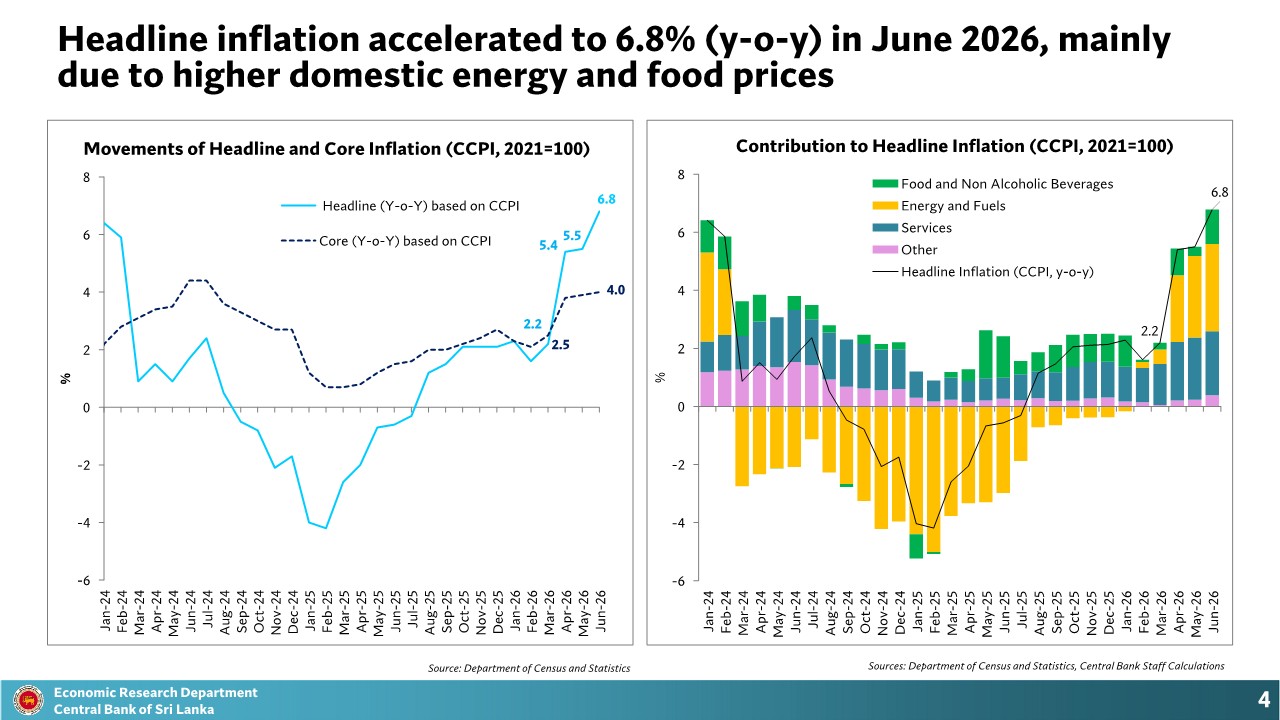
In June 2026, Sri Lanka's headline inflation accelerated to 6.8% on a year-on-year basis, primarily driven by sharp increases in domestic energy and food prices, which together accounted for the bulk of the uptick. The decomposition of headline inflation reveals that the "Energy and Fuels" category made a substantial contribution, reflecting the pass-through of higher global oil prices and possible adjustments to domestic utility tariffs, while "Food and Non-Alcoholic Beverages" also added significant upward pressure, likely due to supply-side constraints, seasonal factors, or elevated import costs. Meanwhile, core inflation—which excludes volatile food and energy items, also moved higher, albeit at a more moderate pace, suggesting that underlying price pressures are broadening beyond just the volatile components, as services and other categories begin to contribute more meaningfully. This acceleration aligns with the central bank's near-term forecast, which had anticipated inflation remaining above the 5% target in the coming quarters, and underscores the rationale behind the monetary policy tightening in May 2026. The data also highlights the vulnerability of Sri Lanka's inflation dynamics to external shocks, particularly in energy and food markets, which are largely imported, making the inflation outlook heavily contingent on global commodity price trends and exchange rate stability. As the central bank monitors these developments, the challenge lies in ensuring that the current inflation overshoot does not feed into broader wage and price-setting behavior, while also recognizing that the recent moderation in treasury bill yields and improvement in liquidity conditions may offer some breathing space for the economy to adjust to the tighter policy stance.
Read More →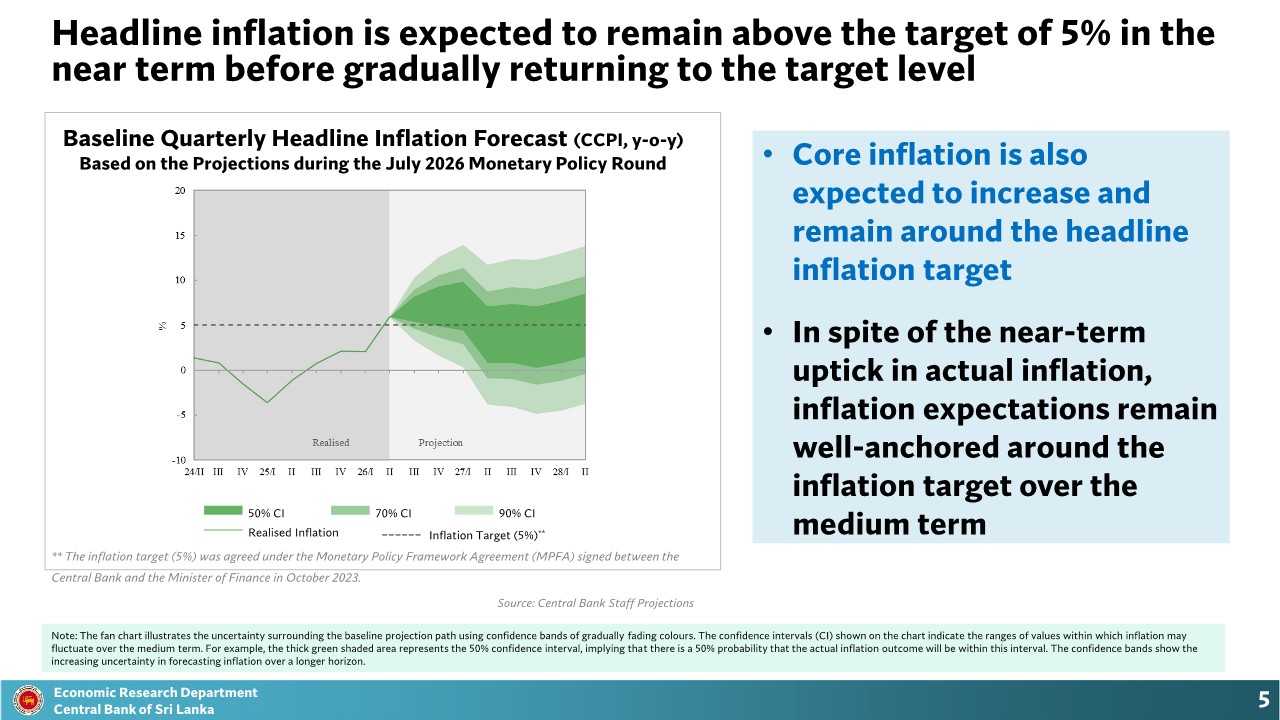
According to the baseline quarterly headline inflation forecast from the Central Bank of Sri Lanka's July 2026 monetary policy round, headline inflation, as measured by the Colombo Consumer Price Index (CCPI) on a year-on-year basis, is expected to remain above the 5% target in the near term before gradually converging back to that level over the medium term. The fan chart illustrates this trajectory, with the thick green 50% confidence band showing that while inflation is projected to peak above 5% in the coming quarters, the path is subject to considerable uncertainty, as reflected by the widening confidence intervals over the longer horizon. Core inflation is also anticipated to increase and track closely around the headline target, suggesting that underlying price pressures are broad-based rather than confined to volatile food or energy items. Importantly, despite the near-term uptick in actual inflation, the central bank assesses that inflation expectations remain well-anchored around the 5% target over the medium term, a credibility dividend from the Monetary Policy Framework Agreement (MPFA) signed with the Minister of Finance in October 2023. This anchoring is critical, as it allows policymakers to look through temporary overshoots without triggering a de-anchoring of expectations, which could otherwise lead to second-round effects through wages and pricing behavior. Nonetheless, the forecast underscores the delicate balancing act facing the central bank: ensuring that monetary policy remains sufficiently tight to guide inflation back to target, while avoiding an excessive tightening that could stifle the nascent economic recovery signaled by leading indicators such as the PMIs and industrial production.
Read More →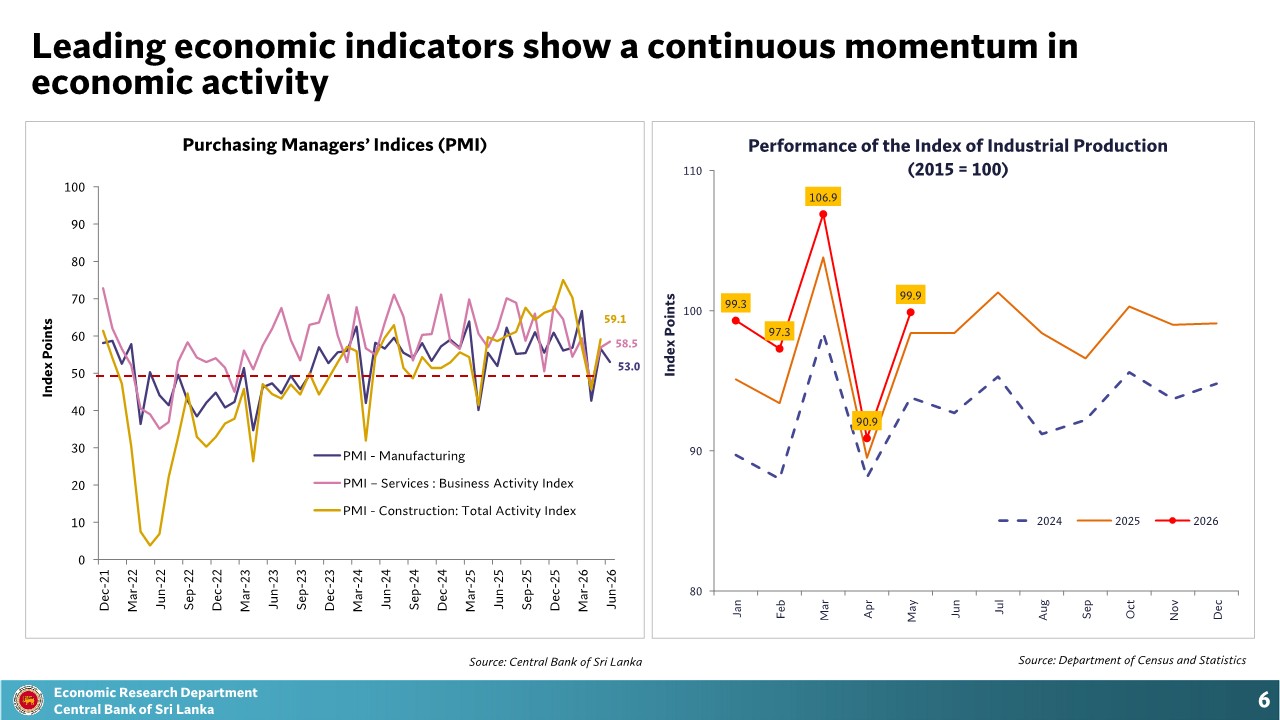
Leading economic indicators point to sustained momentum in Sri Lanka's economic activity through the first half of 2026, with the Purchasing Managers' Indices (PMI) across manufacturing, services, and construction all exhibiting broadly improving trends. The PMI—Manufacturing has climbed steadily from its post-crisis lows, remaining well above the 50-neutral threshold in recent months, signaling ongoing expansion in factory output and new orders. Similarly, the PMI–Services Business Activity Index has trended upward, reflecting robust demand in tourism, trade, and other service sectors, while the Construction Total Activity Index, though more volatile, has shown signs of recovery, likely supported by public infrastructure projects and easing supply chain bottlenecks. This positive sentiment is corroborated by the Index of Industrial Production (IIP), which, despite some monthly fluctuations, has recorded notable year-on-year gains—for instance, reaching 106.9 in March 2026 and 99.9 in May 2026, compared to more subdued levels in 2024 and 2025. The collective improvement in these forward-looking and concurrent indicators suggests that the economy is gaining traction, driven by recovering domestic demand, easing input cost pressures, and improving business confidence. However, the recent monetary policy tightening and elevated interest rates could pose headwinds to this momentum, particularly if credit costs dampen investment and consumer spending, making it crucial for policymakers to balance inflation control with sustaining the nascent recovery in real economic activity.
Read More →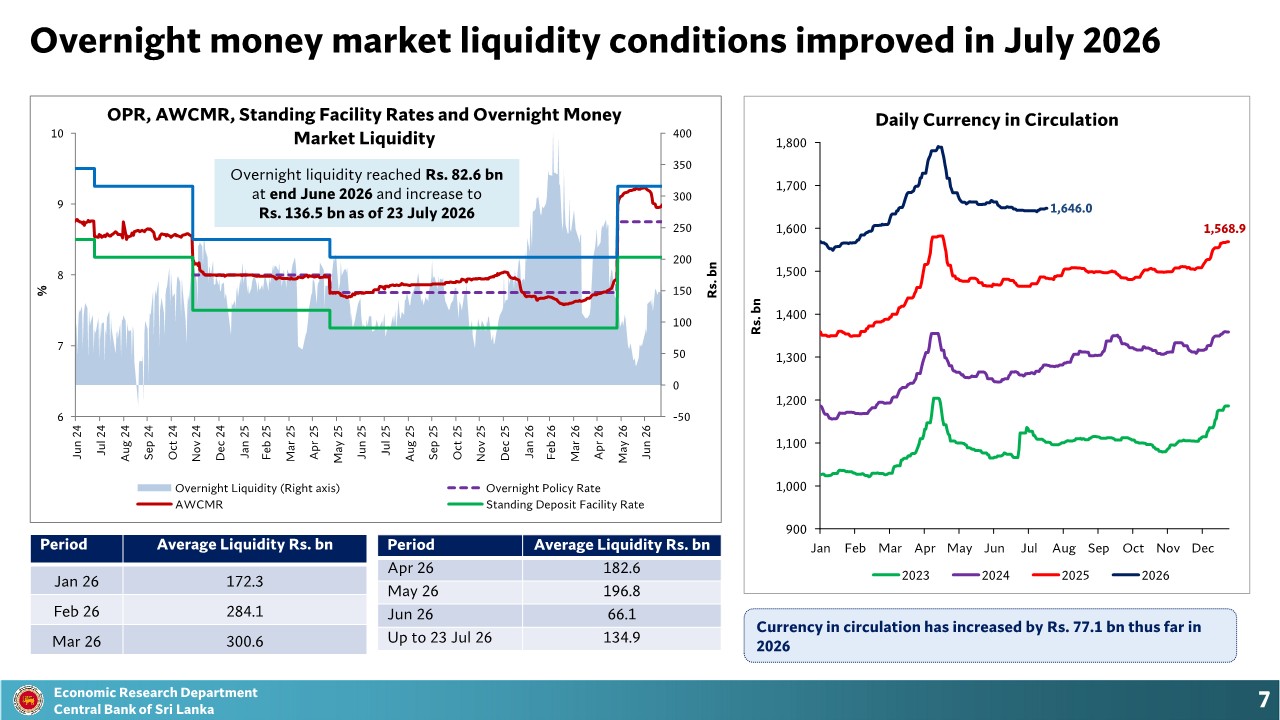
The overnight money market liquidity conditions in Sri Lanka improved notably in July 2026, reversing the sharp contraction experienced in June and providing some relief to the banking system. After average liquidity plummeted to Rs. 66.1 billion in June, a dramatic drop from the Rs. 196.8 billion average seen in May, the situation rebounded, with average liquidity rising to Rs. 134.9 billion in the period up to 23 July, and the actual overnight liquidity figure climbing from Rs. 82.6 billion at end-June to Rs. 136.5 billion by 23 July. This recovery comes despite a steady increase in currency in circulation, which has risen by Rs. 77.1 billion so far in 2026, as shown by the upward trend in daily currency data, indicating sustained cash demand from the public. The improved liquidity suggests that the central bank's open market operations or other liquidity management measures have successfully injected funds into the system, helping to stabilize short-term funding conditions following the policy rate hike in May. This is also reflected in the behavior of the Average Weighted Call Money Rate (AWCMR), which, as noted earlier, has adjusted upward but remains anchored near the OPR, signaling that the overnight market is functioning smoothly with adequate reserves. However, the volatility in liquidity, swinging from surplus in early 2026 to a tight June and then recovering in July, highlights the system's sensitivity to fiscal flows, foreign exchange interventions, and currency demand, necessitating continued vigilant management by the central bank to ensure that overnight rates remain aligned with policy objectives without disrupting credit flows to the private sector.
Read More →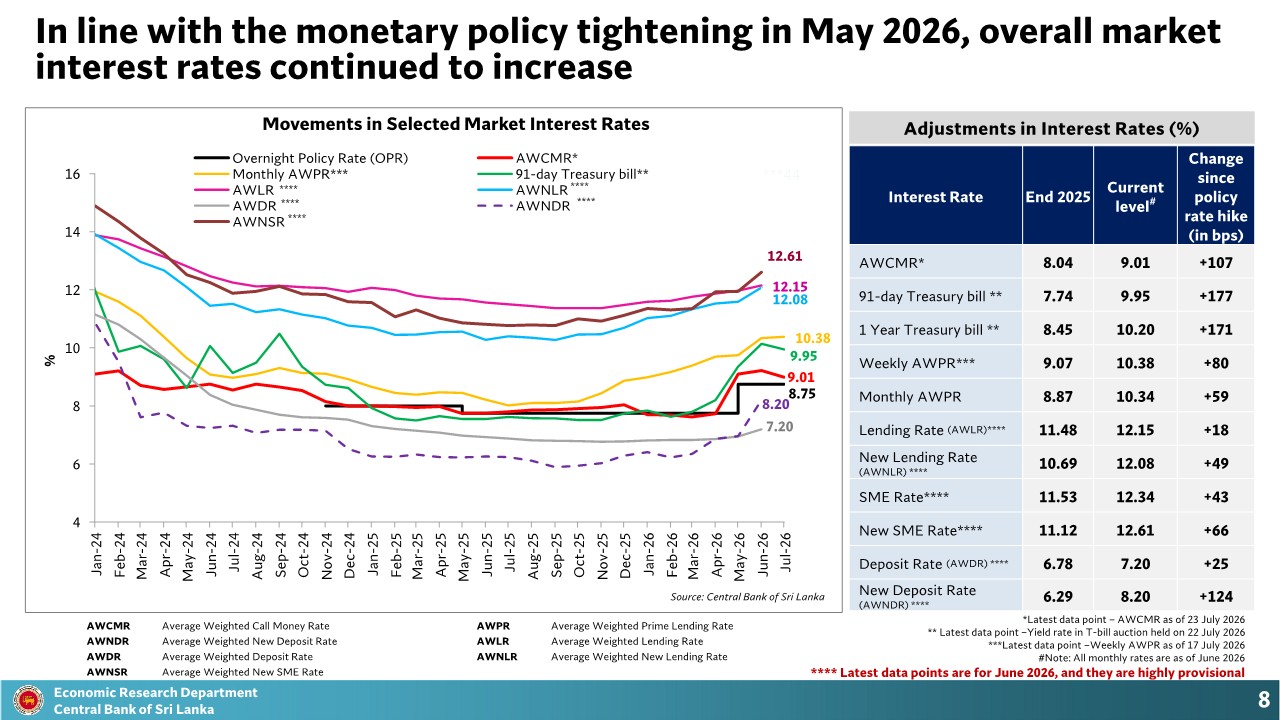
Consistent with the monetary policy tightening implemented in May 2026, overall market interest rates across Sri Lanka's financial system have continued to rise, reflecting the transmission of the policy rate hike to both borrowing and deposit rates. The data shows broad-based increases since the policy action, with treasury bill yields leading the charge, the 91-day T-bill rate surged by 177 basis points to 9.95%, while the 1-year yield climbed 171 basis points to 10.20%, aligning with the earlier noted moderation in secondary market yields after an initial overshoot. In the banking sector, the Average Weighted Call Money Rate (AWCMR) rose by 107 bps to 9.01%, while the Average Weighted Lending Rate (AWLR) increased more modestly by 18 bps to 12.15%, suggesting that lending rates have been somewhat stickier in adjusting downward but are now gradually repricing upward. Notably, new deposit rates (AWNRD) saw a sharp 124-bp jump to 8.20%, indicating that banks are actively competing for funding to support the expanding private sector credit, while the Average Weighted Deposit Rate (AWRD) rose by a milder 25 bps to 7.20%. This pass-through of tighter policy across the yield curve and bank balance sheets underscores the central bank's commitment to anchoring inflation expectations, though the varied adjustments, particularly the larger increases in shorter-term securities and new deposit rates versus the more muted response in overall lending rates, suggest that financial conditions are tightening unevenly, which could weigh on credit-sensitive sectors even as it supports external and price stability.
Read More →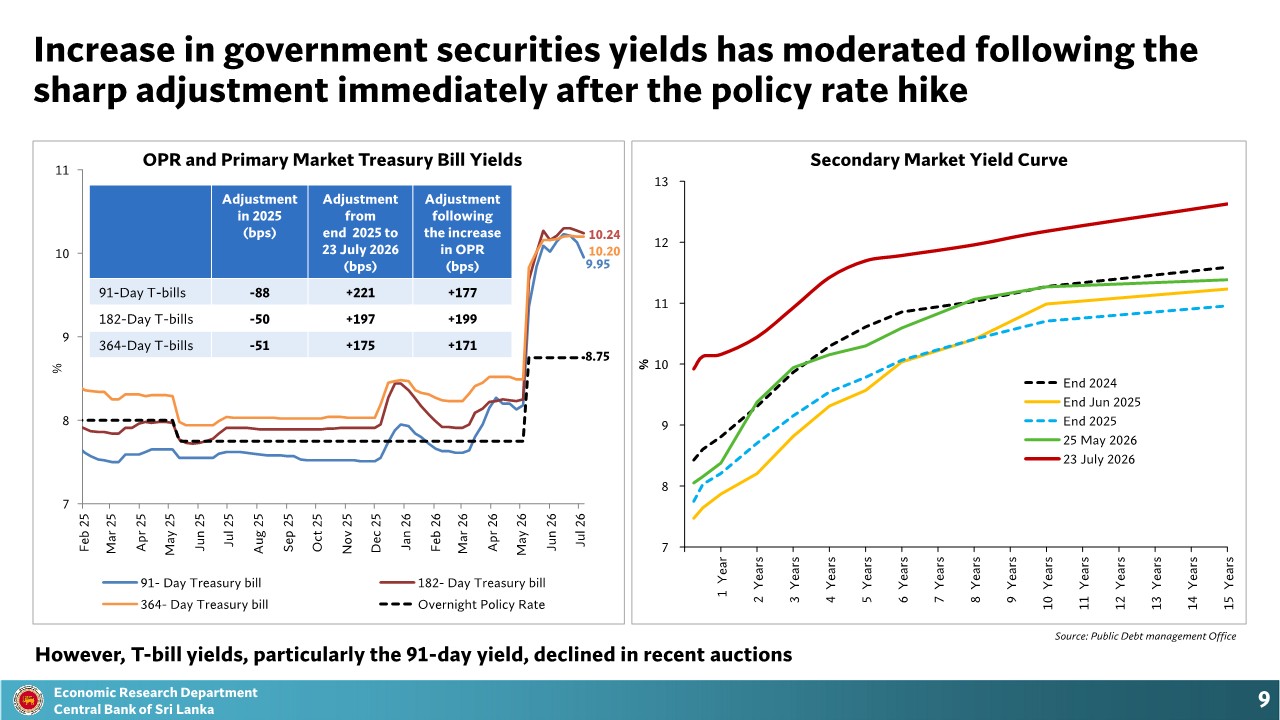
Based on the data from Sri Lanka’s primary and secondary debt markets, the sharp upward adjustment in government securities yields that immediately followed the recent policy rate hike has since moderated, with treasury bill yields, especially the 91-day tenor, even declining in recent auctions. The table shows that after substantial cumulative yield increases from end-2025 to late July 2026 (ranging from +175 to +221 basis points across different maturities), the post-policy-rate-hike adjustment contributed a significant portion of that move (+171 to +199 bps). However, the moderating trend is evident in the secondary market yield curve, where the latest readings for 23 July 2026 sit well below the peaks seen in May 2026, suggesting that market participants have begun to price in a stabilization in monetary policy expectations. This moderation in yields, coupled with the recent auction declines, indicates that the initial overshooting reaction to the rate hike is fading, as investors digest the central bank’s commitment to inflation control while also weighing the potential drag on economic growth, thereby allowing yields to settle at more sustainable levels that balance fiscal borrowing costs with macroeconomic stability.
Read More →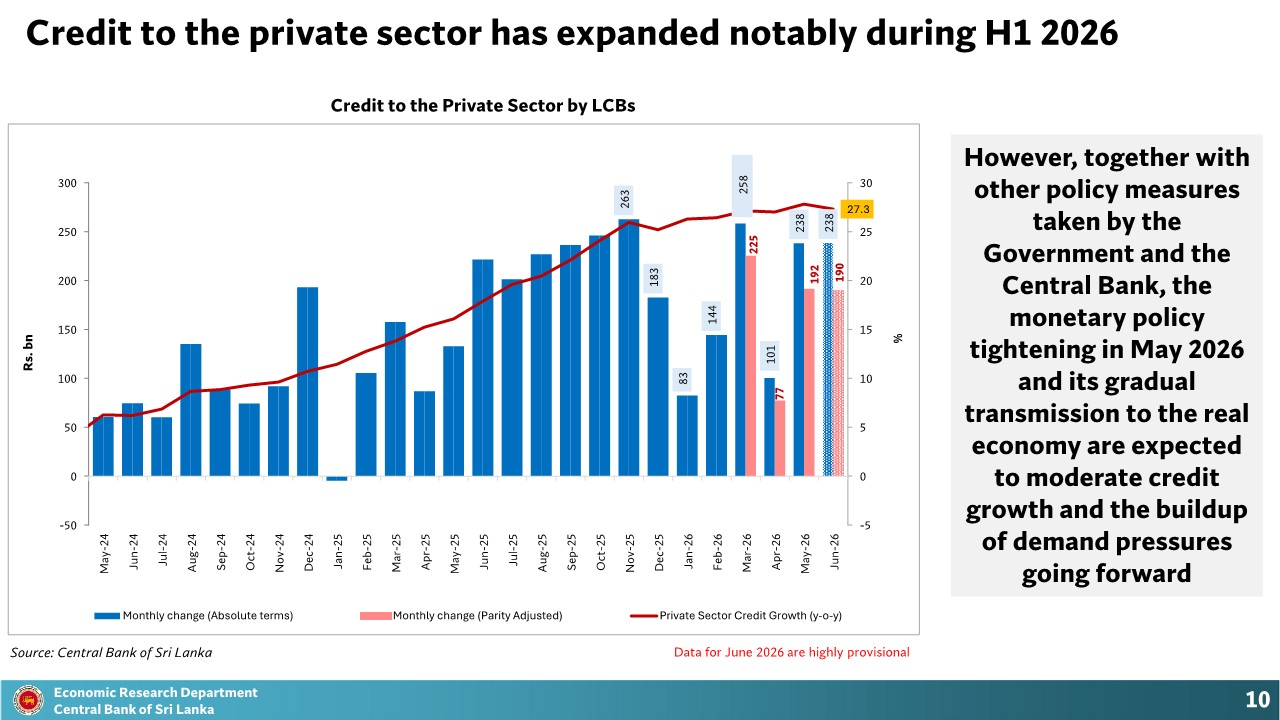
Based on the chart from the Central Bank of Sri Lanka, credit to the private sector by licensed commercial banks (LCBs) expanded notably during the first half of 2026, reflecting a pickup in borrowing activity after a relatively subdued period. The monthly absolute changes show a clear upward trajectory, with several months recording significant positive increases, particularly from early 2026 onward, suggesting that businesses and households are regaining confidence and seeking financing for investment, consumption, or working capital needs. This resurgence in private sector credit is a critical driver of broad money growth, as highlighted in the previous analysis, and signals a potential revival in domestic economic activity. However, the pace of expansion also warrants close monitoring, as rapid credit growth, if not matched by corresponding supply-side improvements or productivity gains, could fuel demand-side inflationary pressures, especially given the concurrent tightening of net foreign assets and the central bank's foreign exchange interventions, which may limit the space for accommodative monetary policy going forward.
Read More →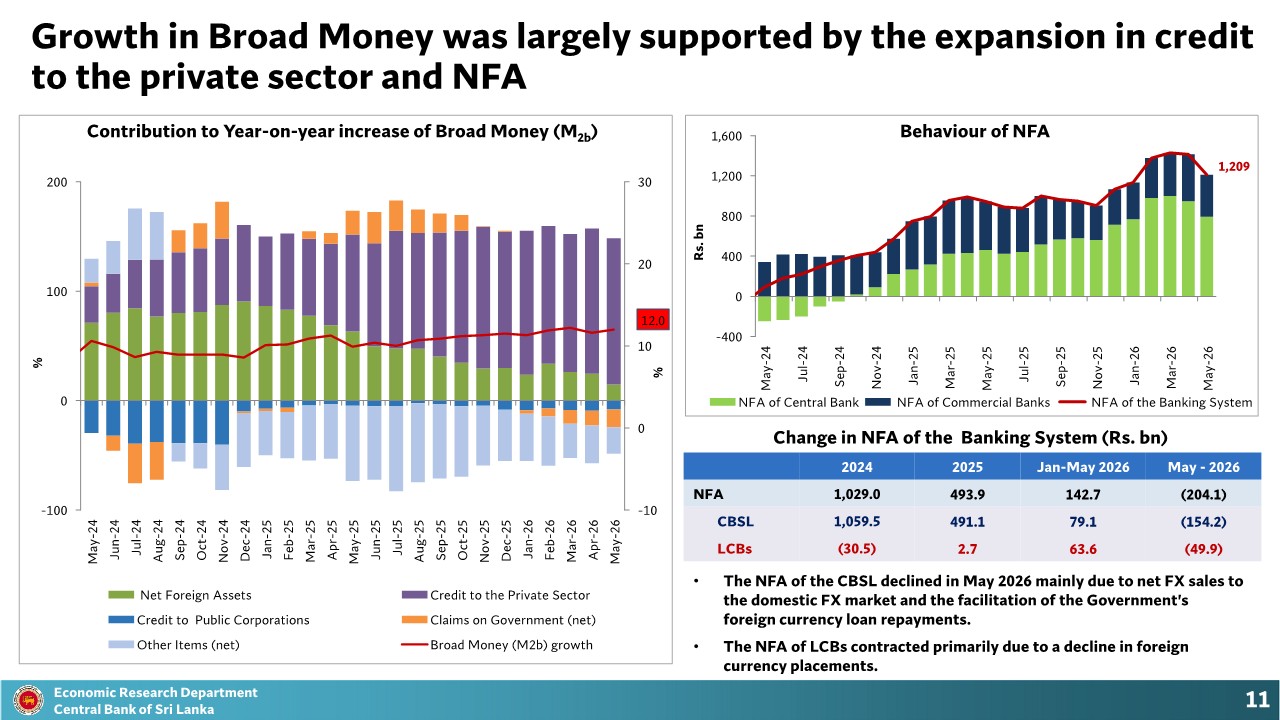
Based on the data, Sri Lanka’s broad money (M2b) growth has been primarily fueled by two key factors: expanding credit to the private sector and the accumulation of net foreign assets (NFA) within the banking system, though the latter has shown recent signs of strain. Over 2024 and 2025, the NFA of the banking system contributed positively, with the Central Bank of Sri Lanka (CBSL) recording substantial increases of Rs. 1,059.5 billion and Rs. 491.1 billion, respectively, while licensed commercial banks (LCBs) saw a slight improvement in 2025 after a minor decline in 2024. However, by May 2026, the momentum shifted sharply: the NFA of the CBSL contracted by Rs. 154.2 billion in that month alone, driven by net foreign exchange sales to the domestic market and government foreign currency loan repayments, while LCBs also saw their NFA fall by Rs. 49.9 billion due to reduced foreign currency placements. This monthly decline, alongside a modest net credit expansion to government and public corporations, suggests that while private sector lending continues to support money supply growth, the recent erosion of NFA, particularly from CBSL interventions, could temper overall monetary expansion, potentially tightening liquidity conditions and putting upward pressure on interest rates if the trend persists.
Read More →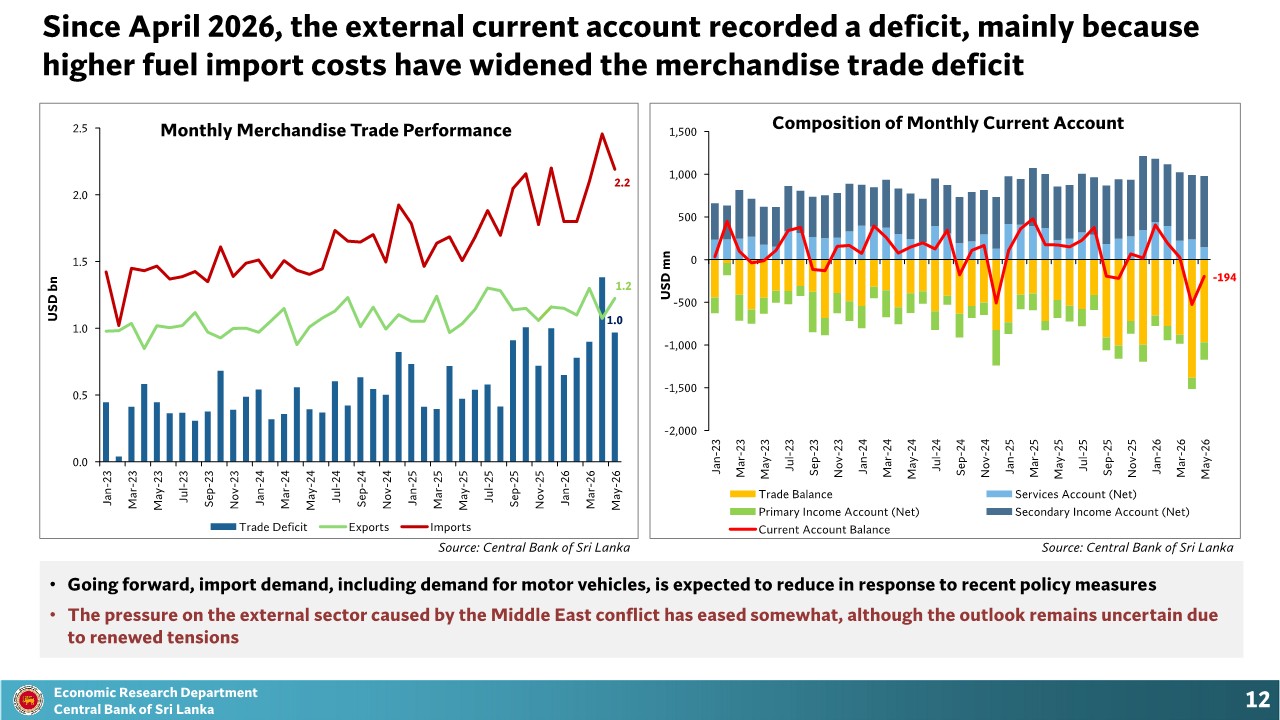
Based on the chart excerpt, Sri Lanka’s external current account has been in deficit since April 2026, a reversal largely driven by a widening merchandise trade deficit due to surging fuel import costs. The monthly trade data shows that while both exports and imports have fluctuated over the period from early 2023 through mid-2026, the gap between them has grown noticeably as import values have outpaced export earnings, particularly as energy prices have risen. This trade imbalance has directly weighed on the current account, offsetting any potential gains from services or remittances, and signals mounting external pressure on the economy. The persistent deficit suggests that Sri Lanka’s reliance on fuel imports, combined with relatively stagnant export performance, is straining its foreign exchange reserves and could necessitate policy adjustments, such as demand management, currency depreciation, or efforts to boost domestic energy alternatives, to restore external stability.
Read More →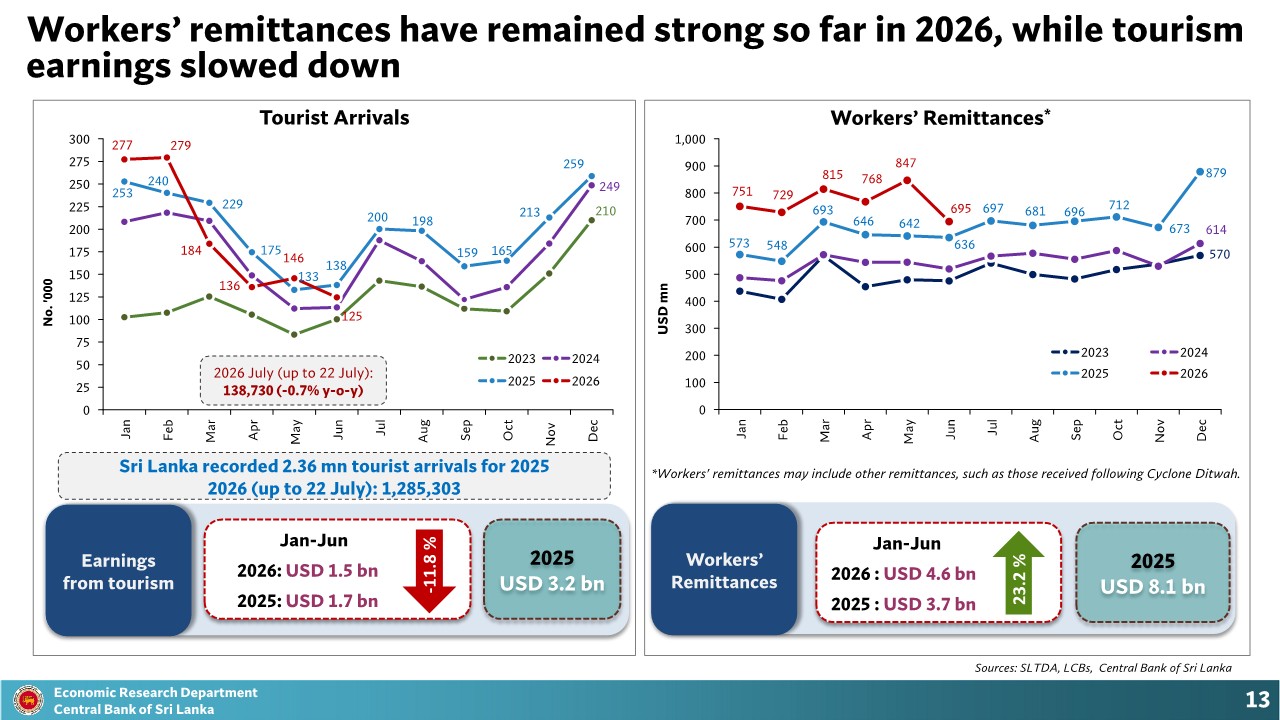
The document presents two charts illustrating key foreign exchange inflows for Sri Lanka, specifically focusing on tourism and remittances. The left chart tracks "Tourist Arrivals" from 2023 to 2026, noting 2.36 million arrivals in 2025 and 1,285,303 arrivals up to July 22, 2026. It also highlights a decline in tourism earnings, with January-June 2026 revenue dropping 11.8% to USD 1.5 billion compared to USD 1.7 billion in the same period of 2025 (which totaled USD 3.2 billion for the full year). Conversely, the right chart on "Workers' Remittances*" shows robust growth, with inflows increasing 23.2% to USD 4.6 billion in the first half of 2026, up from USD 3.7 billion in the first half of 2025 (and USD 8.1 billion for the full year 2025). The data is sourced from official entities including the Central Bank of Sri Lanka and the Sri Lanka Tourism Development Authority.
Read More →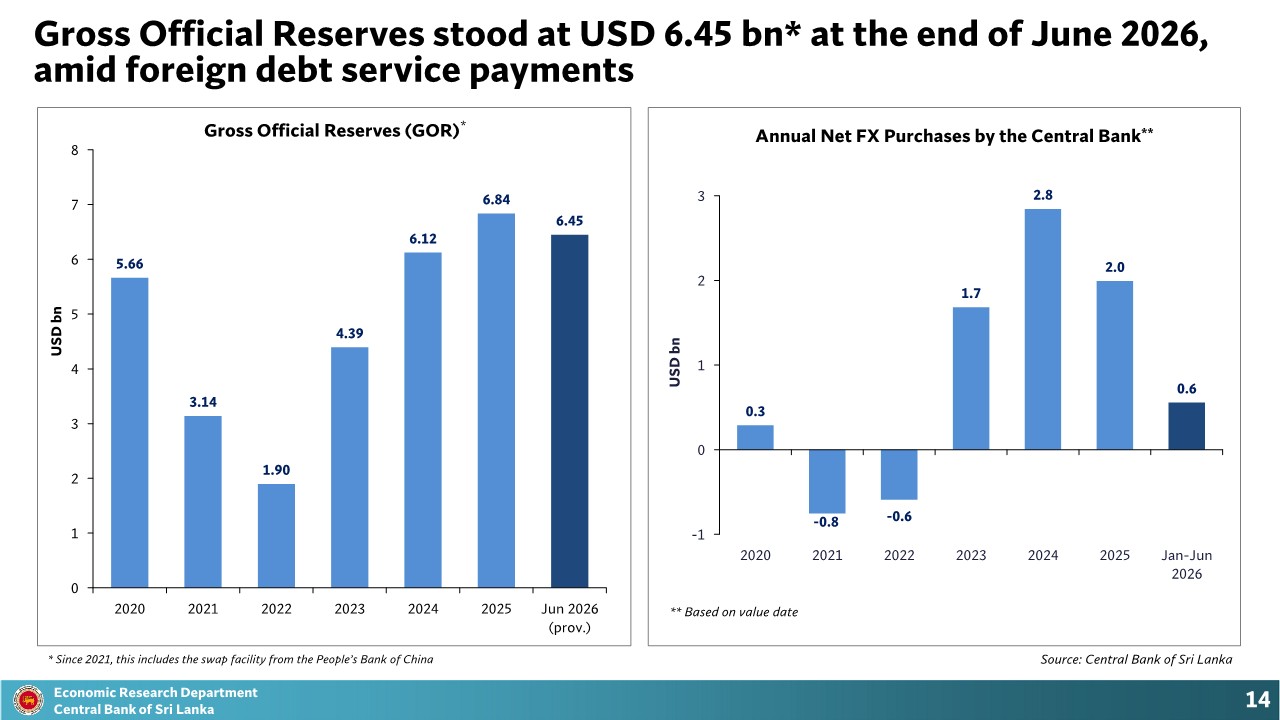
The document presents two financial charts illustrating Sri Lanka's foreign exchange reserves and debt servicing context. The bar chart on the left tracks the "Gross Official Reserves (GOR)" from 2020 to 2026, showing an increase to a provisional 6.45 (billion USD) in June 2026 from 5.66 in 2020. Meanwhile, the chart on the right details the "Annual Net FX Purchases by the Central Bank" across the same timeline, highlighting yearly net foreign exchange acquisition figures such as 0.3 in 2020 and 0.6 in the first half of 2026. Sourced from the Central Bank of Sri Lanka, these visualizations collectively outline the country's foreign exchange management and reserve accumulation efforts.
Read More →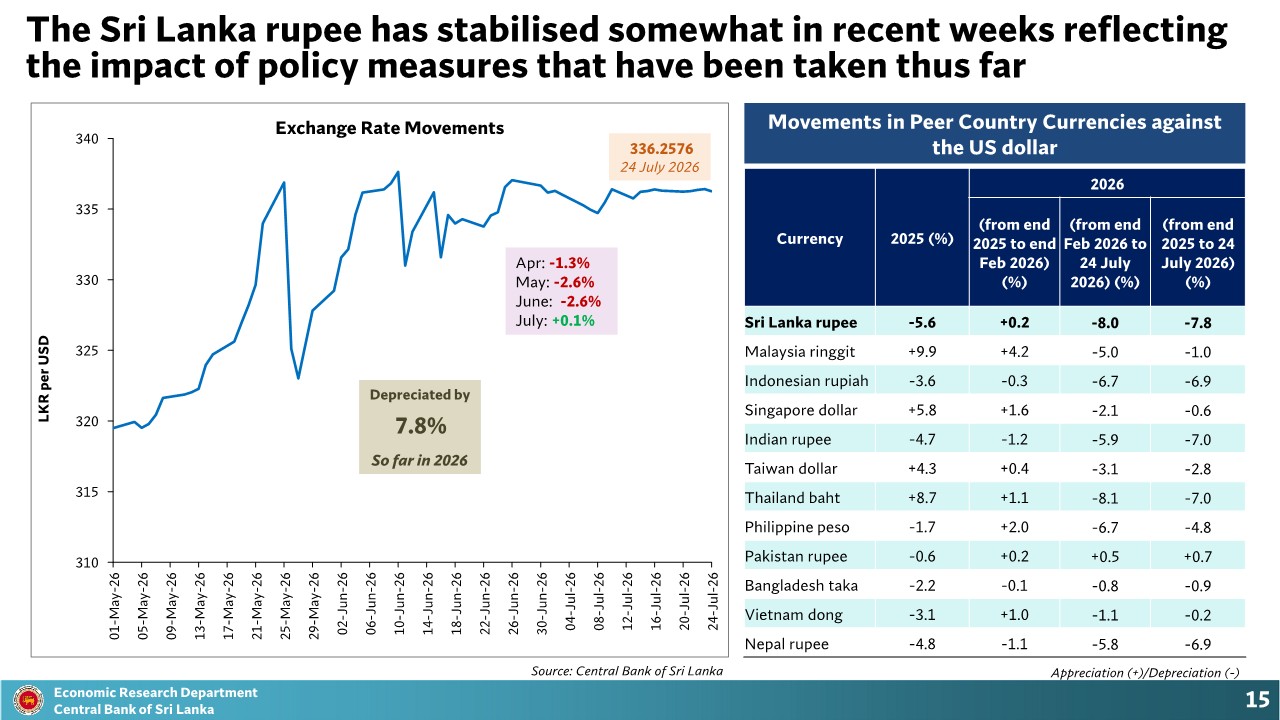
The document illustrates the exchange rate movements of the Sri Lankan Rupee and peer country currencies against the US dollar. A line chart on the left visualizes the Sri Lankan Rupee's fluctuations in 2026, specifically noting a 7.8% depreciation so far that year and detailing monthly changes from April to July. On the right, a comparative table lists the depreciation (-) and appreciation (+) percentages of various currencies against the USD for 2025 and 2026, such as the Sri Lankan Rupee's 5.6% decline in 2025, providing a broader regional context for Sri Lanka's currency performance.
Read More →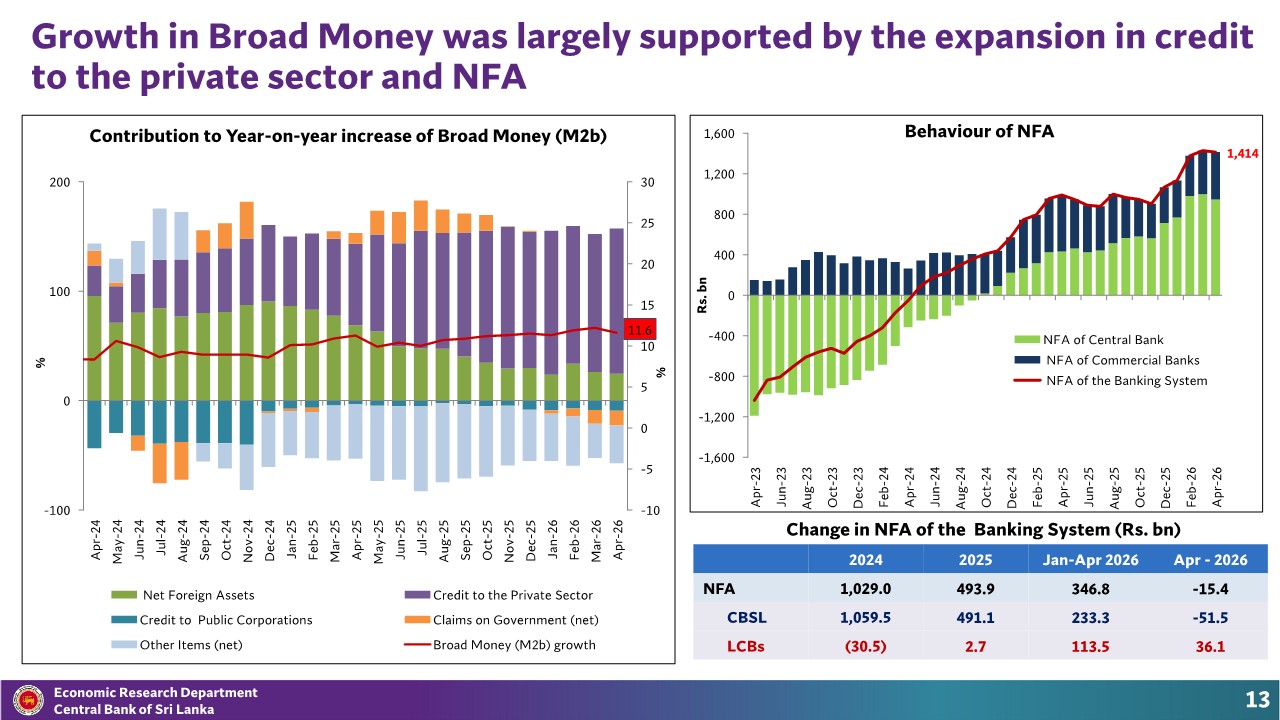
The slide illustrates that the 12.4% year-on-year growth in Broad Money (M2b) as of April 2026 was primarily propelled by the consistent expansion of credit to the private sector, alongside a significant recovery in Net Foreign Assets (NFA), while the "Other Items" category acted as a slight drag. Tracking the behavior of NFA, the cumulative balance has surged from deep negative territory in April 2023 to reach a new high of Rs. 1,414 billion by April 2026. The detailed breakdown of these changes reveals a notable shift in drivers: in 2024, the massive Rs. 1,029.0 billion total increase in banking system NFA was almost entirely attributable to the Central Bank (CBSL), while Licensed Commercial Banks (LCBs) actually saw a decline. This trend continued into 2025 with a total increase of Rs. 493.9 billion. However, during the January-April 2026 period, the total NFA grew by Rs. 346.8 billion, and importantly, LCBs contributed a strong Rs. 113.5 billion to this figure—a significant improvement over their prior full-year performances. Finally, while commercial banks continued to add Rs. 36.1 billion in April 2026 alone, the overall NFA balance experienced a slight monthly contraction of Rs. 15.4 billion due to a sharp Rs. 51.5 billion decline from the Central Bank in that single month.
Read More →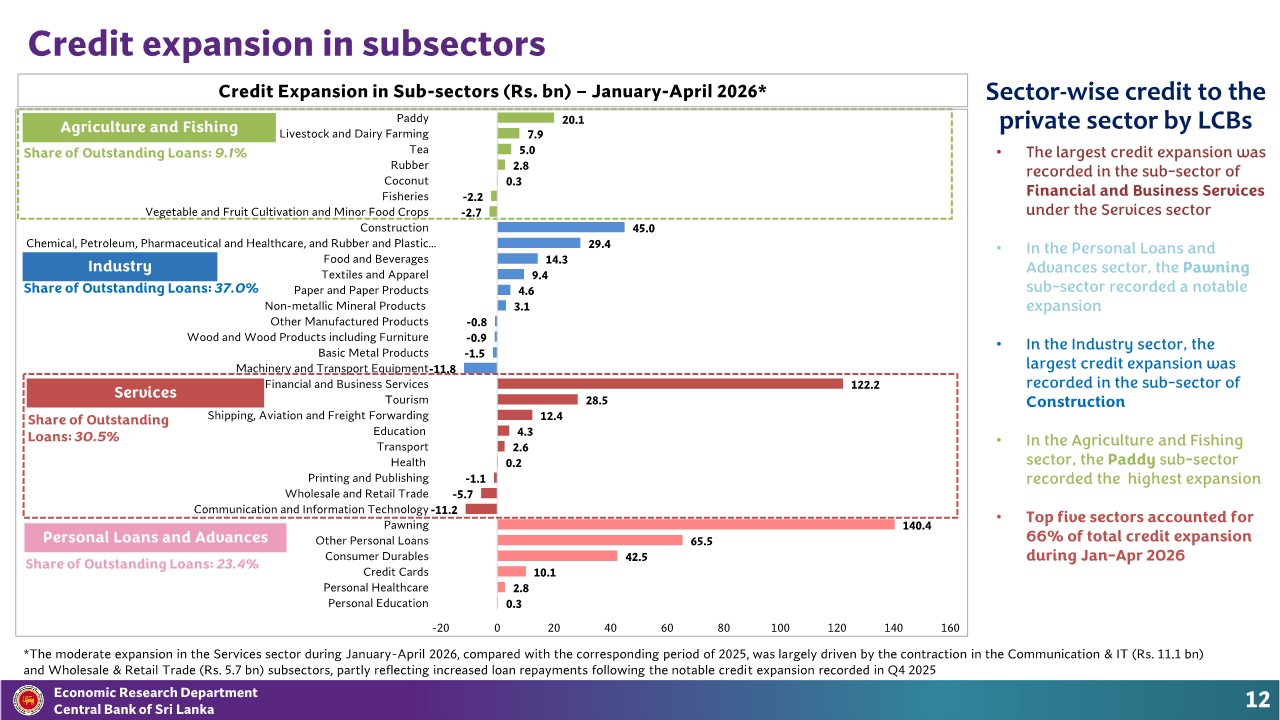
According to the credit expansion data for January-April 2026, growth was heavily concentrated in a few key subsectors, with the top five collectively accounting for 66% of the total expansion. Within the Personal Loans and Advances category, which holds a 23.4% share of outstanding loans, Pawning was the standout subsector, showing a massive expansion of Rs. 140.4 billion—far exceeding "Other Personal Loans" at Rs. 65.5 billion. The Services sector, representing a 30.5% share, recorded its largest growth in Financial and Business Services at Rs. 122.2 billion; however, overall sectoral growth was tempered by notable contractions in Communication and Information Technology (-Rs. 11.2 billion) and Wholesale and Retail Trade (-Rs. 5.7 billion), which the report attributes to increased loan repayments following a robust Q4 2025. Meanwhile, the Industry sector (37.0% share) was primarily driven by Construction (Rs. 45.0 billion) and Chemical, Petroleum, and Pharmaceutical industries (Rs. 29.4 billion), whereas subsectors like Machinery and Transport Equipment saw a significant decline of Rs. 11.8 billion. Finally, within the Agriculture and Fishing sector, Paddy cultivation led the way with an expansion of Rs. 20.1 billion, offsetting minor contractions in fisheries and minor food crops.
Read More →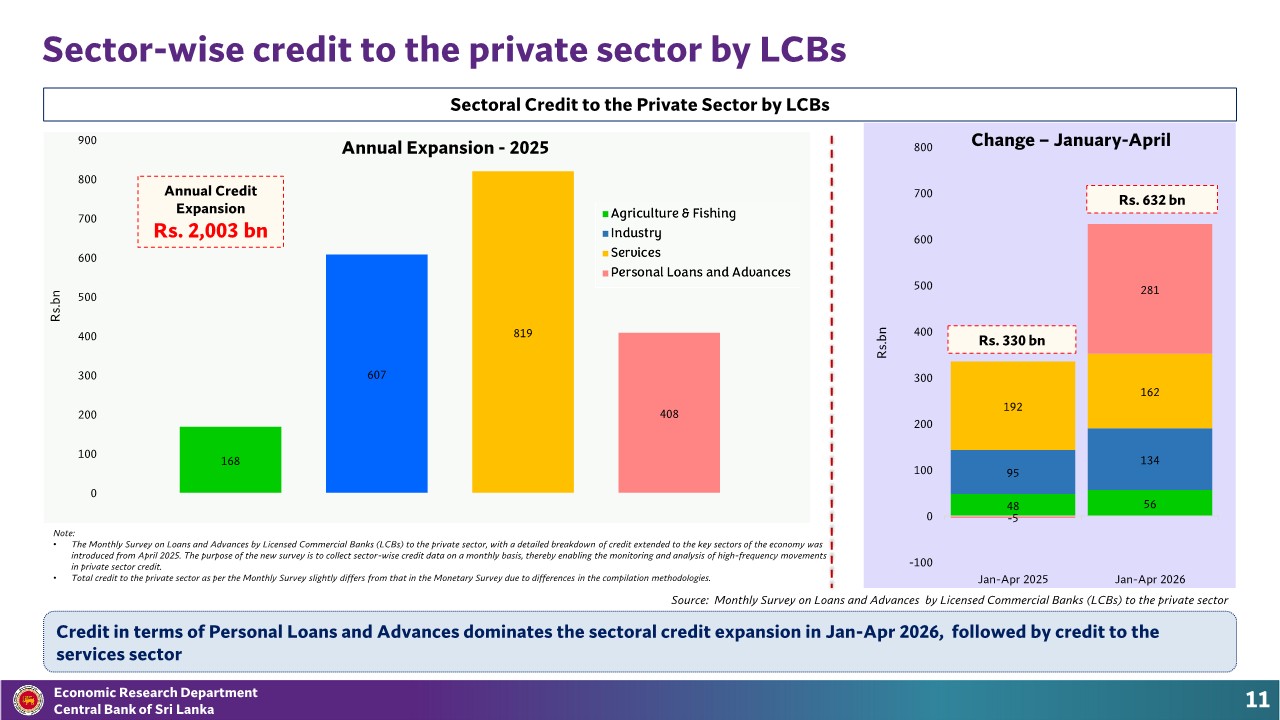
The credit expansion in January-April 2026 was dominated by Personal Loans and Advances (contributing Rs. 281 billion), followed by the Services sector (contributing Rs. 162 billion). Overall credit growth in this period increased from Rs. 330 billion in 2025 to Rs. 632 billion in 2026.
Read More →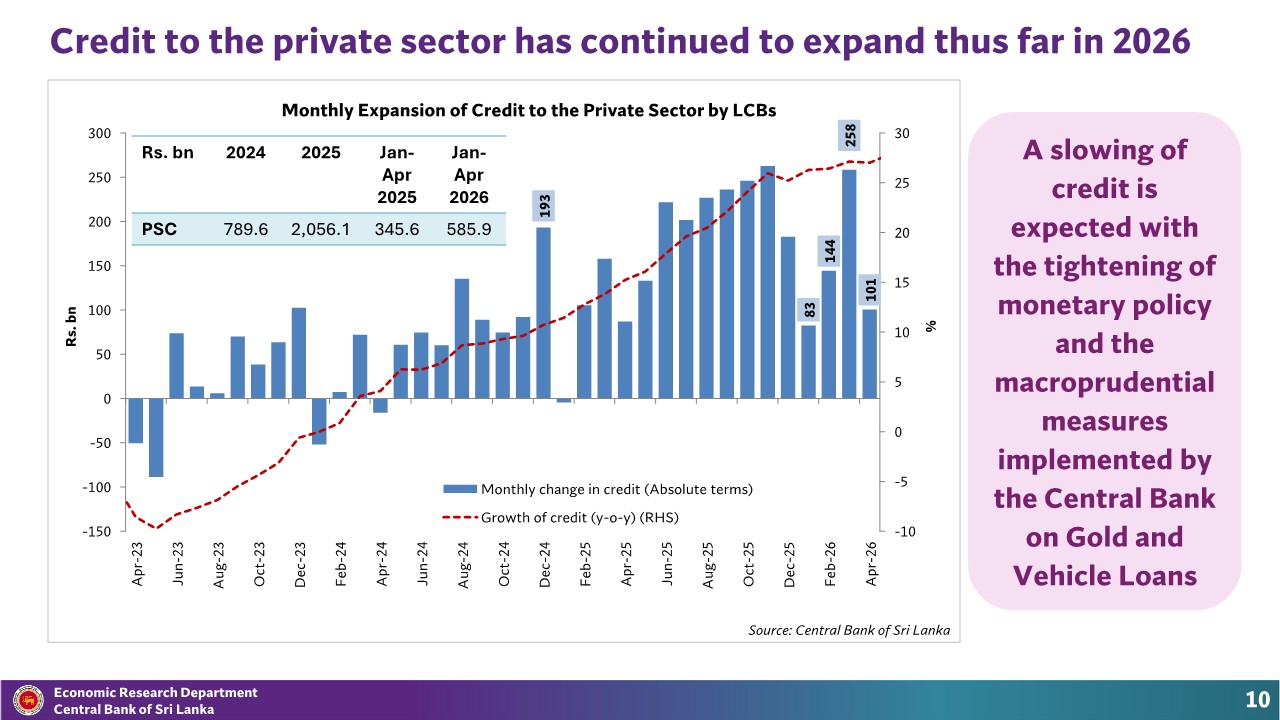
Sri Lanka’s private sector credit growth has continued its strong expansion through the first four months of 2026, with Licensed Commercial Banks (LCBs) extending Rs. 585.9 billion in new credit during January–April 2026, a notable increase from Rs. 345.6 billion in the same period of 2025. This acceleration is part of a broader upward trend, as total annual credit expansion rose sharply from Rs. 789.6 billion in 2024 to Rs. 2,056.1 billion in 2025, indicating robust private sector demand and improving business confidence amid the ongoing economic recovery. However, the Central Bank anticipates a moderation in credit growth going forward, driven by the recent tightening of monetary policy, including the hike in the Overnight Policy Rate, and the implementation of targeted macroprudential measures on gold and vehicle loans, which are specifically designed to curb excessive lending in these segments and contain potential financial stability risks. Consequently, while credit dynamics remain buoyant in the near term, a gradual deceleration is expected as the tighter financial conditions and regulatory constraints take hold over the coming months.
Read More →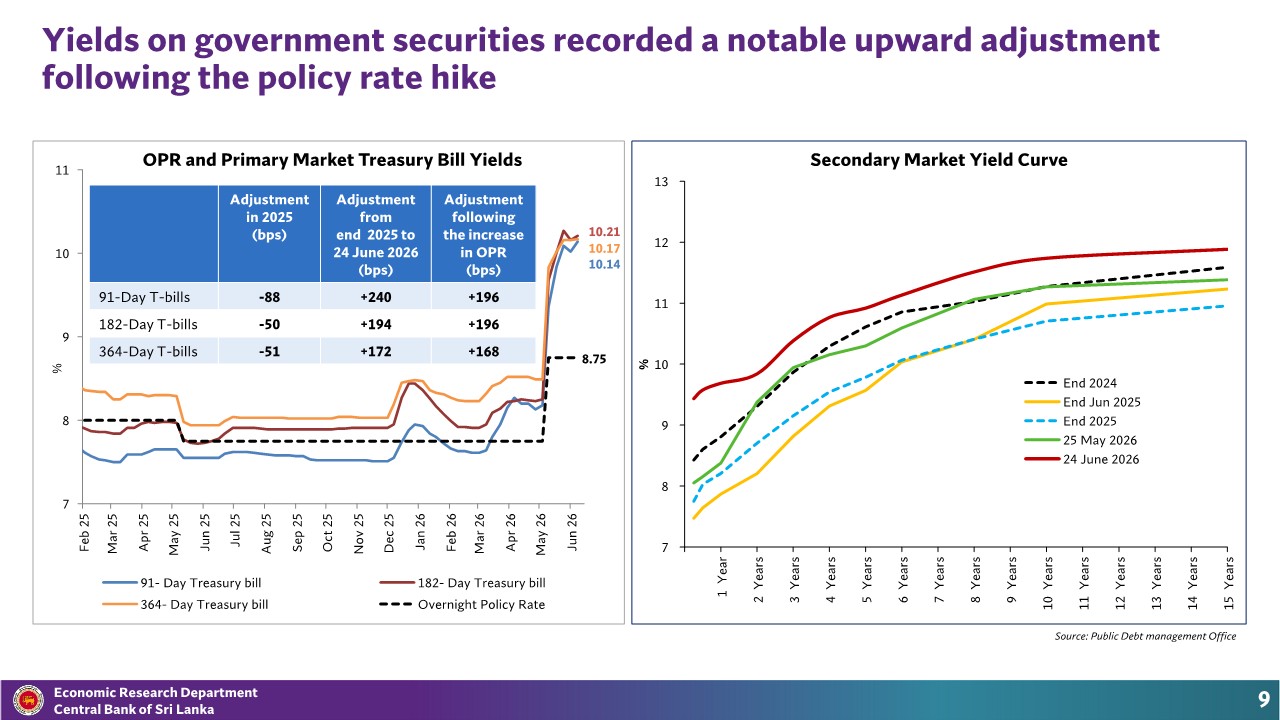
The data on government securities yields shows a sharp and pronounced upward adjustment following the Central Bank's policy rate hike, reflecting the rapid transmission of monetary tightening to the broader fixed-income market. Over the course of 2025, Treasury bill yields had declined substantially—by 88 basis points for 91-day bills, 50 bps for 182-day bills, and 51 bps for 364-day bills—as the Central Bank maintained an accommodative stance. However, from end-2025 through 24 June 2026, yields reversed sharply, rising by 240 bps, 194 bps, and 172 bps for the respective tenors, with the most dramatic spike occurring immediately after the OPR increase, where yields surged by 196 bps for both 91-day and 182-day bills and 168 bps for the 364-day tenor. This steep climb pushed the 91-day, 182-day, and 364-day yields to 10.21%, 10.17%, and 10.14% respectively by 24 June 2026, effectively erasing all the gains from the previous easing cycle. The secondary market yield curve likewise shifted upward across all maturities, with the most pronounced movements at the short end, indicating that markets are fully pricing in the tighter policy stance and potentially anticipating further rate actions, while also reflecting increased government borrowing costs and a repricing of sovereign risk in the wake of the inflation acceleration and external sector pressures.
Read More →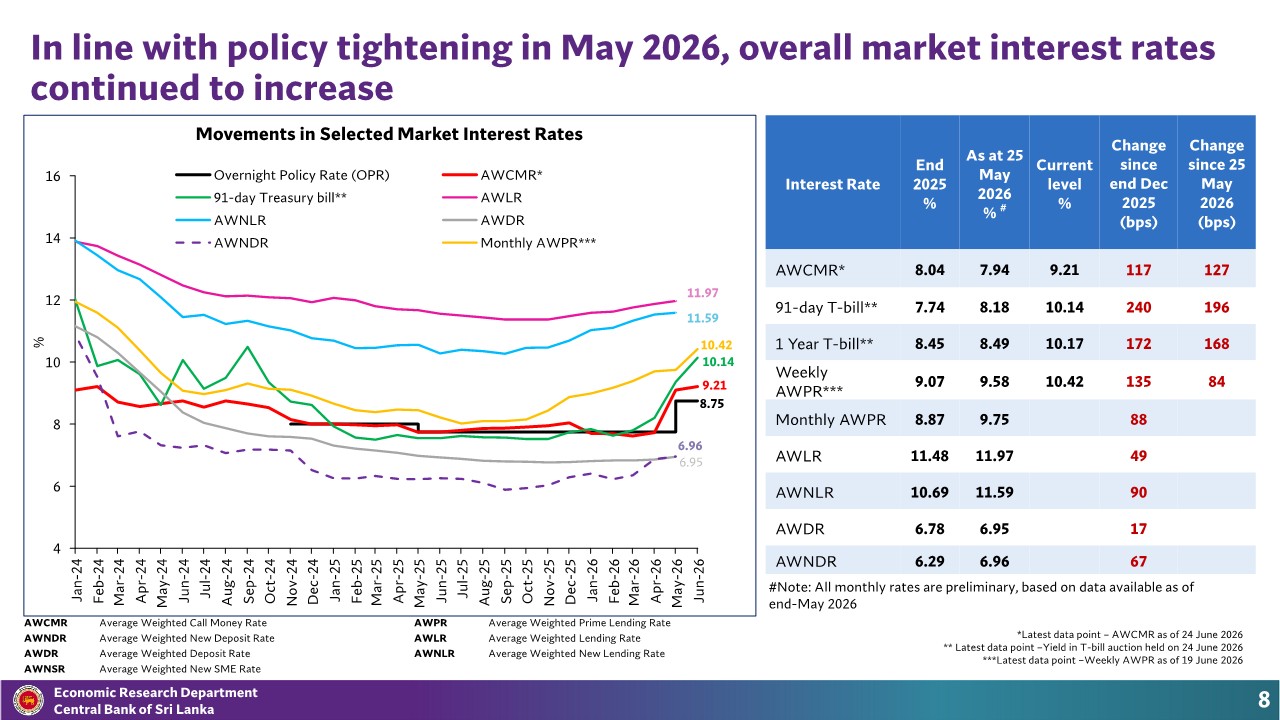
The table on overnight money market liquidity reveals a notable decline in surplus funds within Sri Lanka’s banking system over recent months, despite overall levels remaining positive. Starting from an average of Rs. 136.4 billion in 2025, liquidity surged sharply in the first quarter of 2026, peaking at Rs. 300.6 billion in March, driven by fiscal spending and foreign exchange purchases, before experiencing a pronounced reversal. By April, average liquidity had dropped to Rs. 182.6 billion, recovered modestly to Rs. 196.8 billion in May, and then contracted dramatically to just Rs. 65.5 billion by June 24, 2026, marking the lowest point in the period. This steep drawdown is closely linked to a concurrent increase of Rs. 75.7 billion in daily currency in circulation so far in 2026, which effectively absorbs liquidity from the banking system as cash is withdrawn by the public, often reflecting seasonal demand or increased economic transactions. While the system remains in surplus, ensuring the Central Bank can still manage short-term rates within the OPR corridor, the rapid erosion of excess liquidity signals tighter conditions and suggests that the Central Bank may need to actively calibrate its open market operations to prevent undue upward pressure on market interest rates in the coming months.
Read More →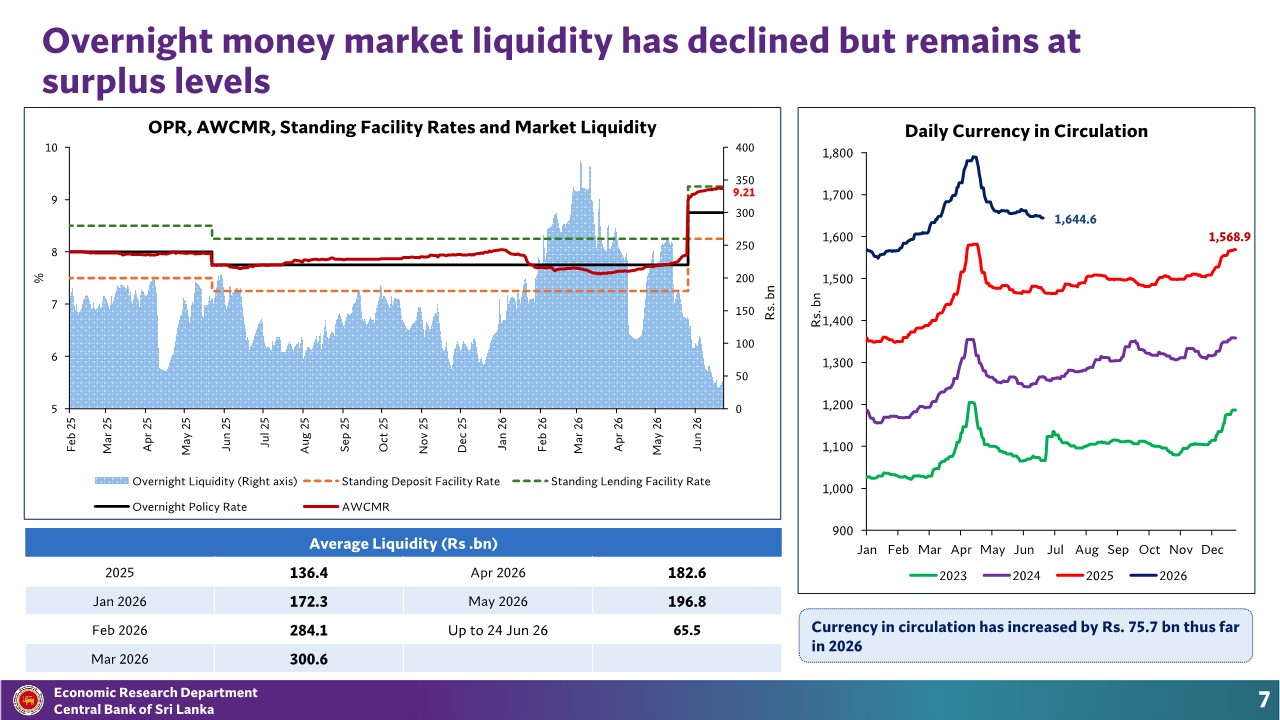
The table on overnight money market liquidity reveals a notable decline in surplus funds within Sri Lanka’s banking system over recent months, despite overall levels remaining positive. Starting from an average of Rs. 136.4 billion in 2025, liquidity surged sharply in the first quarter of 2026, peaking at Rs. 300.6 billion in March—driven by fiscal spending and foreign exchange purchases—before experiencing a pronounced reversal. By April, average liquidity had dropped to Rs. 182.6 billion, recovered modestly to Rs. 196.8 billion in May, and then contracted dramatically to just Rs. 65.5 billion by June 24, 2026, marking the lowest point in the period. This steep drawdown is closely linked to a concurrent increase of Rs. 75.7 billion in daily currency in circulation so far in 2026, which effectively absorbs liquidity from the banking system as cash is withdrawn by the public—often reflecting seasonal demand or increased economic transactions. While the system remains in surplus, ensuring the Central Bank can still manage short-term rates within the OPR corridor, the rapid erosion of excess liquidity signals tighter conditions and suggests that the Central Bank may need to actively calibrate its open market operations to prevent undue upward pressure on market interest rates in the coming months.
Read More →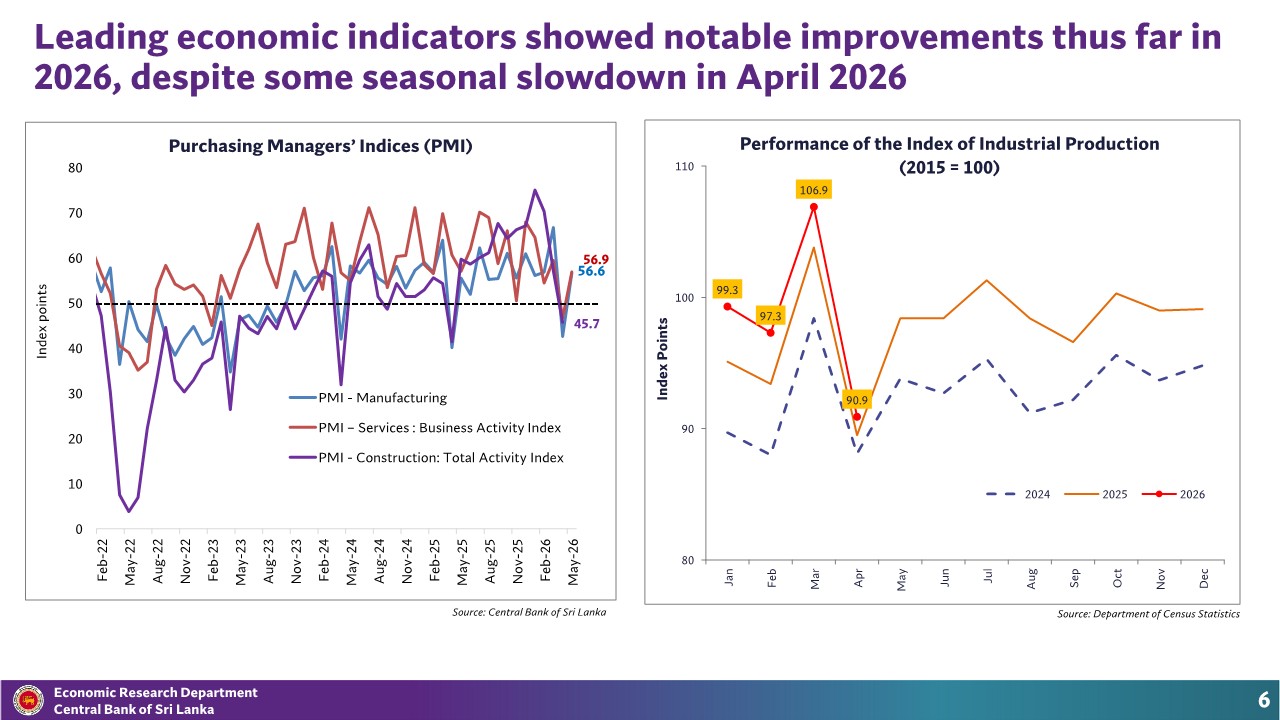
The latest leading economic indicators point to a clear strengthening of Sri Lanka’s economic activity through the early months of 2026, although a seasonal moderation was observed in April. The Purchasing Managers’ Indices (PMIs) for manufacturing, services, and construction all showed an upward trajectory well into the expansionary territory, signaling sustained business confidence and robust activity across these key sectors. Complementing this, the Index of Industrial Production (IIP) recorded notably higher readings in January (99.3), February (97.3), and March (90.9) compared to the same months in both 2024 and 2025, underscoring a solid build-up in manufacturing and industrial output. However, consistent with the seasonal slowdown highlighted in the headline, the IIP eased to 80.0 in April 2026, likely reflecting holiday effects or temporary disruptions, while the PMI sub-indices may have similarly moderated. Despite this monthly dip, the overall trajectory for the first four months confirms that the economy has sustained its recovery momentum into 2026, driven by strengthening domestic demand and improving supply-side conditions, even as policymakers keep a close watch on month-to-month volatility.
Read More →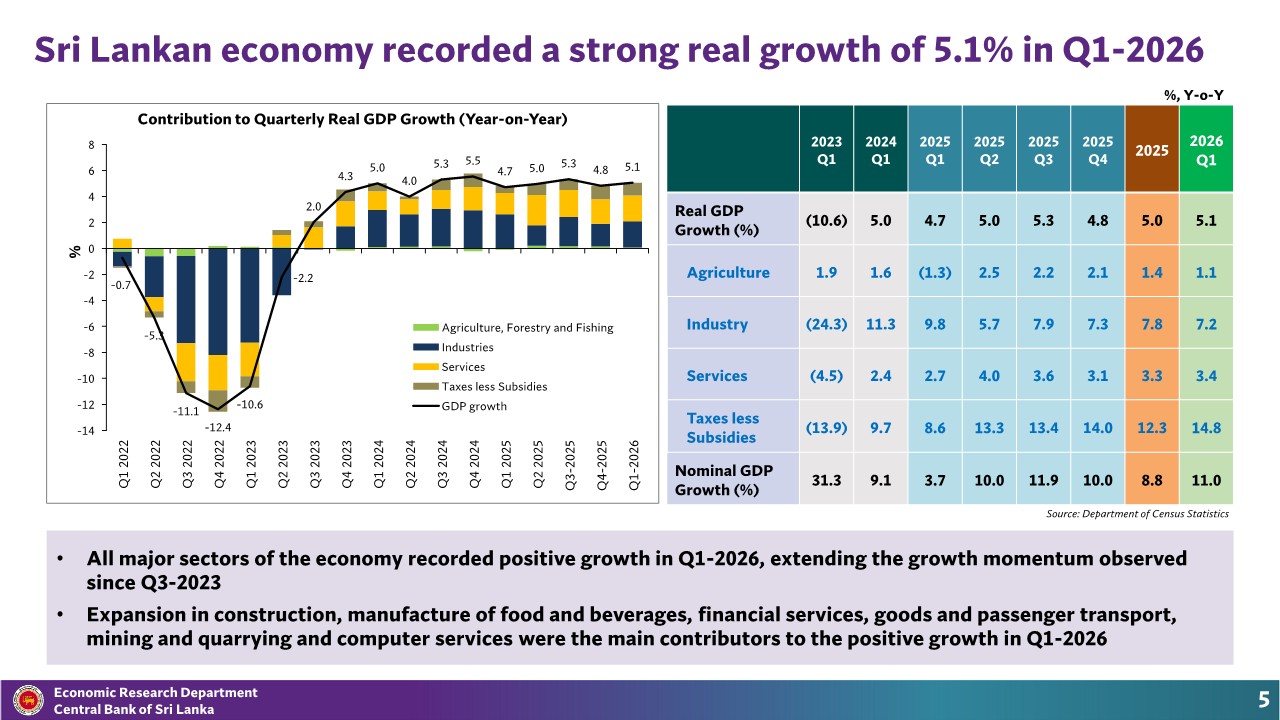
Sri Lanka’s economy delivered robust real GDP growth of 5.1% year-on-year in the first quarter of 2026, marking a strong continuation of the recovery momentum that has been building since the third quarter of 2023. This expansion was notably broad-based, with all three major sectors, Agriculture, Industry, and Services, recording positive growth, reflecting a synchronized pickup in economic activity across the board. The main drivers of this impressive performance included significant expansions in construction, the manufacture of food and beverages, financial services, goods and passenger transport, mining and quarrying, and computer services, all of which contributed substantially to the quarterly output. The sustained growth across these diverse segments underscores the strengthening of domestic demand and business confidence, suggesting that the Sri Lankan economy is firmly on a recovery path, bolstered by improving supply conditions and a gradually stabilizing macroeconomic environment.
Read More →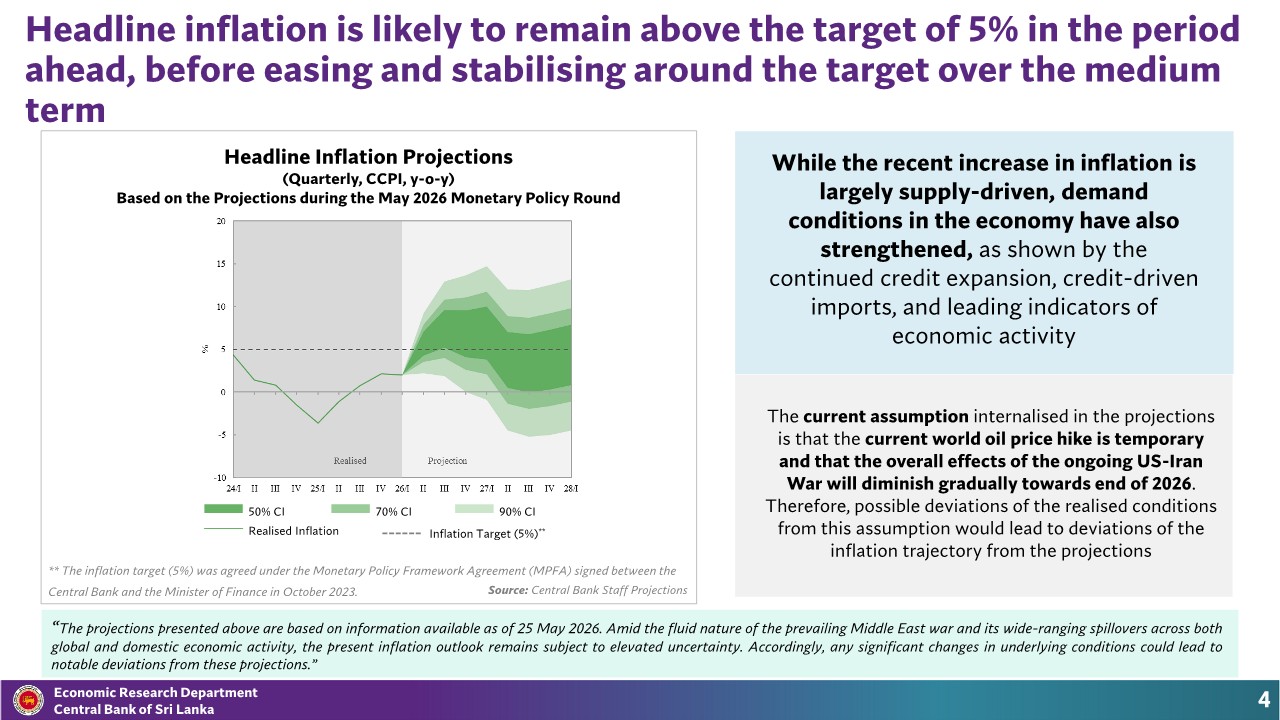
According to the Central Bank’s projections from the May 2026 policy round, Sri Lanka’s headline inflation is expected to remain above the 5% target in the near term, before gradually easing and stabilizing around that level over the medium term, consistent with the inflation target agreed under the Monetary Policy Framework Agreement of October 2023. While the recent uptick in inflation is predominantly supply-driven, stemming from upward adjustments to domestic energy and fuel prices, demand-side conditions have also strengthened notably, as evidenced by continued credit expansion, higher credit-driven imports, and improving leading indicators of economic activity. However, these projections are critically contingent on the assumption that the current world oil price hike is temporary and that the spillover effects from the ongoing US-Iran war will diminish toward the end of 2026. Given the highly fluid and unpredictable geopolitical environment, the Central Bank cautions that the inflation outlook remains subject to exceptional uncertainty, and any significant deviations in global conditions could cause actual inflation to diverge materially from these baseline forecasts.
Read More →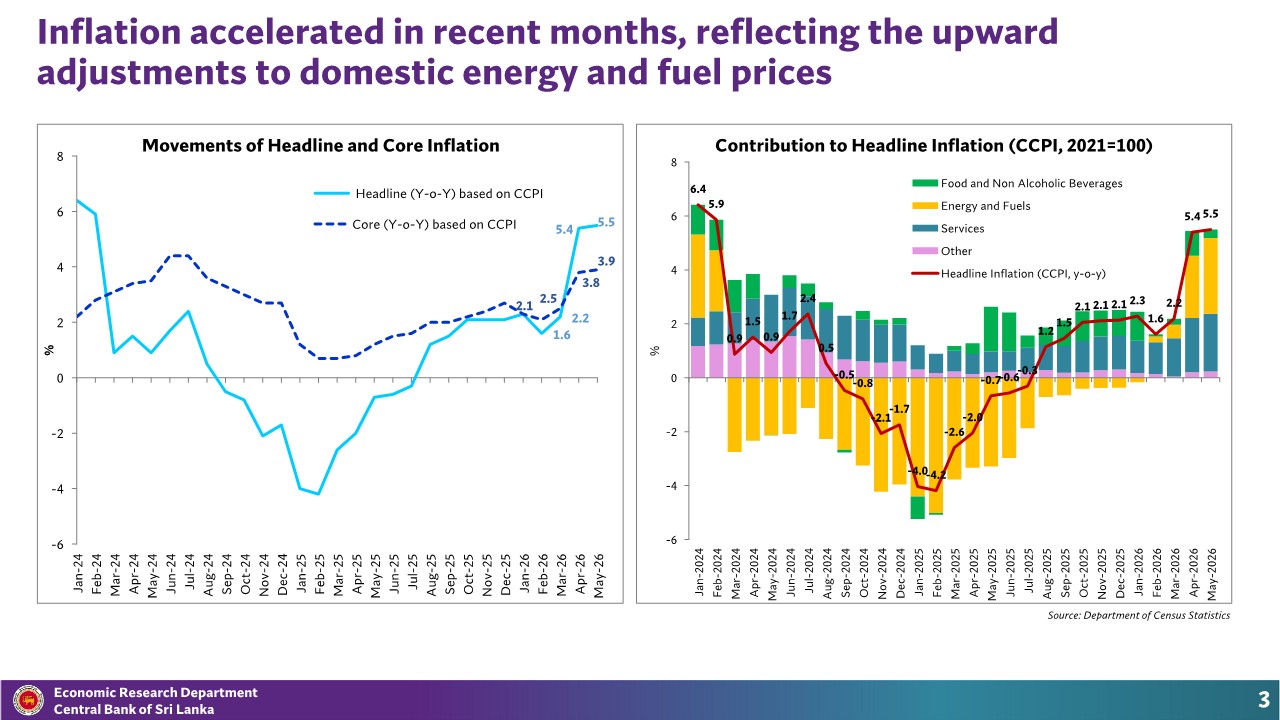
Sri Lanka’s inflation trajectory has turned notably higher in recent months, reversing the prolonged disinflationary trend observed throughout much of 2023 and 2024, as headline and core inflation measures both accelerated toward positive territory. This renewed upward pressure stems directly from the government’s upward adjustments to domestic energy and fuel prices, which have fed through to transportation, production, and broader consumer costs, thereby pushing the year-on-year inflation rate higher compared to the subdued or negative readings seen earlier. Although core inflation, which strips out volatile food and energy items, has remained somewhat more contained, it too has begun to rise, indicating that the price pressures are gradually broadening beyond just administrative price hikes. This acceleration presents a fresh challenge for policymakers, as it risks eroding household purchasing power and could prompt the Central Bank to reconsider its monetary policy stance, particularly given the delicate balance between supporting economic recovery and maintaining price stability in the wake of recent fiscal and external adjustments.
Read More →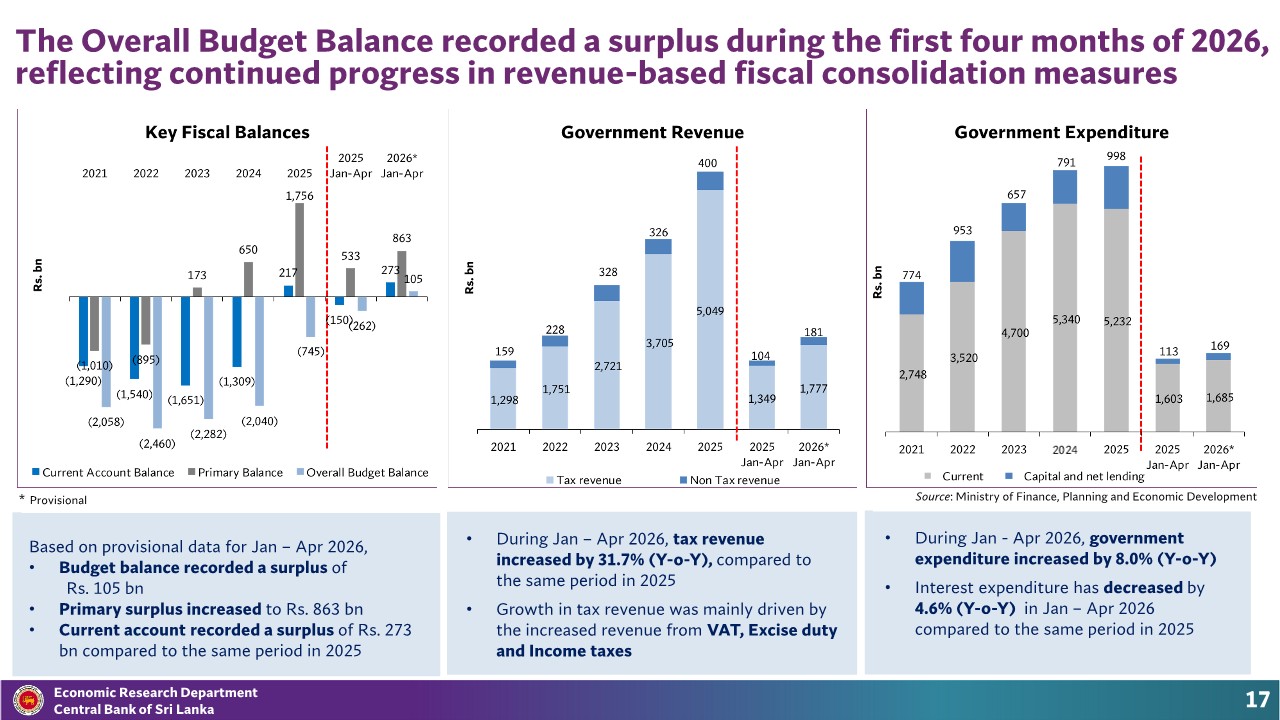
Sri Lanka’s fiscal performance showed marked improvement during the first four months of 2026, as the overall budget balance recorded a provisional surplus of Rs. 105 billion, reflecting continued success in revenue-based consolidation efforts. This outcome was reinforced by a substantial primary surplus of Rs. 863 billion and a fiscal current account surplus of Rs. 273 billion compared to the same period in 2025. On the revenue side, tax collections surged by 31.7% year-on-year, driven primarily by higher receipts from VAT, excise duties, and income taxes, which significantly boosted the government's fiscal capacity. Meanwhile, although total government expenditure rose by 8.0%, interest expenditure declined by 4.6% year-on-year, easing the debt-service burden and contributing meaningfully to the expanding primary surplus. Together, these trends underscore that fiscal consolidation measures are firmly taking hold, strengthening the government’s budgetary position while gradually reducing reliance on costly debt financing.
Read More →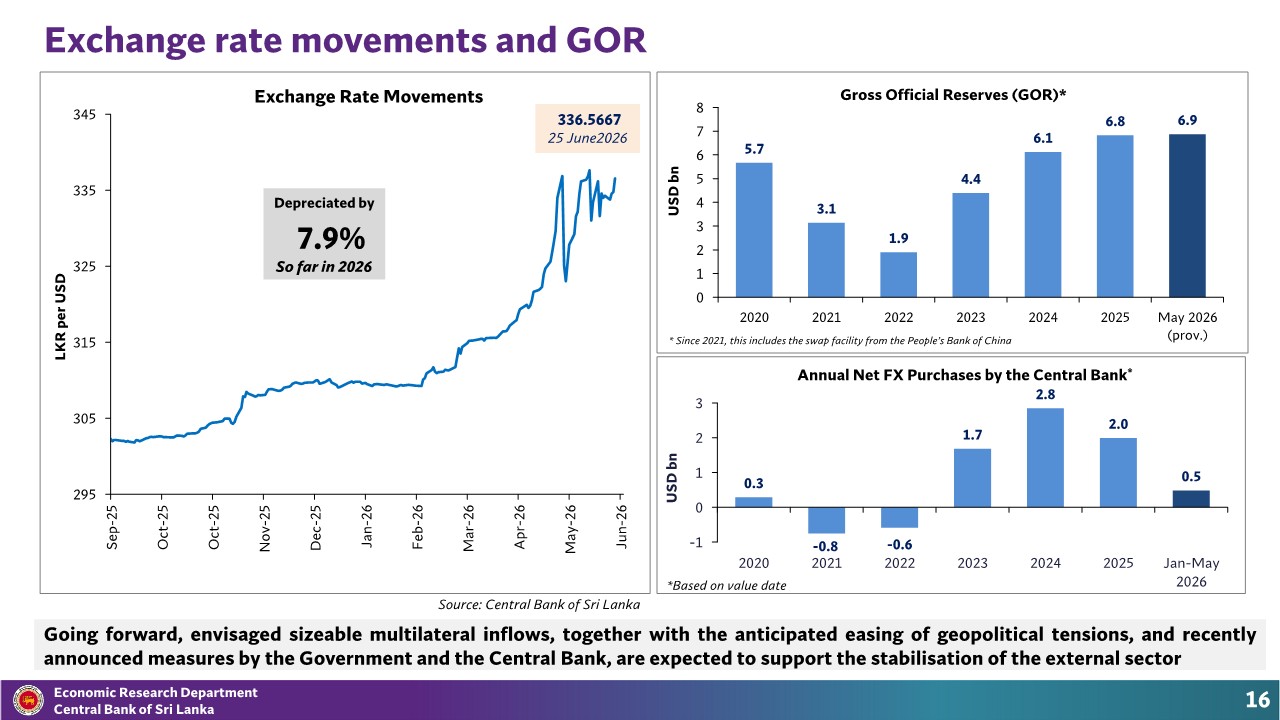
Sri Lanka’s external sector indicators for 2026 reveal a mixed but gradually stabilizing picture, as the Sri Lankan rupee depreciated by 7.9% against the US dollar so far this year, trading at approximately 336.57 LKR/USD by late June. Nevertheless, the country’s Gross Official Reserves have improved considerably, recovering from earlier stressed levels to a projected USD 6.9 billion by May 2026, reflecting ongoing balance-of-payments adjustments and improved buffer capacity. In parallel, the Central Bank shifted toward net foreign exchange purchases during January–May 2026, a notable reversal from the net selling positions recorded in 2021–2022, which suggests a strengthening ability to manage liquidity and reduce excessive volatility in the forex market. Looking ahead, the external position is expected to gain further support from sizeable multilateral financial inflows, a potential easing of geopolitical tensions, and recently announced policy measures by both the government and the Central Bank, all of which are anticipated to reinforce reserve adequacy, alleviate pressure on the currency, and foster greater overall stability in the external sector over the coming months.
Read More →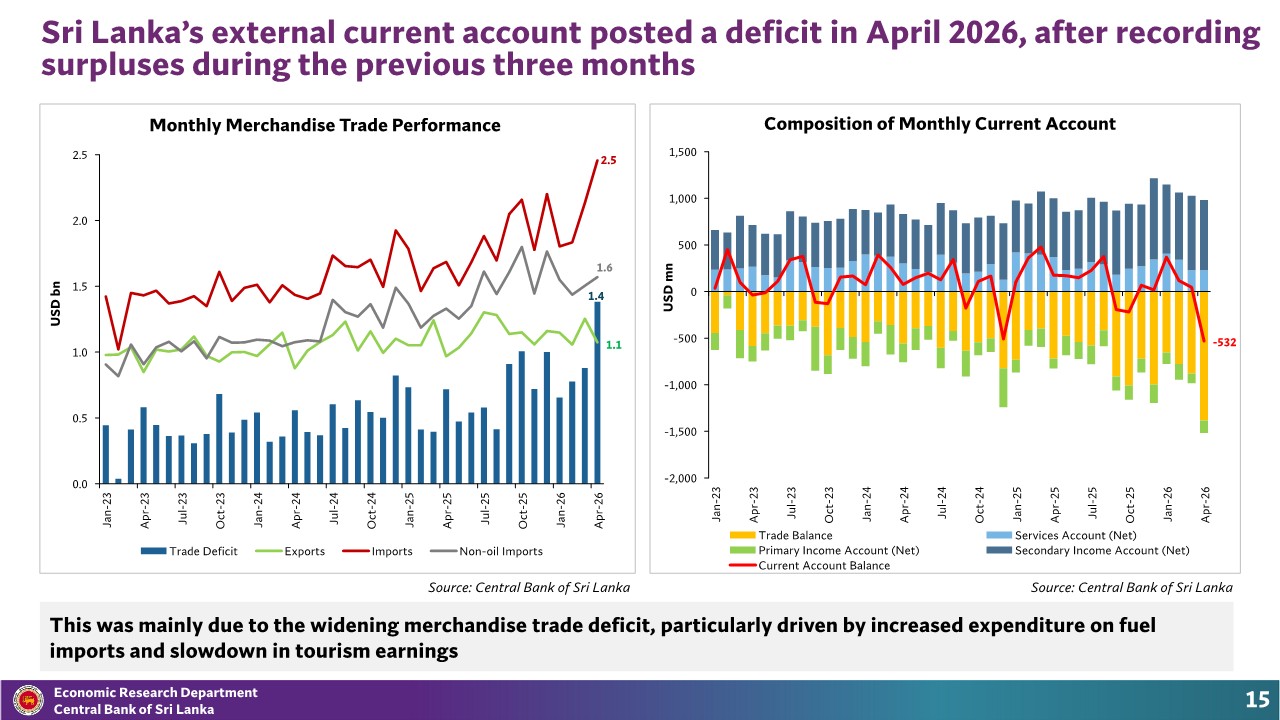
Sri Lanka’s external current account swung into a deficit in April 2026, breaking a three-month streak of surpluses, primarily driven by a sharp widening of the merchandise trade deficit. This deterioration was largely fueled by a notable increase in expenditure on fuel imports, which pushed up the overall import bill, while export performance failed to keep pace. Adding further pressure, the services account weakened due to a slowdown in tourism earnings, which reduced the positive contribution from this sector. Although secondary income, such as workers' remittances, likely provided some cushion, the combined drag from the larger trade gap and softer services receipts overwhelmed these inflows, pushing the overall current account balance firmly into negative territory for the month
Read More →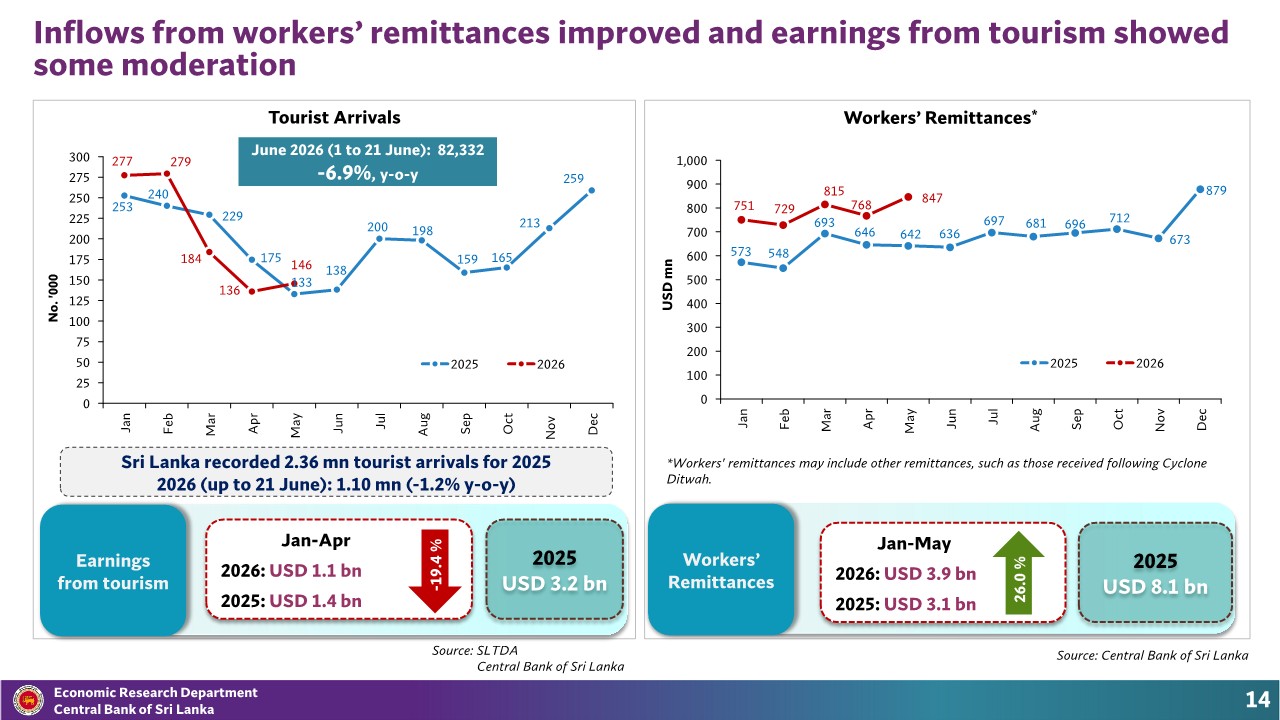
Sri Lanka’s external sector displayed a mixed performance in the first half of 2026, as a clear slowdown in tourism was offset by a significant surge in workers' remittances. Tourism data pointed to weakening demand, with total arrivals reaching 1.10 million by June 21, a slight 1.2% year-on-year decline, while June arrivals alone contracted more steeply by 6.9%; this moderation directly reduced tourism earnings, which dropped to USD 1.1 billion in January–April 2026 from USD 1.4 billion in the same period of 2025. In contrast, workers' remittances proved to be a vital stabilizing force, posting robust growth to USD 3.9 billion during January–May 2026, compared to USD 3.1 billion in the corresponding period of the prior year, highlighting their increasingly crucial role in shoring up the country’s foreign exchange reserves amid uneven recovery in other key inflow categories.
Read More →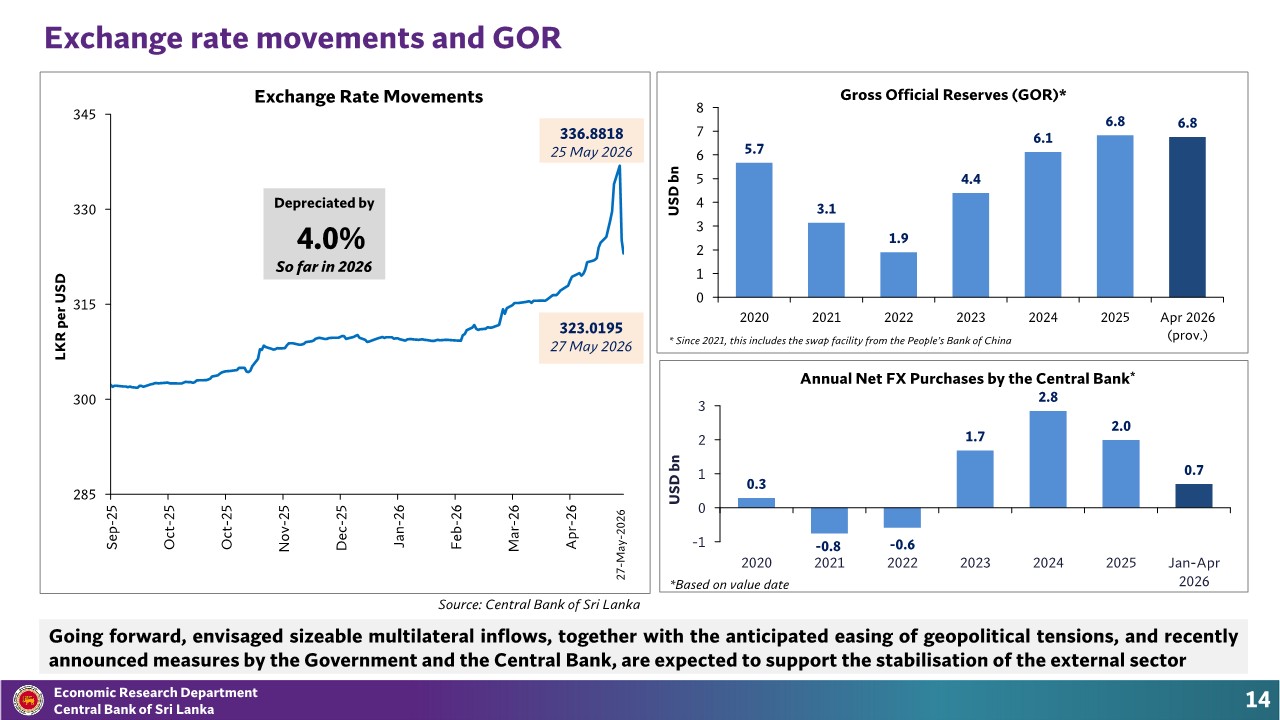
The summary diagram presenting key data on Sri Lanka's exchange rate movements and the central bank's foreign exchange operations. The diagram shows that the Sri Lankan rupee has depreciated by 4.0% so far in 2026, with the exchange rate moving from 323.0195 on 27 May 2026 to 336.8818 on 25 May 2026 (noting that the dates appear slightly out of chronological order, suggesting a possible data-entry reversal, but the overall direction indicates depreciation). It also references annual net FX purchases by the Central Bank, though the specific amount is not provided in the text. The accompanying narrative offers a forward-looking perspective, stating that sizeable multilateral inflows, anticipated easing of geopolitical tensions, and recently announced measures by both the Government and the Central Bank are expected to support external sector stabilization going forward. In essence, while the rupee has weakened notably in 2026, the authorities are counting on a combination of external financing, improved global conditions, and policy actions to anchor the exchange rate and restore balance to the external sector in the period ahead.
Read More →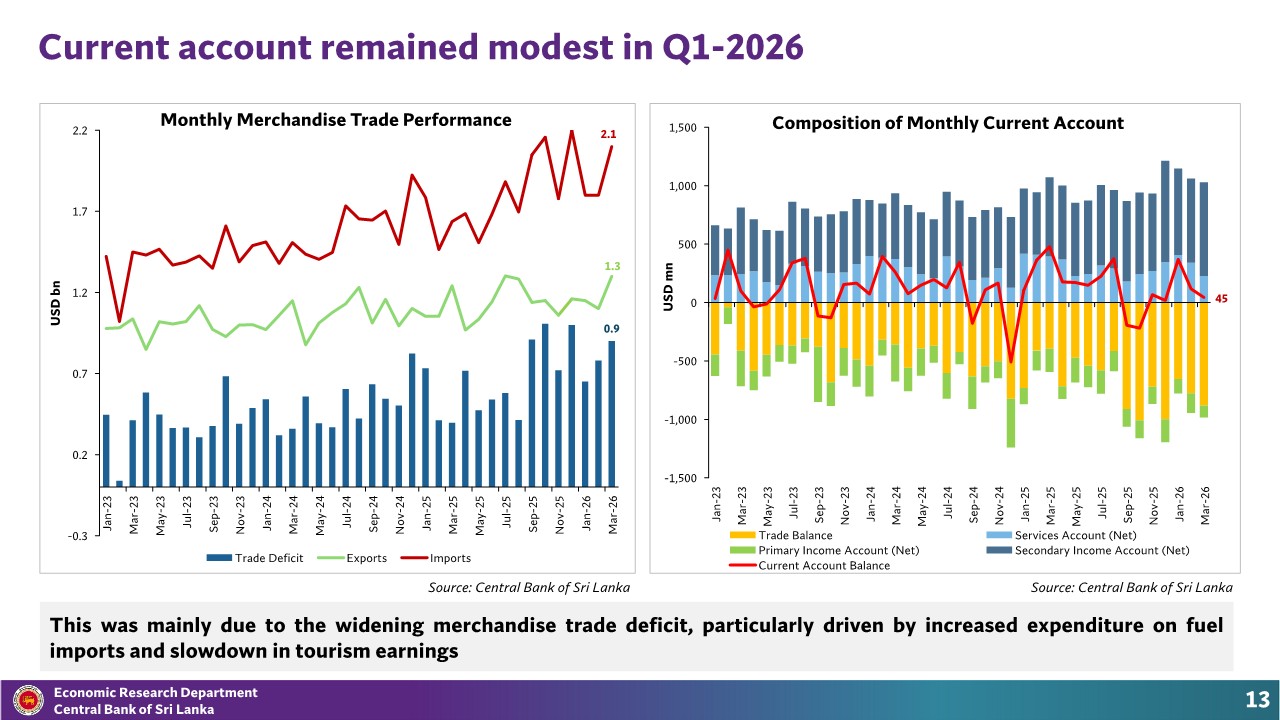
The diagram indicates that Sri Lanka's current account balance remained modest in the first quarter of 2026, primarily due to a widening merchandise trade deficit. This deterioration in the trade balance was largely driven by two factors: increased expenditure on fuel imports, which raised the import bill, and a slowdown in tourism earnings, which reduced service export revenues. The combined effect of higher outflows for fuel and lower inflows from tourism offset any gains from other external sources, such as workers' remittances, leaving the current account in a modest position. The diagram appears to visually represent this trend, though the actual chart data is not provided in the text; nonetheless, the accompanying note clearly attributes the current account's modest performance to these twin pressures on the external sector.
Read More →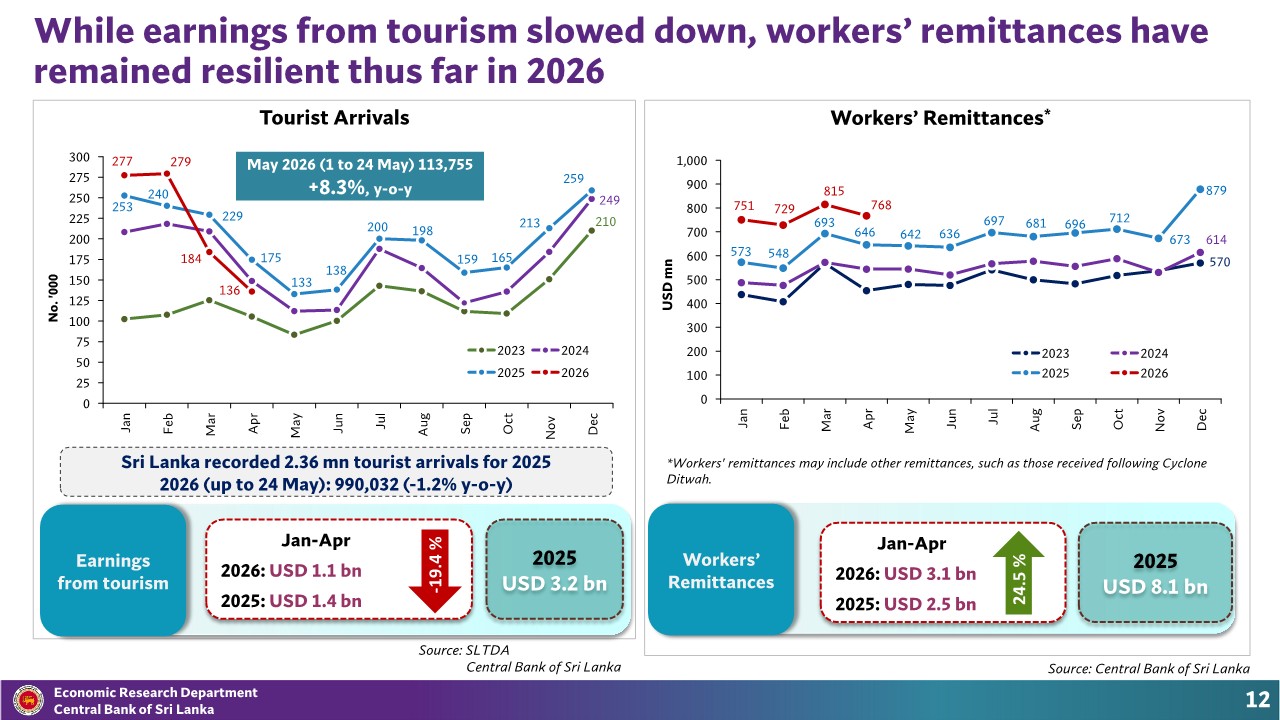
This diagram presents a comparative overview of Sri Lanka's two key external income sources, tourism and workers' remittances, revealing that while tourism earnings have slowed, remittances have remained resilient thus far in 2026. On the tourism front, Sri Lanka recorded 2.36 million tourist arrivals for the full year 2025, but by 24 May 2026, arrivals had reached 990,032, reflecting a slight year-on-year decline of 1.2%; however, the partial data for May 2026 (1–24 May) shows a positive uptick of 8.3% year-on-year with 113,755 arrivals. Correspondingly, tourism earnings for January–April 2026 stood at USD 1.1 billion, down from USD 1.4 billion in the same period of 2025, and well below the full-year 2025 total of USD 3.2 billion. In contrast, workers' remittances have shown strong resilience, with January–April 2026 remittances reaching USD 3.1 billion, up from USD 2.5 billion in the same period of 2025, and already approaching nearly 40% of the full-year 2025 total of USD 8.1 billion. This divergence suggests that while the tourism sector is experiencing a temporary slowdown, possibly due to seasonal factors or global uncertainties, remittances continue to provide a stable and growing source of foreign exchange, helping to cushion the external sector against the decline in tourism earnings.
Read More →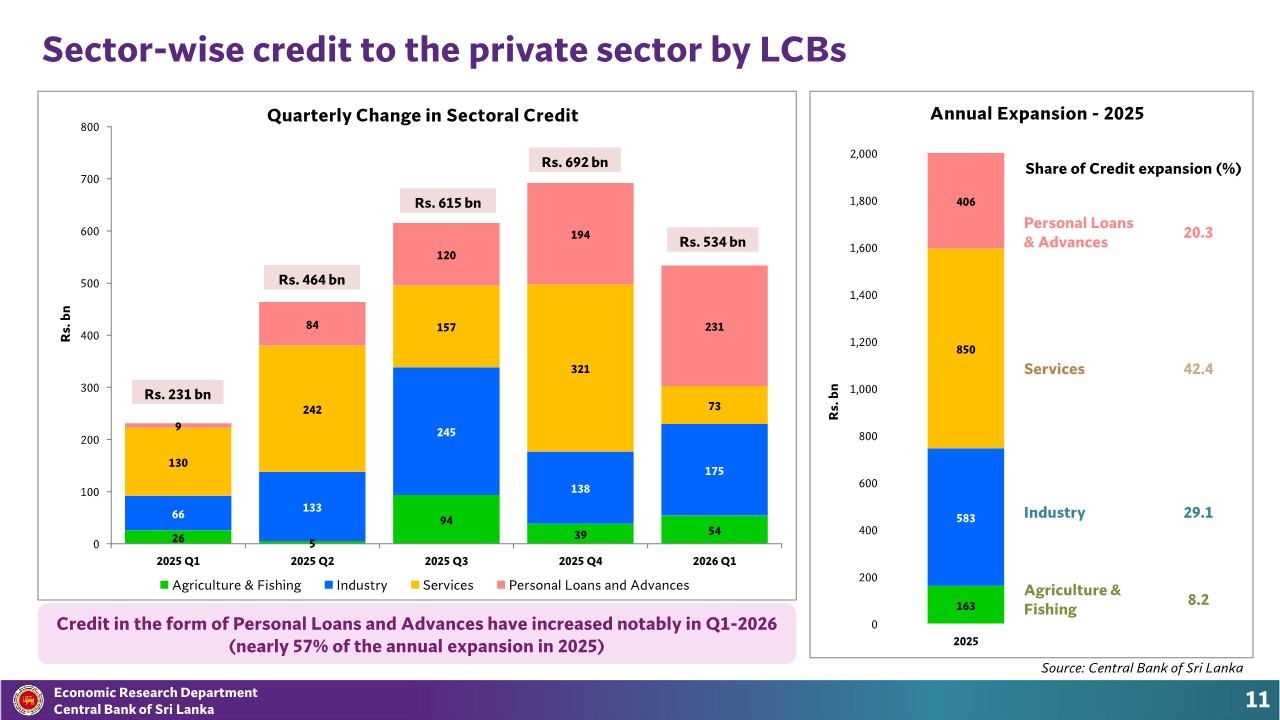
This diagram provides a sector-wise breakdown of credit to the private sector by Licensed Commercial Banks (LCBs), highlighting both quarterly changes and the annual expansion for 2025, with a notable surge in personal loans in early 2026. The upper panel shows quarterly changes in sectoral credit from 2025 Q1 through 2026 Q1, with total quarterly credit rising from Rs. 231 billion in Q1 2025 to Rs. 464 billion in Q2, Rs. 615 billion in Q3, Rs. 592 billion in Q4, and further to Rs. 634 billion in Q1 2026, though the repeated Rs. 634 billion figures for later quarters appear to be a formatting artifact. The lower table breaks down the annual expansion for 2025 by sector, revealing that Services accounted for the largest share at 42.4%, followed by Industry at 29.1%, Personal Loans and Advances at 20.3%, and Agriculture & Fishing at just 8.2%. The most striking takeaway, however, is the accompanying text stating that Personal Loans and Advances increased notably in Q1‑2026, representing nearly 57% of the entire annual expansion seen in 2025, a sharp acceleration that underscores a shift in borrowing toward consumer and personal financing. This rapid growth in personal credit, combined with the sectoral distribution, suggests that while services and industry remain dominant drivers of overall credit, the recent spike in personal lending has become a key feature of the current credit cycle, which the Central Bank may seek to moderate through its recent macroprudential measures.
Read More →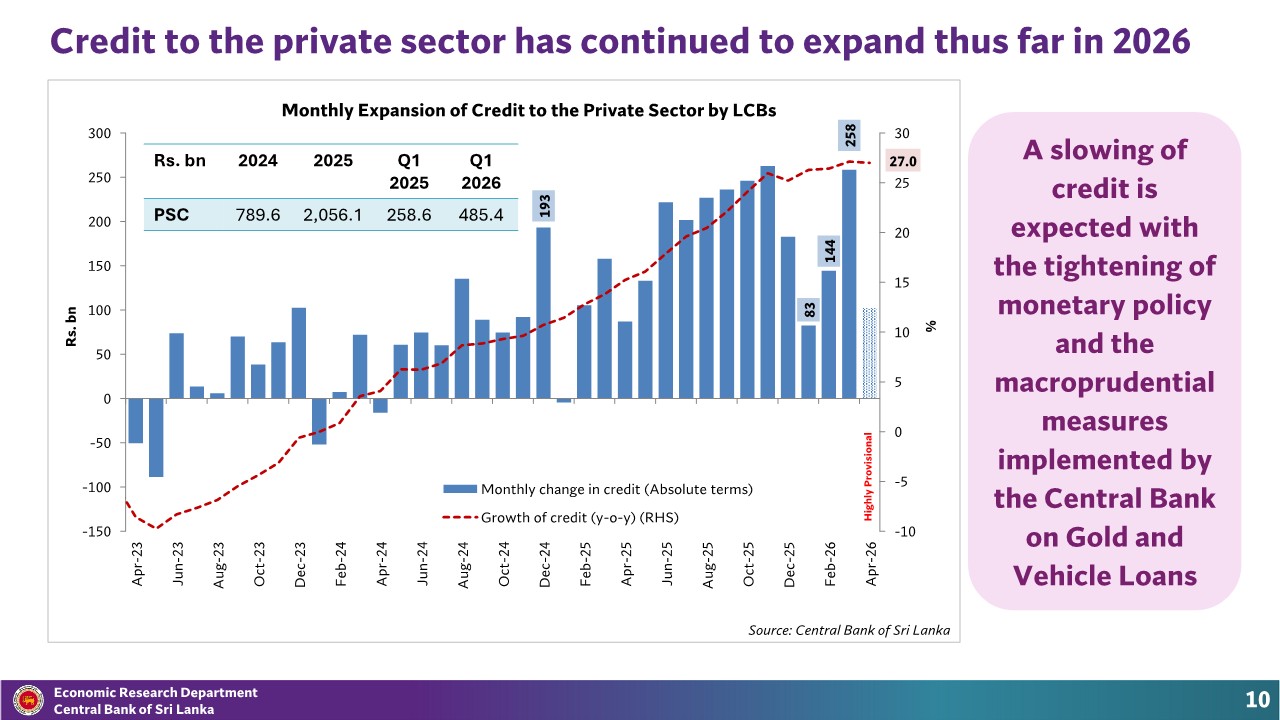
The diagram illustrates the monthly expansion of credit to the private sector by Licensed Commercial Banks (LCBs) in Sri Lanka, showing continued growth thus far in 2026, alongside a table and a cautionary note about future moderation. The bar chart presents monthly changes in credit in absolute terms (Rs. billion) from early 2024 through the first quarter of 2026, with a line overlay tracking year-over-year credit growth (right-hand scale). The accompanying table provides cumulative figures: credit expanded by Rs. 789.6 billion in full-year 2024, surged to Rs. 2,056.1 billion in 2025, and in Q1 2026 alone reached Rs. 485.4 billion, nearly double the Rs. 258.6 billion recorded in Q1 2025, with the Private Sector Credit (PSC) showing a strong increase of 193 billion year-on-year. The chart also includes a notable dip in monthly credit in January and February 2026, but the overall trend remains positive, with year-on-year growth staying in positive territory, though well below the highs seen in mid‑2025. However, the diagram explicitly notes that this credit momentum is expected to slow in the period ahead, as the recent monetary policy tightening and new macroprudential measures on gold and vehicle loans begin to restrain borrowing, thereby cooling private sector demand and aligning credit expansion with the Central Bank's policy objectives.
Read More →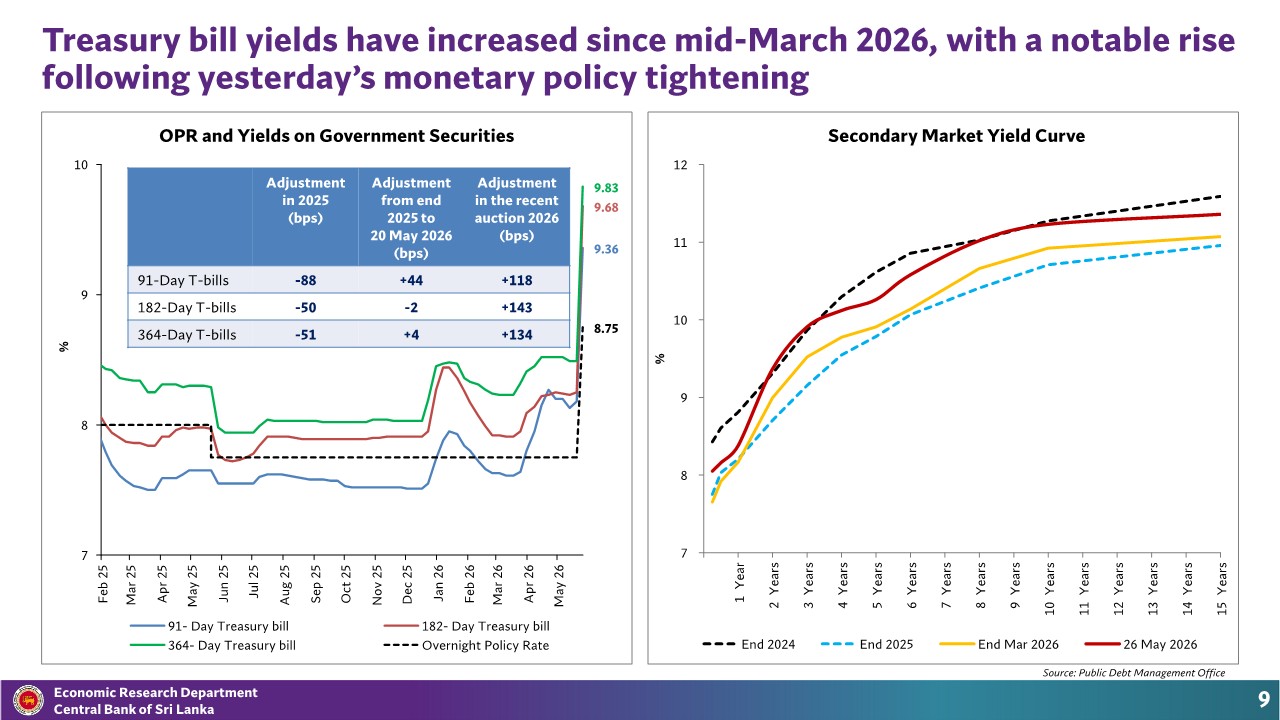
The diagram presents data on Sri Lankan Treasury bill yields and their adjustments over three distinct periods, clearly showing a sharp upward movement following a recent monetary policy tightening. The table breaks down the yield changes for three T-bill maturities, 91-day, 182-day, and 364-day, across three phases: during 2025, from end‑2025 to 20 May 2026, and in the most recent auction of 2026. In 2025, all three maturities saw significant yield declines, ranging from, 50 to -88 basis points. However, from the end of 2025 to mid‑May 2026, yields began to reverse, with the 91‑day bill rising by +44 bps, while the 182‑day and 364‑day bills saw only marginal changes (-2 bps and +4 bps, respectively). The most striking shift occurred in the recent auction, where yields surged dramatically across all maturities, by +118 bps for 91‑day, +143 bps for 182‑day, and +134 bps for 364‑day bills, coinciding with the Central Bank's policy rate hike announced the previous day. The diagram also references the secondary market yield curve, sourced from the Public Debt Management Office, implying that these auction adjustments are feeding into broader market rates. Overall, the table illustrates how monetary policy tightening is rapidly transmitted to short-term government securities, reversing the earlier easing trend observed throughout 2025.
Read More →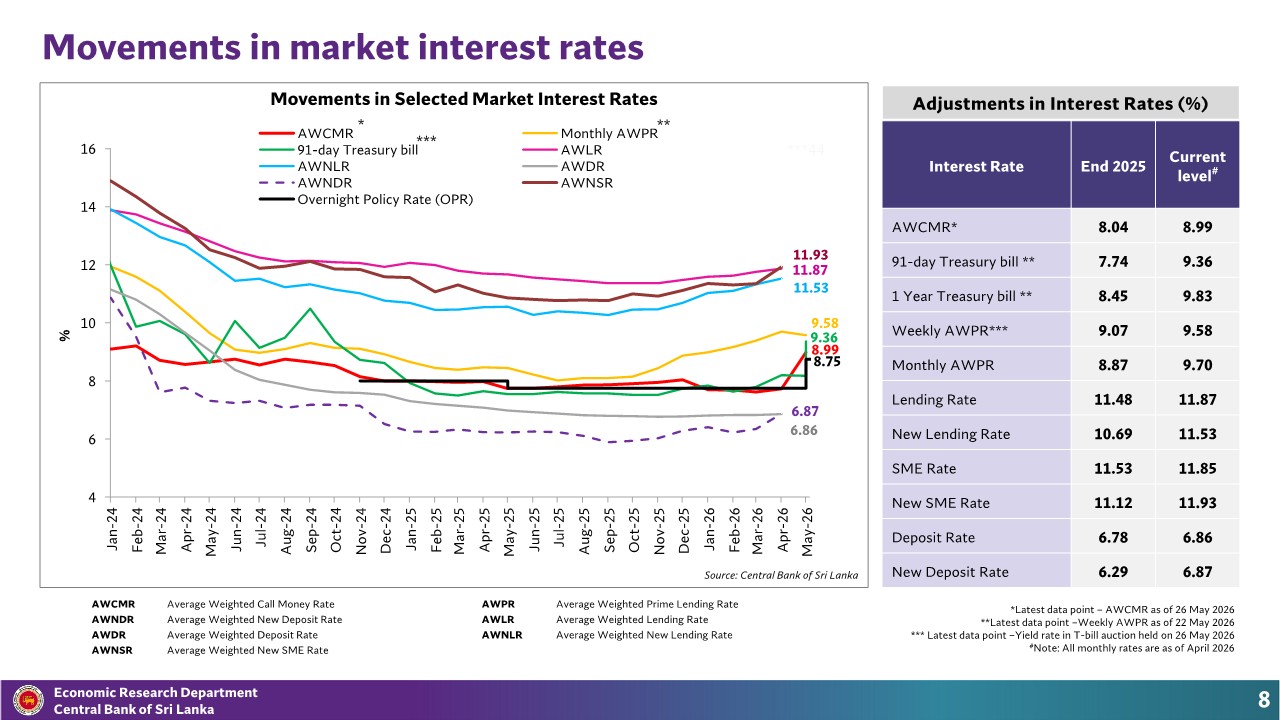
This diagram is intended to show the movements in selected market interest rates over time, but the text provided contains only the chart title and an excessively long, auto-generated date axis ranging from January 2024 far into the future, with no actual rate data, plotted lines, or legend visible. The y‑axis spans from roughly, 16% to +16%, suggesting it tracks percentage rates, but without the underlying numerical series or identified rate categories, such as treasury bill yields, lending rates, or deposit rates, it is impossible to analyze specific trends, directional changes, or the relationship between different rates. The only concrete takeaway is that the chart likely aims to illustrate how market borrowing and lending rates have evolved, but the absence of data means no meaningful explanation of movements, turning points, or responses to monetary policy can be provided; to interpret this diagram properly, the actual rate series and legend are required.
Read More →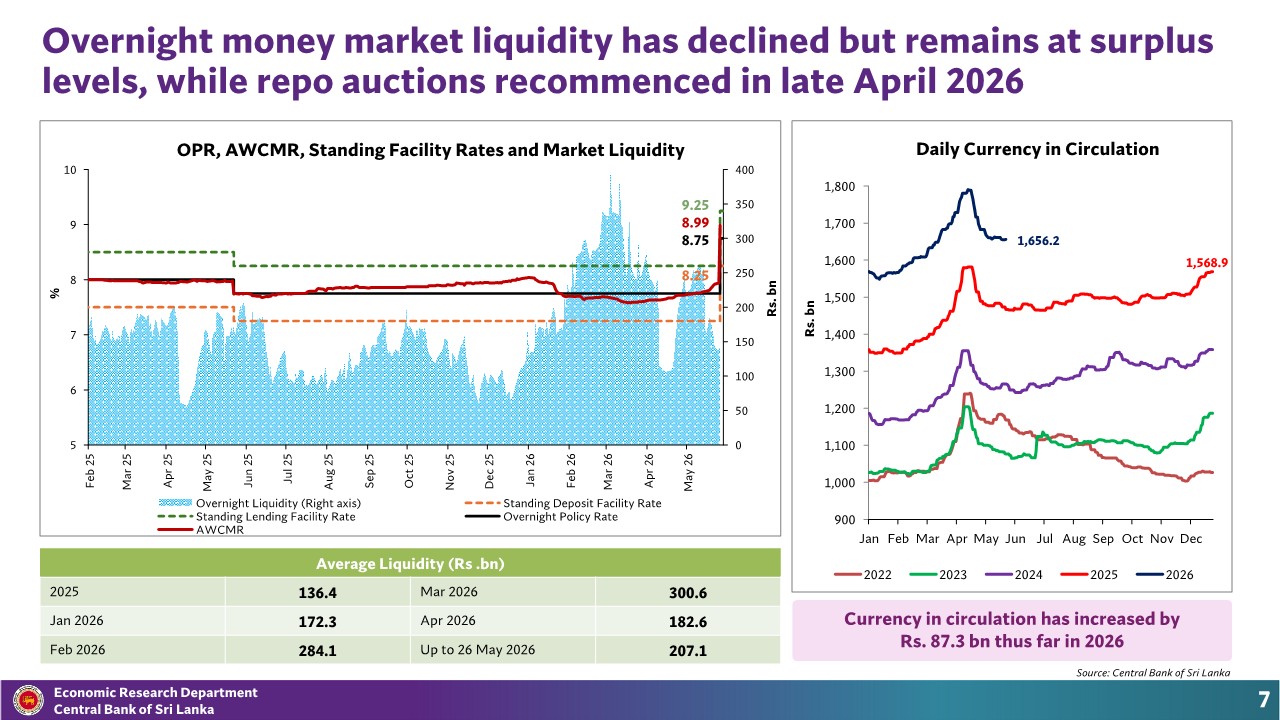
This composite diagram presents two sets of leading economic indicators for Sri Lanka, both showing notable improvements through early 2026 despite a seasonal slowdown in April of that year. The upper chart tracks three Purchasing Managers' Indices (PMIs), Manufacturing, Services (Business Activity), and Construction (Total Activity), from January 2022 to January 2026, with all three exhibiting a clear upward trajectory over the period, signaling expanding activity across these sectors, though the April 2026 dip suggests a temporary seasonal retreat. The lower chart displays the Index of Industrial Production (IIP), with 2015 as the base year (100), providing annual averages that show a steady climb from 99.3 in 2024 to 106.9 in 2026, indicating a strong recovery in industrial output by that year. Together, these indicators point to strengthening domestic economic activity, driven by manufacturing, services, construction, and industrial production. However, the diagram also includes a cautionary note that ongoing global uncertainties—such as geopolitical tensions or external shocks—could weigh on this positive momentum in the period ahead.
Read More →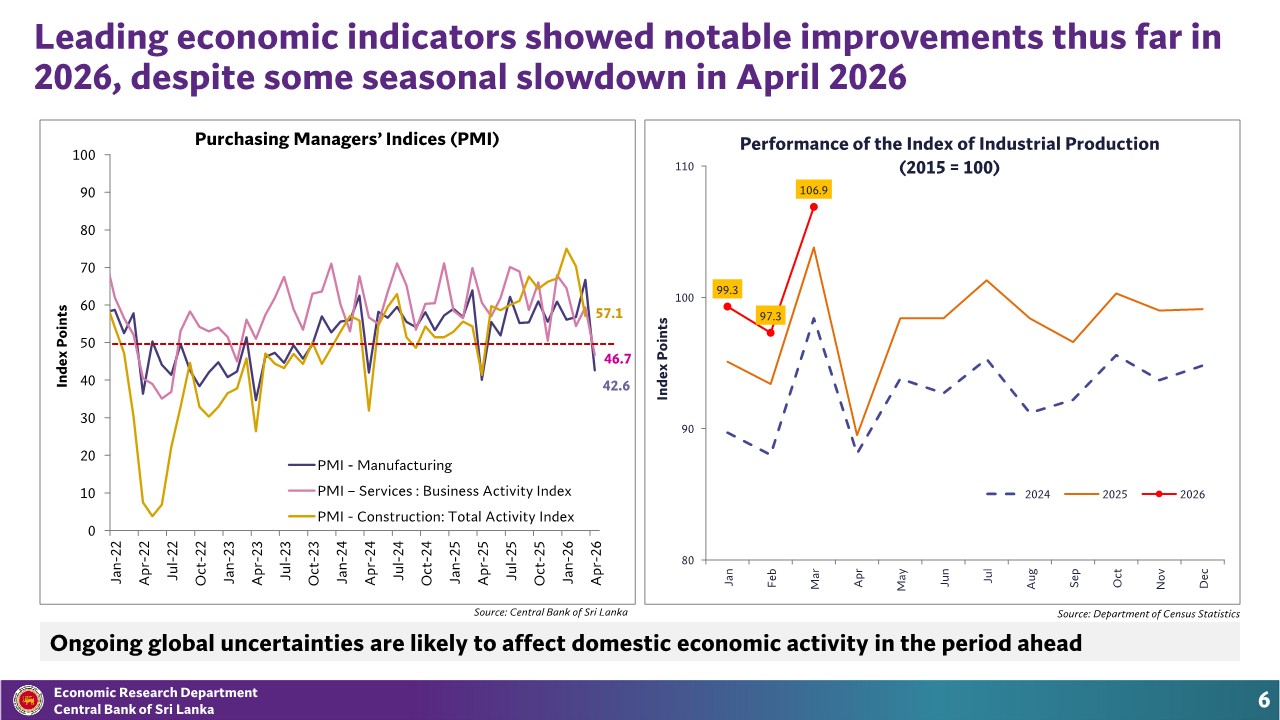
This composite diagram presents two sets of leading economic indicators for Sri Lanka, both showing notable improvements through early 2026 despite a seasonal slowdown in April of that year. The upper chart tracks three Purchasing Managers' Indices (PMIs), Manufacturing, Services (Business Activity), and Construction (Total Activity), from January 2022 to January 2026, with all three exhibiting a clear upward trajectory over the period, signaling expanding activity across these sectors, though the April 2026 dip suggests a temporary seasonal retreat. The lower chart displays the Index of Industrial Production (IIP), with 2015 as the base year (100), providing annual averages that show a steady climb from 99.3 in 2024 to 106.9 in 2026, indicating a strong recovery in industrial output by that year. Together, these indicators point to strengthening domestic economic activity, driven by manufacturing, services, construction, and industrial production. However, the diagram also includes a cautionary note that ongoing global uncertainties—such as geopolitical tensions or external shocks—could weigh on this positive momentum in the period ahead.
Read More →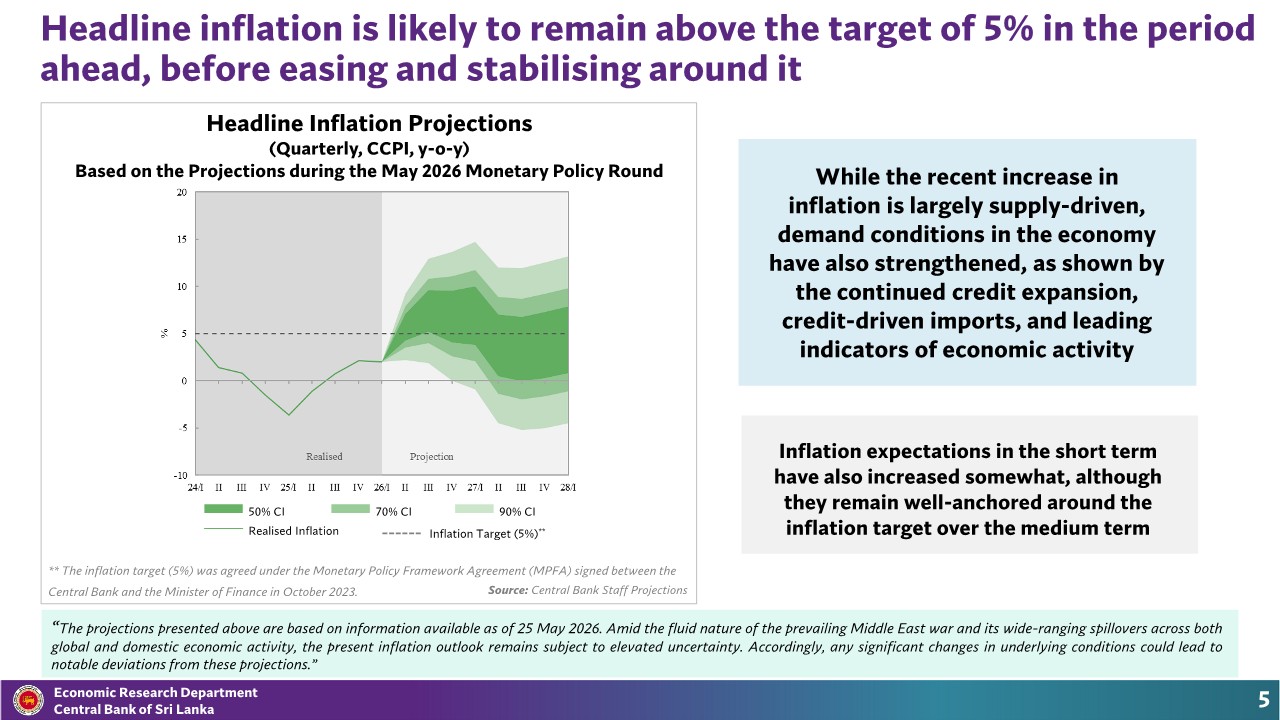
This diagram presents the Central Bank of Sri Lanka’s headline inflation projections from the May 2026 monetary policy round, shown as a quarterly year-over-year CCPI-based forecast. The graph plots projected inflation paths with three uncertainty bands, 50%, 70%, and 90% confidence intervals, alongside the actual realized inflation and a fixed 5% inflation target, which was agreed under the October 2023 Monetary Policy Framework Agreement with the Minister of Finance. The central forecast indicates that headline inflation is expected to remain above the 5% target in the near term before gradually easing and stabilizing around that level over the medium term. The widening confidence intervals reflect growing uncertainty, particularly due to external risks such as the Middle East war and its spillover effects. While the recent inflation uptick is largely attributed to supply-side factors, the statement also notes that demand conditions have strengthened through credit expansion, credit-driven imports, and positive leading economic indicators. Although short-term inflation expectations have risen somewhat, they remain well-anchored around the target over the medium term. However, the projections are explicitly caveated as highly fluid, with any significant changes in underlying conditions, especially geopolitical or global economic shocks—likely to cause notable deviations from the forecasted path.
Read More →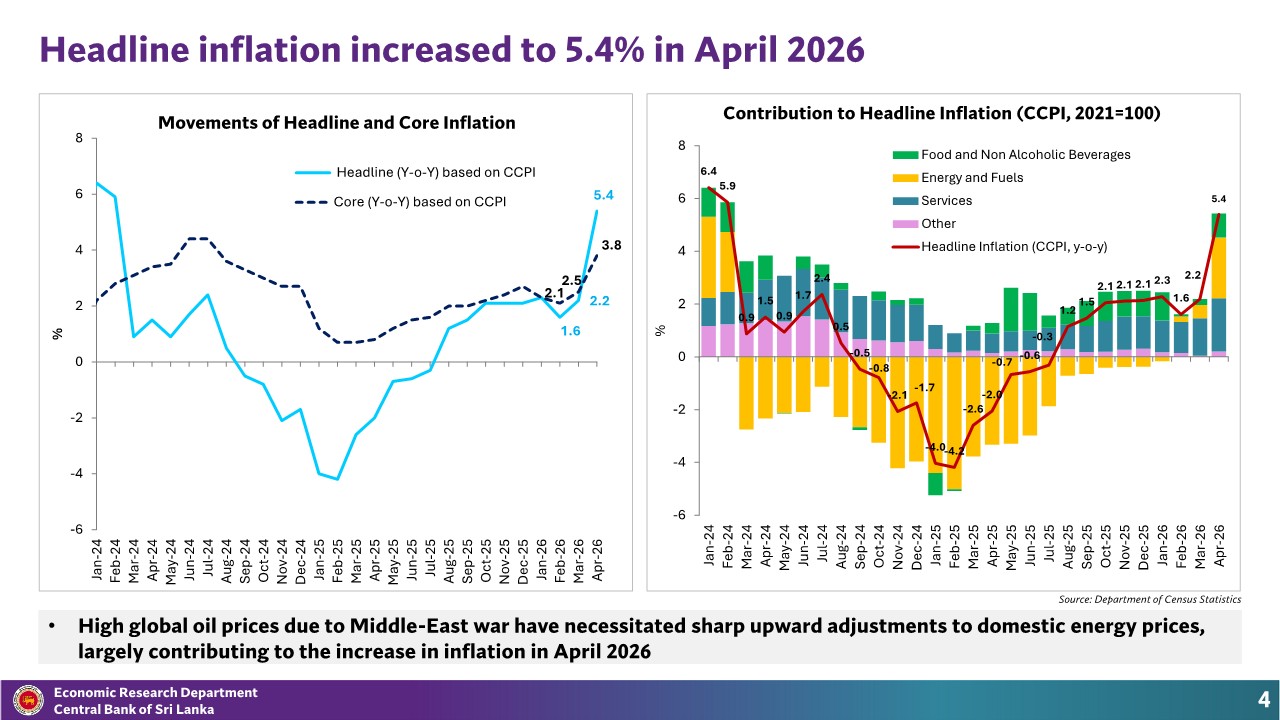
The line chart illustrating the movements of headline and core inflation in Sri Lanka over time, with the key data point being that headline inflation rose to 5.4% in April 2026. The chart tracks two metrics, headline inflation (year-over-year, based on the CCPI) and core inflation (year-over-year, based on the CCPI), against a y‑axis ranging from approximately, 6% to +8%, while the x‑axis spans a monthly timeline from January 2021 far into the future, though the actual trend lines and historical values are not visible in the text. The only concrete takeaway is the April 2026 headline inflation figure of 5.4%, which signals a rising price level, but without the visual plot or numerical data, it is not possible to compare it with core inflation or analyze past trends; to get a full explanation, you would need to view the actual chart or provide the underlying data in a tabular format.
Read More →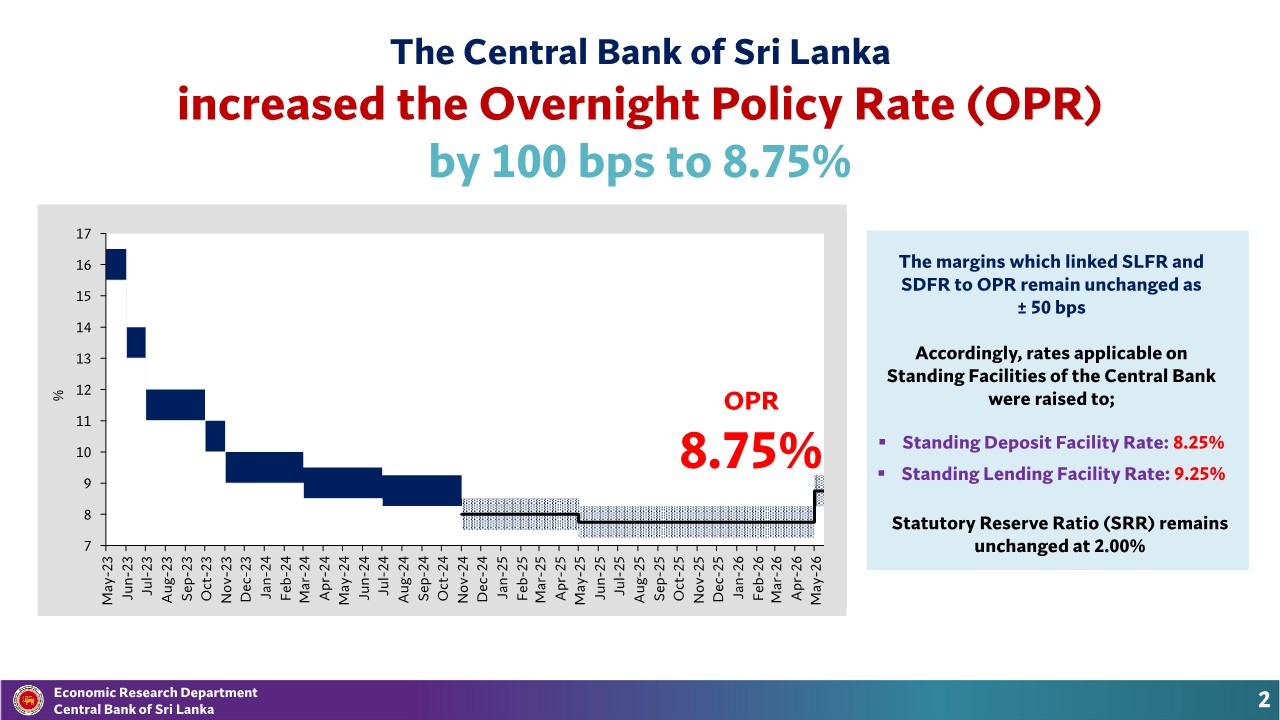
The table summarizes a monetary policy decision by the Central Bank of Sri Lanka. It announces a 100-basis-point (1 percentage point) increase in the Overnight Policy Rate (OPR), raising it to 8.75%. The corridor around this policy rate, set by the Standing Deposit Facility (SDF) and Standing Lending Facility (SLF) rates, remains at ±50 basis points, meaning the new SDF rate becomes 8.25% (lower end) and the new SLF rate becomes 9.25% (upper end). In contrast, the Statutory Reserve Ratio (SRR), which dictates the proportion of deposits banks must hold as reserves, is left unchanged at 2.00%. Overall, the table signals a tightening of monetary policy through higher interest rates, while leaving reserve requirements steady.
Read More →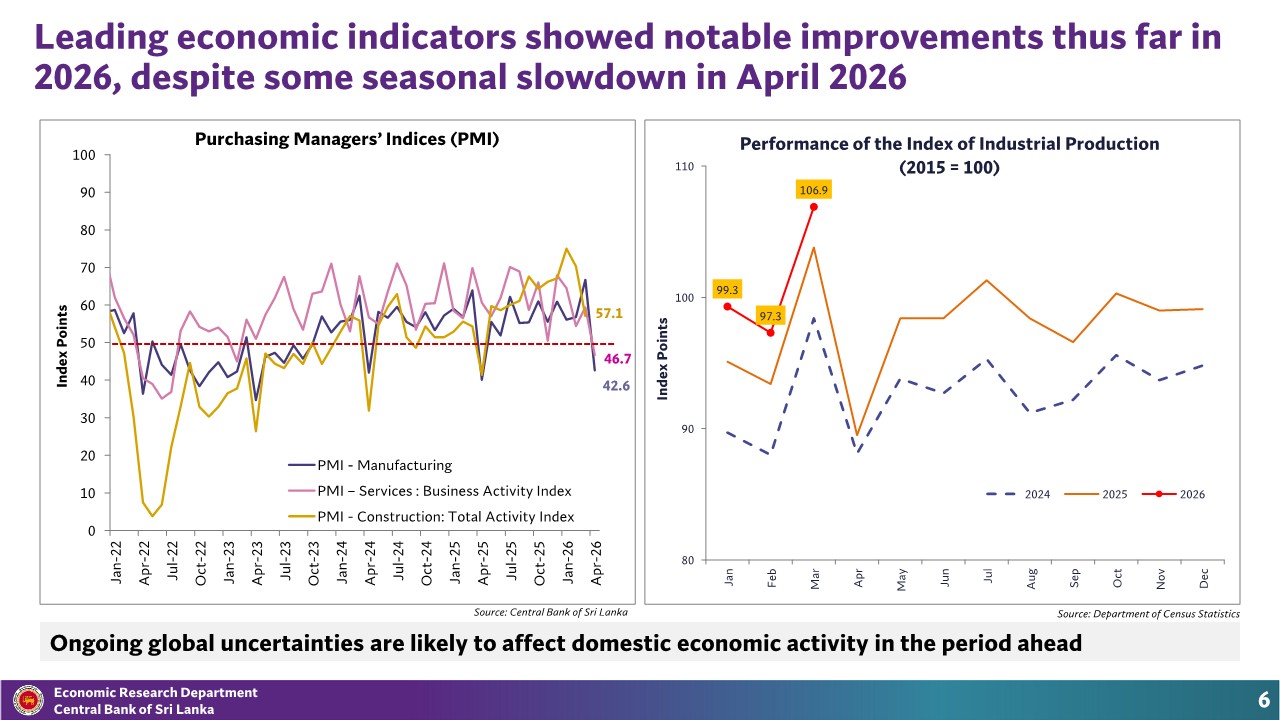
The table presents two sets of leading economic indicators for Sri Lanka. The first chart shows Purchasing Managers’ Indices (PMI) from January 2022 to January 2026, with separate lines for Manufacturing, Services (Business Activity Index), and Construction (Total Activity Index). All three indices improved notably in 2026, though they experienced a seasonal slowdown in April 2026. The second chart displays the Index of Industrial Production (IIP) for January in 2024, 2025, and 2026, rising from 99.3 in 2024 to 97.3 in 2025 (a slight dip) and then to 106.9 in 2026, indicating a strong rebound in industrial output. The text notes that despite the April slowdown, leading indicators have shown notable improvements thus far in 2026, but ongoing global uncertainties are likely to affect domestic economic activity in the period ahead.
Read More →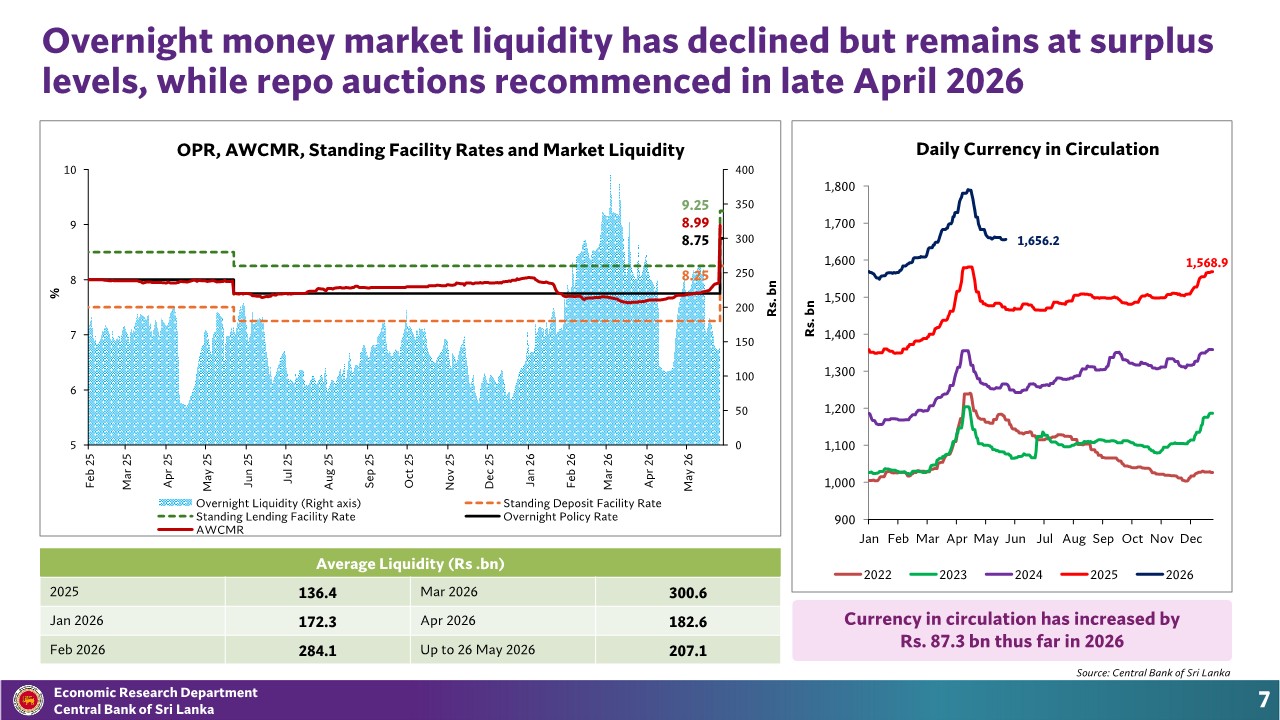
The table and accompanying text describe Sri Lanka's overnight money market liquidity, policy rates, and currency in circulation. Overnight liquidity, while declining from earlier peaks, remained in surplus as of late May 2026, with average liquidity rising from Rs. 136.4 billion in 2025 to Rs. 172.3 billion in 2026 and further to Rs. 284.1 billion by 2027 (though later figures show some fluctuation). The Overnight Policy Rate (OPR) and Standing Deposit Facility Rate are shown alongside liquidity levels. Repo auctions recommenced in late April 2026, indicating a shift in liquidity management. Additionally, currency in circulation increased by Rs. 87.3 billion thus far in 2026, suggesting continued demand for cash. Overall, despite a decline in surplus liquidity, the system remained well-supplied with funds, and the central bank resumed active repo operations to manage short-term interest rates.
Read More →
The table presents movements in selected market interest rates in Sri Lanka from January 2024 to May 2026, though the chart image is corrupted with an extended, repetitive date axis. Based on the visible structure and title, it is a line chart tracking various market interest rates (such as Treasury bill yields, lending rates, or deposit rates) over time. The vertical axis shows percentage values ranging from -16% to 16%, indicating both positive rates and potential negative deviations from a baseline. The purpose is to illustrate how market interest rates responded to the central bank's policy rate changes (e.g., the OPR hike to 8.75% shown in the first image) during this period. While the exact rate lines cannot be discerned due to data corruption, the chart likely shows the transmission of monetary policy to broader financial markets, with market rates moving in response to the policy tightening.
Read More →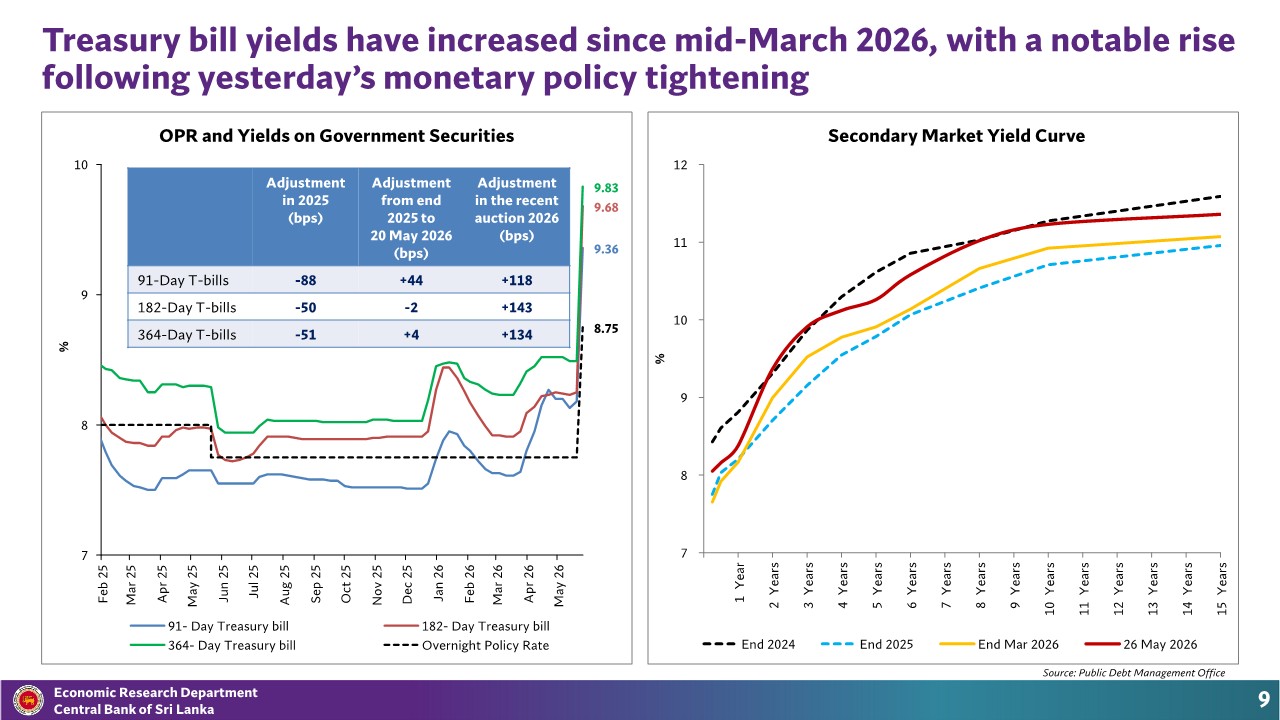
The table shows changes in Treasury bill yields for three maturities (91‑day, 182‑day, and 364‑day) across three periods: adjustments made in 2025, adjustments from the end of 2025 to 20 May 2026, and adjustments at the most recent auction in 2026. Yields fell during 2025 (by 88, 50, and 51 basis points respectively). From end‑2025 to 20 May 2026, yields moved modestly: +44 bps for 91‑day bills, –2 bps for 182‑day bills, and +4 bps for 364‑day bills. However, following the latest monetary policy tightening, yields jumped sharply in the recent auction—by 118 bps (91‑day), 143 bps (182‑day), and 134 bps (364‑day). The accompanying text notes that Treasury bill yields have been rising since mid‑March 2026, with a notable increase after yesterday’s policy tightening. The secondary market yield curve (not shown in detail) would reflect these upward shifts across maturities.
Read More →
The table illustrates the monthly expansion of credit to Sri Lanka's private sector by Licensed Commercial Banks (LCBs) in 2024, 2025, and the first quarter of 2026. It shows that credit growth has continued to expand thus far in 2026, with the year-on-year growth rate (right-hand scale) remaining positive and relatively strong. In absolute terms (left-hand scale, bars), monthly changes in credit turned positive in 2025 and into 2026, contrasting with some negative months in 2024. For instance, credit growth increased from Rs. 258.6 billion in Q1 2025 to Rs. 485.4 billion in Q1 2026, while the personal services and credit (PSC) component also grew. The accompanying text notes that a slowing of credit is expected going forward due to the recent monetary policy tightening and new macroprudential measures introduced by the Central Bank on gold and vehicle loans.
Read More →
The table presents sector-wise credit to the private sector by Licensed Commercial Banks (LCBs), showing quarterly changes from Q1 2025 to Q1 2026, as well as the annual expansion shares for 2025. Total quarterly credit expansion increased from Rs. 231 billion in Q1 2025 to Rs. 464 billion in Q2, Rs. 615 billion in Q3, Rs. 592 billion in Q4, and further to Rs. 634 billion in Q1 2026. The breakdown by sector, Agriculture & Fishing, Industry, Services, and Personal Loans and Advances, indicates that Personal Loans and Advances accounted for the largest share of credit expansion in 2025, followed by Services, then Industry, and finally Agriculture & Fishing. The steady rise in total credit, particularly the strong Rs. 634 billion increase in Q1 2026, reflects continued private sector credit growth, consistent with the trend noted in the previous image.
Read More →
The table presents two key external inflows for Sri Lanka in 2026: tourism and workers’ remittances. Tourist arrivals in the first 24 days of May 2026 reached 113,755, an 8.3% year-on-year increase, but cumulative arrivals from January to 24 May 2026 stood at 990,032, a slight 1.2% decline compared to the same period in 2025. Earnings from tourism in January–April 2026 were USD 1.1 billion, down from USD 1.4 billion in the same period of 2025. In contrast, workers’ remittances have remained resilient, with monthly remittances rising from around USD 600–700 million in 2023–2025 to USD 879 million in a recent month of 2026 (likely April or May). The text notes that remittances may include other inflows, such as those received following Cyclone Diwath. Overall, while tourism earnings have slowed, remittances have strengthened, providing continued support to the external sector.
Read More →
The bar chart shows nine selected market interest rates in early 2026, with most monthly rates as of February 2026 and some updated to April 2026. The highest rates, Awcrmr (11.62%, 22 April 2026), Awnrr (11.31%), and Awndr (11.11%), are very short‑term money market rates, followed by the 91‑day Treasury bill yield (9.79%, auction of 22 April 2026). Mid‑range rates include the average weighted lending rate (AWLR, 8.27%), average weighted deposit rate (AWD, 7.75%), and AWNSR (7.70%). The lowest rates are the weekly average weighted prime lending rate (Awprs, 6.83%, as of 17 April 2026) and an unlabeled rate at 6.23%. Although short‑term market interest rates have shown mixed movements, the observed easing in short‑term rates and surplus liquidity in the money market are expected to gradually bring down other market rates, narrowing the gap between the highest and lowest rates.
Read More →
The graphic illustrates a concerning continuous rise in prime lending rates (measured by the Average Weighted Prime Lending Rate, AWPR) in early 2026. After falling by 347 basis points during 2024 and a further 5 bps in 2025, the monthly AWPR began increasing in January 2026 (+12 bps to 8.99%), February (+18 bps to 9.17%), and March (+22 bps to 9.39%). A related line chart tracks the weekly AWPR alongside the AWCMR (call money rate) to show the spread between them, while a separate bank‑wise scatter plot uses black dots for state banks, red dots for domestic private banks, and blue dots for foreign banks, indicating how different banking groups have moved over time. Although the full date axis in the provided text appears garbled (listing dates from 2025 through 1970s), the core message is clear: after a prolonged decline, prime lending rates have reversed course and are now rising steadily.
Read More →
The table shows how Treasury bill yields changed in 2025 versus early 2026. During 2025, yields fell across all three maturities: 91‑day bills by 88 basis points, 182‑day bills by 50 bps, and 364‑day bills by 51 bps, indicating an easing trend. However, in early 2026 (up to the time of the report), the pattern turned mixed: the 91‑day yield rose sharply by 53 bps, the 364‑day yield increased modestly by 7 bps, while the 182‑day yield continued to edge lower by 4 bps. This reversal—especially the steep rise in very short‑term T‑bill yields since mid‑March 2026—contrasts with the overall easing observed earlier and aligns with the report’s note that secondary market yield curve has shifted upward since end‑February 2026, partly due to market sentiment amid heightened global uncertainties.
Read More →
The chart shows monthly changes in private sector credit extended by Licensed Commercial Banks (LCBs) from January 2024 to February 2026, along with the year‑on‑year growth rate. After a period of negative or low monthly credit expansion in early 2024, the bars turned mostly positive from mid‑2024 onwards, indicating renewed borrowing by the private sector. The momentum strengthened through 2025 and continued into early 2026, with January and February 2026 showing solid positive monthly increases. The year‑on‑year growth line (right axis) also rose steadily over the same period, moving from negative or low single digits in early 2024 to double‑digit levels by late 2025 and early 2026. This persistent upward trend confirms that private sector credit growth maintained its momentum into 2026, reflecting improving credit demand and confidence in the economy.
Read More →
The chart from the Central Bank of Sri Lanka shows sector-wise credit to the private sector by Licensed Commercial Banks, comparing the quarterly change in early 2026 (January–February) with the annual expansion in 2025. For Jan‑Feb 2026, total credit increased by large absolute amounts, indicated by bars labelled Rs. 692 billion, Rs. 615 billion, and Rs. 464 billion—with sectoral breakdowns showing increments such as 321, 242, 245, 157, 139, 138, 94, 84, 74, 42, and 8 (likely in Rs. billion). The 2025 annual expansion figures list Agriculture & Fishing (2,200), Industry (2,000), Services (1,800), and Personal Loans and Advances (1,600), though the reported total of 1,400 appears inconsistent with the sum of those parts, possibly a labelling error or different units. A separate set of percentages (406%, 850%, 583%, 163%) is presented as “Share of Credit expansion (%)” for Services, Industry, Agriculture, and Personal Loans respectively, which exceeds 100% and may instead represent year‑on‑year growth rates or index values. Overall, the chart indicates that private sector credit continued to expand strongly across all major sectors in early 2026, building on the positive momentum seen in 2025.
Read More →
The graphic presents two related charts on Sri Lanka’s external sector. The top chart shows monthly merchandise trade performance from early 2023 through February 2026, with exports and imports as stacked bars and the trade deficit as a line. Despite stronger import expenditures compared to exports throughout the period, the trade deficit narrowed in late 2025 and early 2026. The bottom chart breaks down the monthly current account into its components: trade balance, services account (net), primary income account (net), secondary income account (net), and the overall current account balance (line). Notably, although the trade balance remained negative for most months, the current account balance turned positive (a surplus) in February 2026. This surplus was achieved because net services, secondary income (e.g., remittances), and possibly narrower primary income outflows more than offset the merchandise trade deficit. Thus, despite higher import expenditures relative to exports, the external current account recorded a surplus in February 2026, reflecting resilient invisibles and transfer receipts.
Read More →
The chart presents data on tourism and workers’ remittances for Sri Lanka up to April 2026. Earnings from tourism declined in March 2026 year‑on‑year, with tourist arrivals in the first 19 days of April 2026 reaching 88,211, a drop of 25.8% compared to the same period in 2025. For the full year 2025, Sri Lanka recorded 2.36 million tourist arrivals. Tourist earnings for January–March 2026 stood at USD 954.0 million, down from USD 1,122.3 million in the same period of 2025 (or possibly a different comparison, as the text is somewhat ambiguous). In contrast, workers’ remittances showed steady improvement: remittances reached USD 2.3 billion in January–March 2026, up from USD 1.8 billion in the same period of 2025, indicating resilient inflows despite recent geopolitical tensions. A footnote notes that remittances may include additional receipts following Cyclone Ditwah. Overall, the data highlight a weakening in tourism but continued strength in remittances.
Read More →
The table shows exchange rate movements of the Sri Lanka rupee and several peer currencies against the US dollar for 2025 and 2026 (year‑to‑date). The Sri Lanka rupee depreciated by 5.6% in 2025 and a further 2.1% in early 2026, reflecting depreciation pressures following the onset of the Middle East war. Among peers, the Malaysian ringgit and Singapore dollar appreciated in both years, while the Indonesian rupiah, Indian rupee, Philippine peso, Bangladesh taka, Vietnam dong, and Nepalese rupee also depreciated (though generally less than Sri Lanka’s 2025 decline). The Thai baht appreciated sharply in 2025 (+8.7%) but turned to depreciation in 2026 (-2.8%). Additional data indicate that the Central Bank engaged in net FX purchases (based on value date), and gross official reserves increased steadily from USD 5.7 billion in 2020 to a provisional USD 7.0 billion by March 2026, providing some buffer against external shocks.
Read More →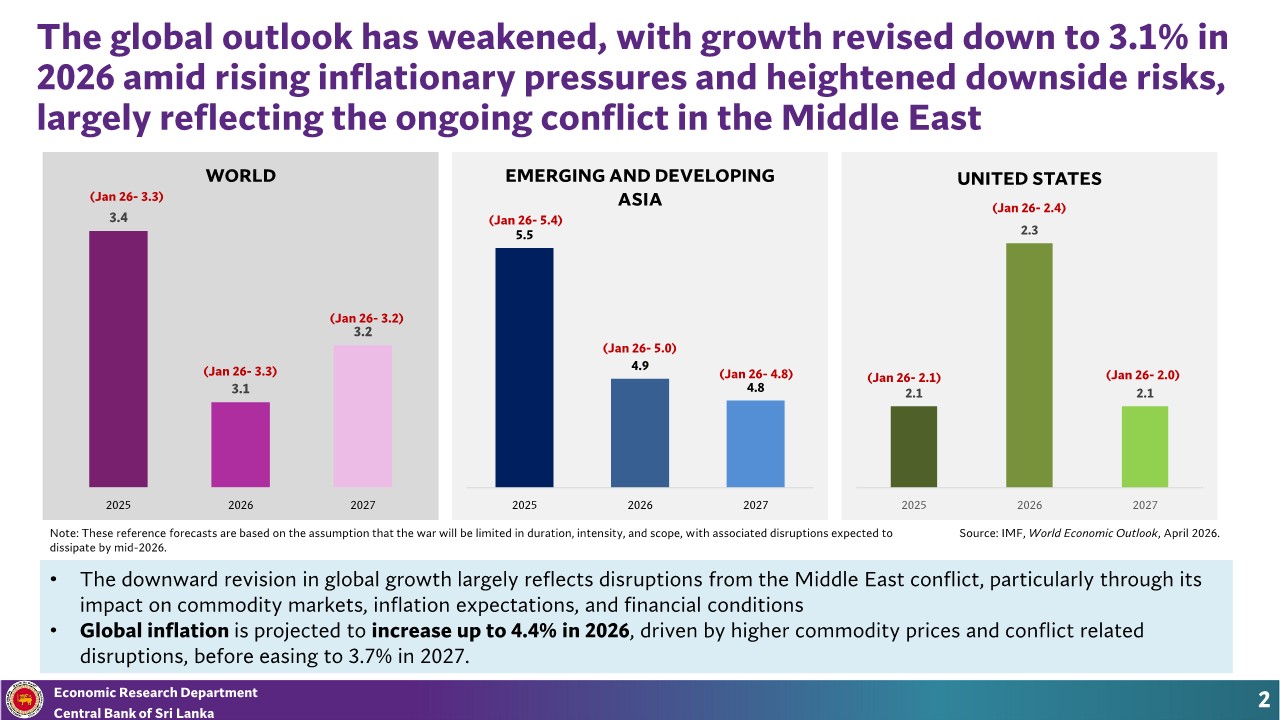
The table presents global and regional growth forecasts from the IMF’s April 2026 World Economic Outlook, showing a weakened outlook with world growth revised down to 3.1% in 2026 (from an earlier 3.3% forecast) amid rising inflationary pressures and heightened downside risks, largely reflecting the ongoing Middle East conflict. For the United States, growth was revised to 2.1% in 2026 (down from a prior 2.4% forecast). Emerging and Developing Asia also saw downward adjustments, with growth projections of 5.5%, 4.9%, and 4.8% for different sub‑periods or scenarios, compared to earlier January forecasts of 5.4%, 5.0%, and 4.8% respectively. The revisions assume the conflict is limited in duration, intensity, and scope, with disruptions dissipating by mid‑2026. Global inflation is projected to rise to 4.4% in 2026, driven by higher commodity prices and conflict‑related disruptions, before easing to 3.7% in 2027.
Read More →
The graphic presents four leading indicators of Sri Lanka’s economic activity as of early 2026, all pointing to continued resilience despite possible spillover risks from the Middle East conflict. The Manufacturing PMI stood at 66.7 in March 2026, well above the 50 threshold, indicating strong expansion. The Index of Industrial Production shows a steady recovery from 2024 through early 2026, with the 2026 line tracking above previous years. The Services PMI Business Activity Index registered 59.4 in March 2026, also signaling robust growth, while the Construction PMI Total Activity Index reached 70.3 in February 2026, reflecting a post‑cyclone rebound. Although these indicators suggest a strong start to 2026, the accompanying note warns that if the Middle East conflict becomes prolonged, spillovers could weigh on domestic economic activity in the period ahead.
Read More →
The chart shows that inflation in Sri Lanka remained low through early 2026, based on the Colombo Consumer Price Index (CCPI, 2021=100). The upper graph indicates that both headline and core year‑on‑year inflation have declined steadily from elevated levels in early 2024 to below 3% by March 2026, with core inflation even turning slightly negative in recent months. The lower stacked bar chart breaks down the contribution to headline inflation by component: food and non‑alcoholic beverages, energy and fuel, services, and others. It reveals that the decline in food inflation was the primary driver of subdued headline inflation in February and March 2026, as the positive contributions from services and other items were largely offset by negative or falling food and energy prices. Overall, disinflationary pressures, especially from food, have kept headline inflation very low in the first quarter of 2026.
Read More →
The chart presents the Central Bank of Sri Lanka’s headline inflation projections from the March 2026 monetary policy round. Inflation is expected to reach the target of 5% in Q2‑2026, earlier than previously anticipated, driven largely by increases in energy prices. The current low level of inflation, well below 5% in early 2026, provides sufficient policy space to absorb the impact of higher energy prices and their spillovers. After reaching the target, inflation is projected to remain around 5% for the subsequent quarters. The 5% target was agreed under the Monetary Policy Framework Agreement signed between the Central Bank and the Minister of Finance in October 2023. However, the outlook is subject to elevated uncertainty due to the fluid Middle East conflict and its wide‑ranging spillovers; any significant changes in underlying conditions could lead to notable deviations from these projections.
Read More →
The table shows average money market liquidity in Sri Lanka for January and February 2026, with figures of 176.3 and 172.3 (possibly comparing 2025 and 2026 levels) for January, and 284.1 for February in both years. Although liquidity has declined from an initial downward adjustment in early 2026, it remains in surplus. The accompanying text notes that supported by elevated surplus liquidity and improved distribution, the subsequent moderation in liquidity conditions has led the Average Weighted Call Money Rate (AWCMR) to move closer to the Official Policy Rate (OPR) in recent periods. Additionally, daily currency in circulation increased by Rs. 180.2 billion so far in 2026. Overall, while liquidity has tightened somewhat, the surplus persists, helping to anchor short-term market rates near the policy rate.
Read More →
Based on the information from the table and accompanying text, the Sri Lankan economy showed a strong recovery in 2024, with real GDP growth reaching 5.0% after two years of contractions. The chart illustrates the year-on-year contribution to GDP growth from four main components—Agriculture, Industries, Services, and Taxes less Subsidies—from Q1 2022 through Q4 2024. While most quarterly growth rates from early 2022 through early 2023 were negative, the contributions turned consistently positive from around Q2 2024 onward, with all key sectors recording broad-based growth during 2024. In particular, the fourth quarter of 2024 saw notable positive contributions from sub-sectors such as construction, accommodation, and the manufacturing of food, beverages, textiles, and apparel.
Read More →
This presents two charts illustrating recent inflationary trends and their underlying drivers. The left chart tracks the year-on-year movements of both headline and core inflation through line graphs, while the right chart uses a stacked bar graph to break down the specific category contributions to headline inflation (CCPI, 2021=100), overlaid with a line indicating the overall inflation rate. Together, these visual data points reinforce the overarching headline, which indicates that current inflationary conditions are projected to gradually ease starting from March 2025.
Read More →
This outlines the Central Bank of Sri Lanka's decision to maintain the Overnight Policy Rate (OPR) at 8.00% and the Statutory Reserve Ratio (SRR) at 2.00%. Adopting a forward-looking and data-dependent monetary policy approach, the Board's decision takes into account global and geopolitical factors impacting the domestic economy. The statement highlights that these current rates are intended to guide inflation toward the 5% target while simultaneously supporting domestic economic growth. It emphasizes the Board's ongoing commitment to proactively manage risks in order to sustain price stability and foster the country's overall economic potential.
Read More →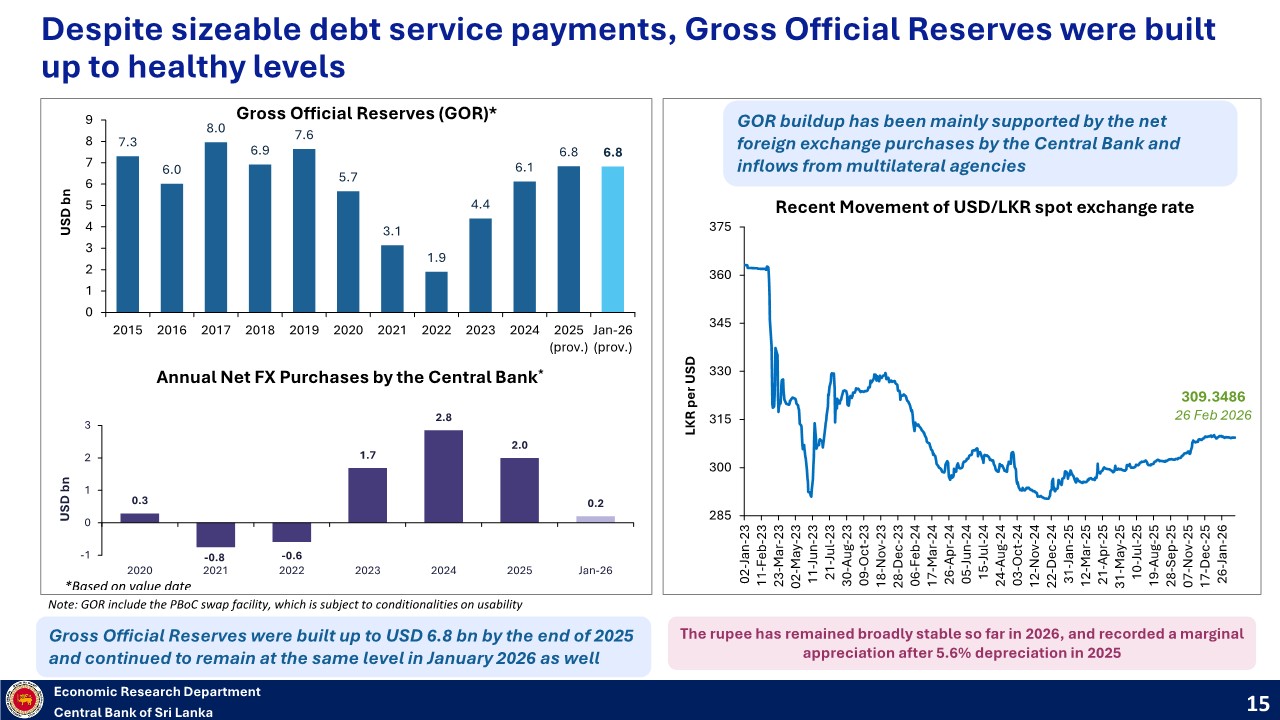
This economic data visualization presents Sri Lanka's financial indicators from 2015 to 2026, highlighting three key metrics: Gross Official Reserves (GOR) shown as bar charts, the Central Bank's annual net foreign exchange purchases, and the USD/LKR exchange rate trend line. The GOR, which represents the country's foreign currency holdings, is primarily supported by the Central Bank's foreign exchange purchases and funding from multilateral institutions. According to the information provided, Sri Lanka's reserves reached USD 6.8 billion by the end of 2025 and remained unchanged in January 2026. The exchange rate data indicates that the Sri Lankan rupee experienced depreciation in 2025 but showed marginal appreciation in 2026, suggesting some stabilization in the currency market during this period. This visualization likely demonstrates the challenges and gradual recovery of Sri Lanka's economic position over this decade-long timeframe.
Read More →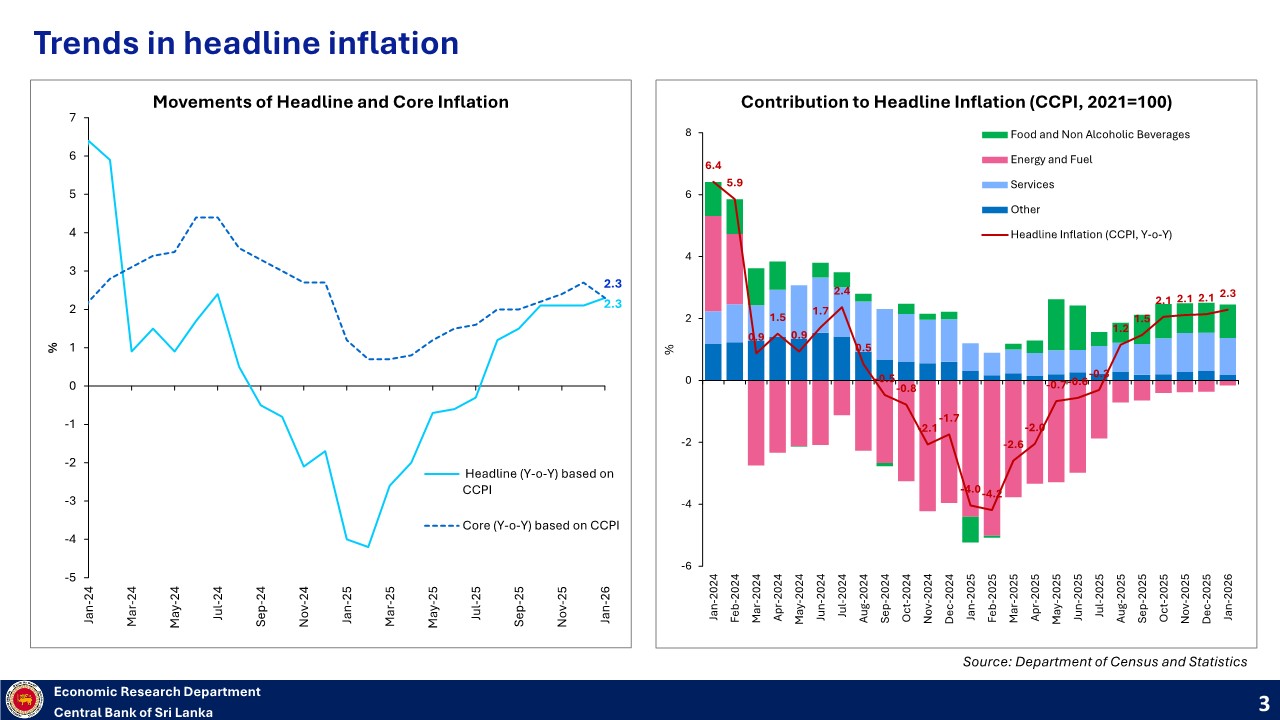
This economic visualization provides a detailed analysis of Sri Lanka's inflation trends through two complementary charts. The left chart, "Movements of Headline and Core Inflation," illustrates the year-on-year percentage changes from 2021 to 2024, showing a dramatic surge in headline inflation peaking around 70% in 2022 before sharply declining, while core inflation followed a similar but less volatile pattern. The right chart, "Contribution to Headline Inflation," uses a stacked bar chart to decompose the inflation rate into its main components—Food and Non-alcoholic beverages, Energy and Fuel, Services, and Other. This breakdown reveals that the 2022 inflation crisis was predominantly driven by massive contributions from the Food and Energy categories, and the subsequent disinflation is largely attributable to the easing of these specific pressures. Sourced from the Central Bank of Sri Lanka, the data effectively visualizes the causes and evolution of the country's recent inflationary episode.
Read More →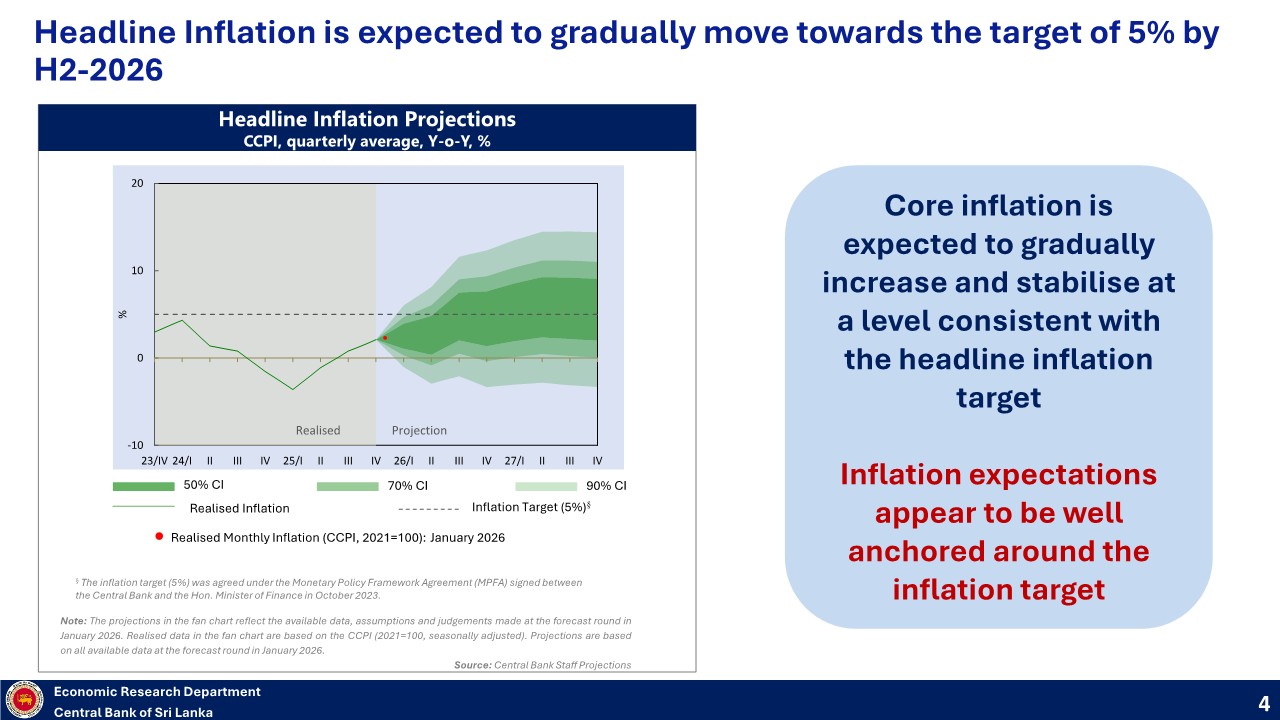
This visualization presents Sri Lanka's inflation projections from the Central Bank, showing that headline inflation is expected to gradually move toward the target of 5% by the second half of 2026. The left side displays a line graph of "Headline Inflation Projections" with CCPI (Colombo Consumer Price Index) quarterly average year-on-year inflation rates, distinguishing between realized historical data and future projections with multiple confidence intervals (50%, 70%, and 90%). The graph also includes a line for core inflation and a horizontal reference line at the 5% target level. On the right side, a blue text box explains that core inflation is expected to gradually move toward the target and that inflation expectations remain anchored to this target. This visualization appears to be part of the Central Bank of Sri Lanka's forward-looking monetary policy communication, showing their forecast for inflation to stabilize at the target rate by mid-2026.
Read More →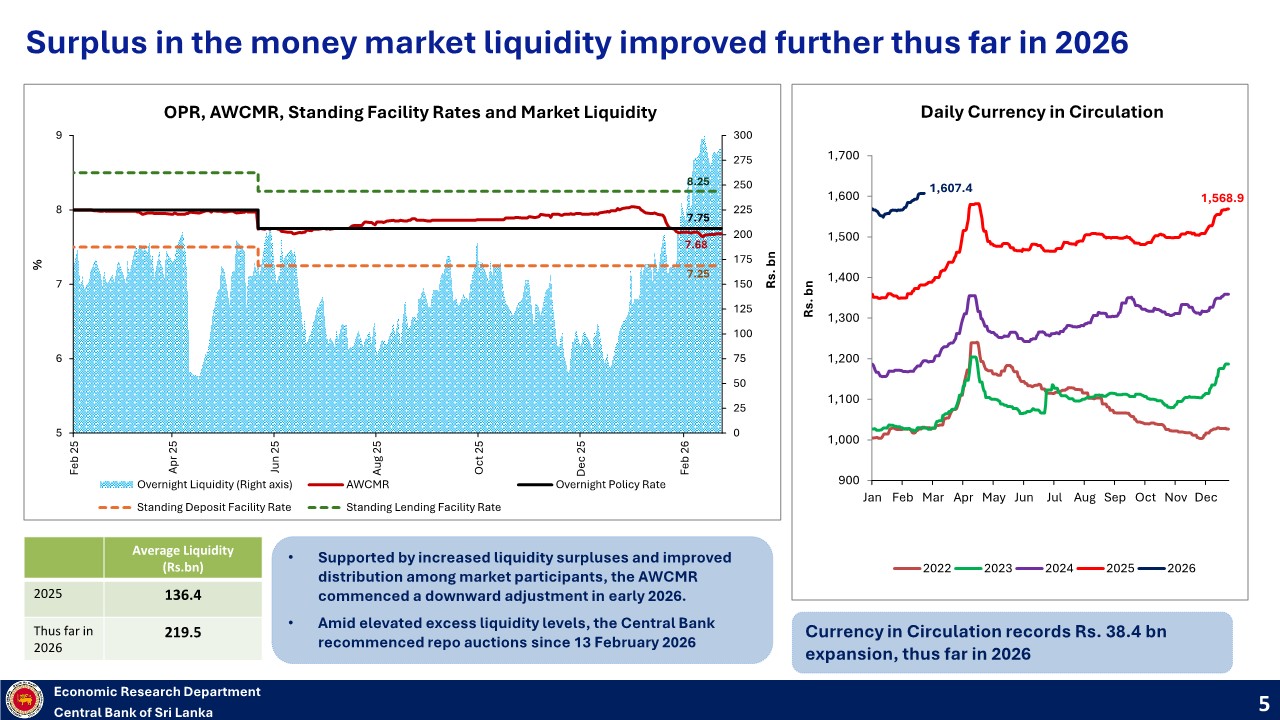
This visualization presents Sri Lanka's monetary market liquidity situation in 2026 through two complementary charts and supporting data. The left chart displays the relationship between various policy rates (OPR, AWCMR, Standing Facility Rates) and market liquidity, with overnight liquidity represented in blue, while the right chart shows the daily currency in circulation patterns across different years. The data table reveals a significant increase in market liquidity, rising from an average of 136.4 billion rupees in 2025 to 219.5 billion rupees in 2026 so far. According to the accompanying text, this growing liquidity surplus has prompted policy adjustments, including the central bank's decision to restart repo auctions to manage the excess liquidity in the financial system. This visualization effectively illustrates how Sri Lanka's monetary authorities are responding to changing liquidity conditions in the banking sector..
Read More →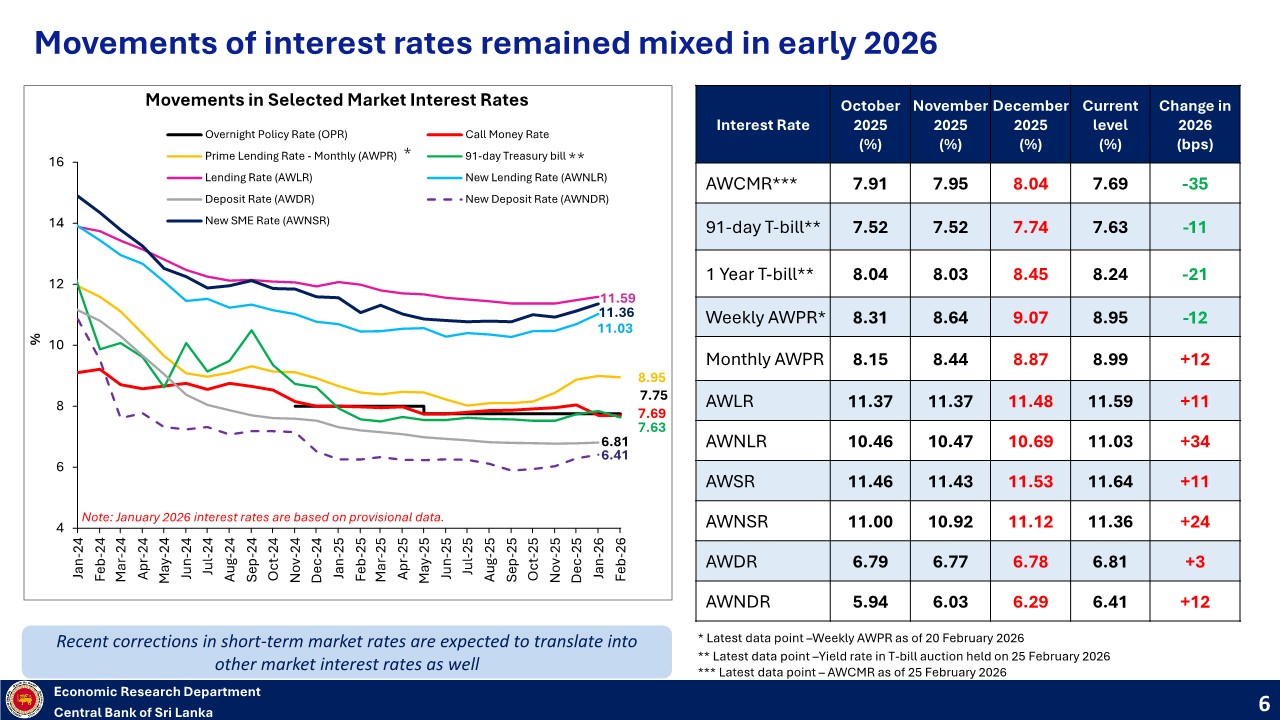
This visualization from the Central Bank of Sri Lanka presents market interest rate movements in early 2026 through a combination of a line chart and data table. The left side displays a line chart titled "Movements in Selected Market Interest Rates" that tracks the trends of various rates including the Overnight Policy Rate and Call Money Rate over time. Complementing this, the right side features a detailed table that compares multiple interest rates such as AWCMR and 91-day T-bill across three time periods: October-December 2025, current levels, and 2026 changes. The visualization effectively illustrates the mixed characteristics of early interest rate fluctuations, providing stakeholders with a comprehensive view of how different market rates have evolved during this period, which is crucial for understanding the monetary policy direction and market conditions in Sri Lanka.
Read More →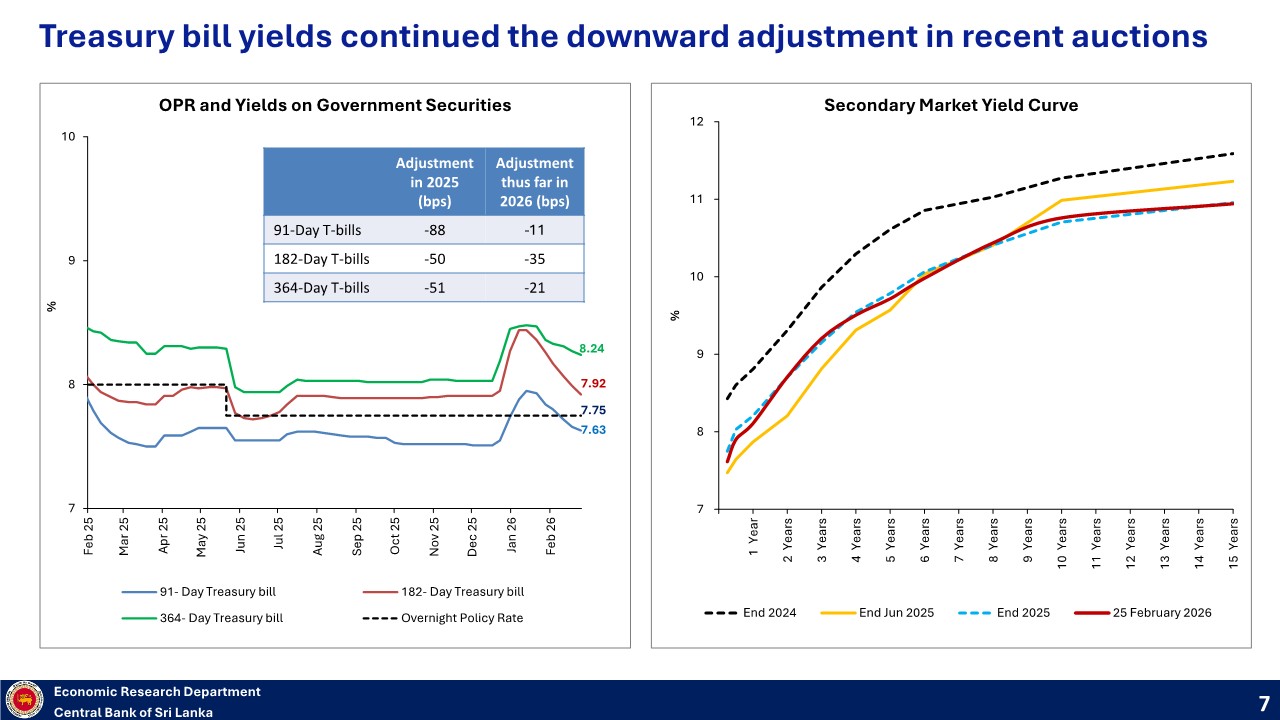
This visualization from the Central Bank of Sri Lanka's Economic Research Department illustrates that treasury bill yields continued their downward adjustment in recent auctions. The left chart, titled "OPR and Yields on Government Securities," displays the yields for 91-day, 182-day, and 364-day treasury bills (represented by blue, red, and green lines) in relation to the Overnight Policy Rate (shown as a black dashed line), with an accompanying table detailing the specific basis point adjustments in 2025 and 2026. The right chart, "Secondary Market Yield Curve," complements this by showing the evolution of the entire yield curve at different points in time, providing a comprehensive view of the downward trend in government borrowing costs.
Read More →
This visualization from Sri Lanka's financial sector illustrates the trends in banking rates, specifically focusing on the Average Weighted Prime Rate (AWPR) and Average Weighted Call Money Rate (AWCMR). The image features two main charts: the left side displays a "Weekly AWPR and AWCMR" line chart showing the relationship between these rates and their spread over time, while the right side presents a "Bank-wise Weekly AWPR" chart that likely compares AWPR across different banks. The title indicates that despite recent declines, the AWPR experienced volatility in early 2026. A central table provides monthly AWPR data, showing adjustments such as a +12 basis point change from January to December 2024, with the end period Monthly AWPR at 8.99%. This visualization effectively captures the fluctuating nature of Sri Lanka's banking rates during this period, highlighting both the overall declining trend and the short-term volatility in the early part of 2026.
Read More →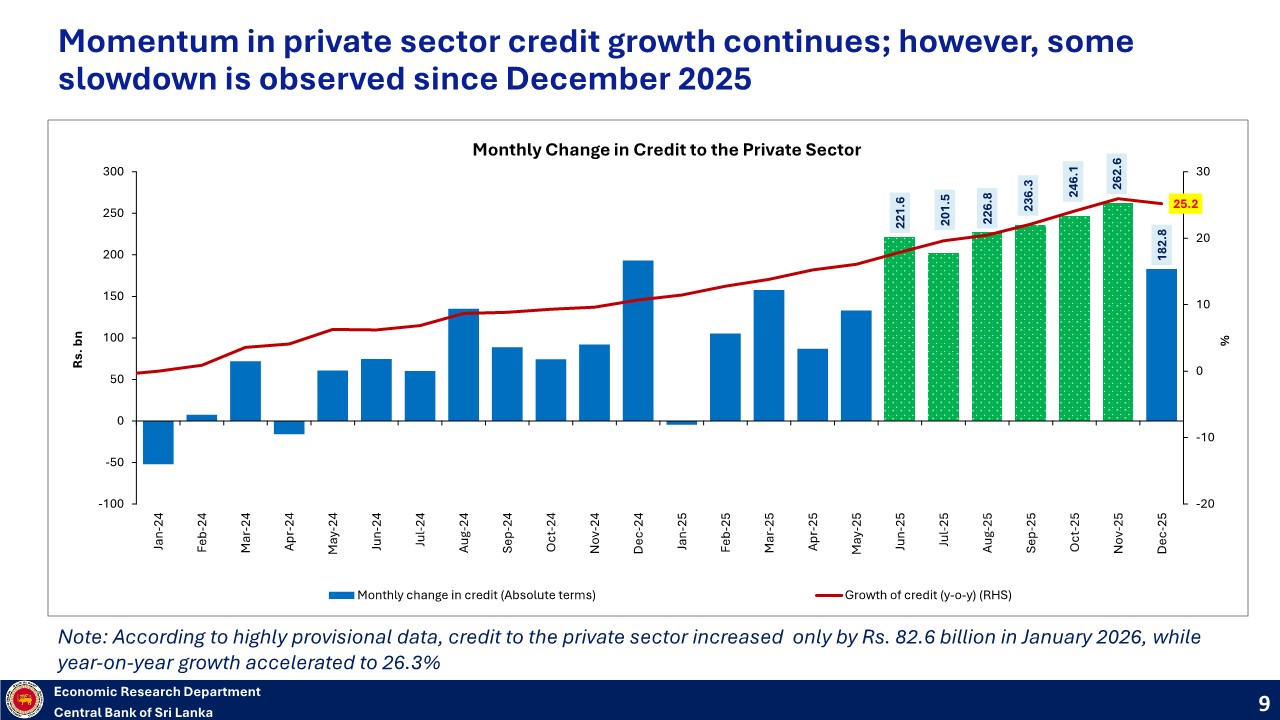
This visualization illustrates the trends in Sri Lanka's private sector credit growth, displaying both monthly changes and year-on-year growth rates. The blue bars represent the monthly credit changes measured in billions of rupees, while the red line tracks the year-on-year growth rate percentage. According to the title, while momentum in private sector credit growth continues, there has been a noticeable slowdown since December 2025. The data specifically notes that in January 2026, private sector credit increased by 8.26 billion rupees with a year-on-year growth rate of 26.3%. This dual representation of absolute changes and percentage growth provides a comprehensive view of the credit market's trajectory, highlighting both the continued expansion of credit to the private sector and the emerging moderation in growth pace as the new year begins.
Read More →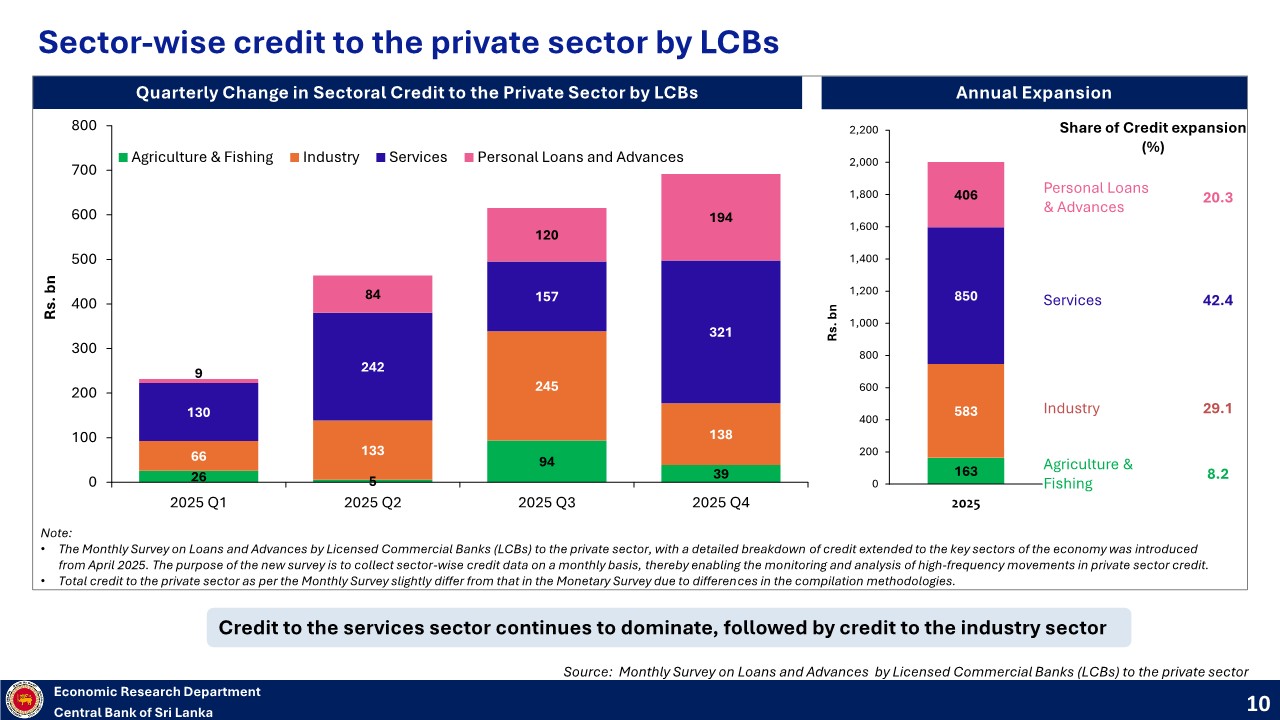
This visualization illustrates the sectoral distribution of credit to the private sector by Licensed Commercial Banks (LCBs) in Sri Lanka, presented through two complementary components. The left section displays quarterly changes in sectoral credit throughout 2025 (Q1-Q4), using colored bar charts to represent different economic sectors measured in billions of rupees. The right section shows the annual expansion percentages for 2025, revealing that the services sector dominates with 850 billion rupees (42.4% share), followed by the industrial sector at 583 billion rupees (29.1% share). The visualization clearly demonstrates that services credit maintains its leading position in the private sector lending portfolio, with industry as the second-largest recipient, while also showing the quarterly flow of credit to various sectors including agriculture and personal loans throughout the year.
Read More →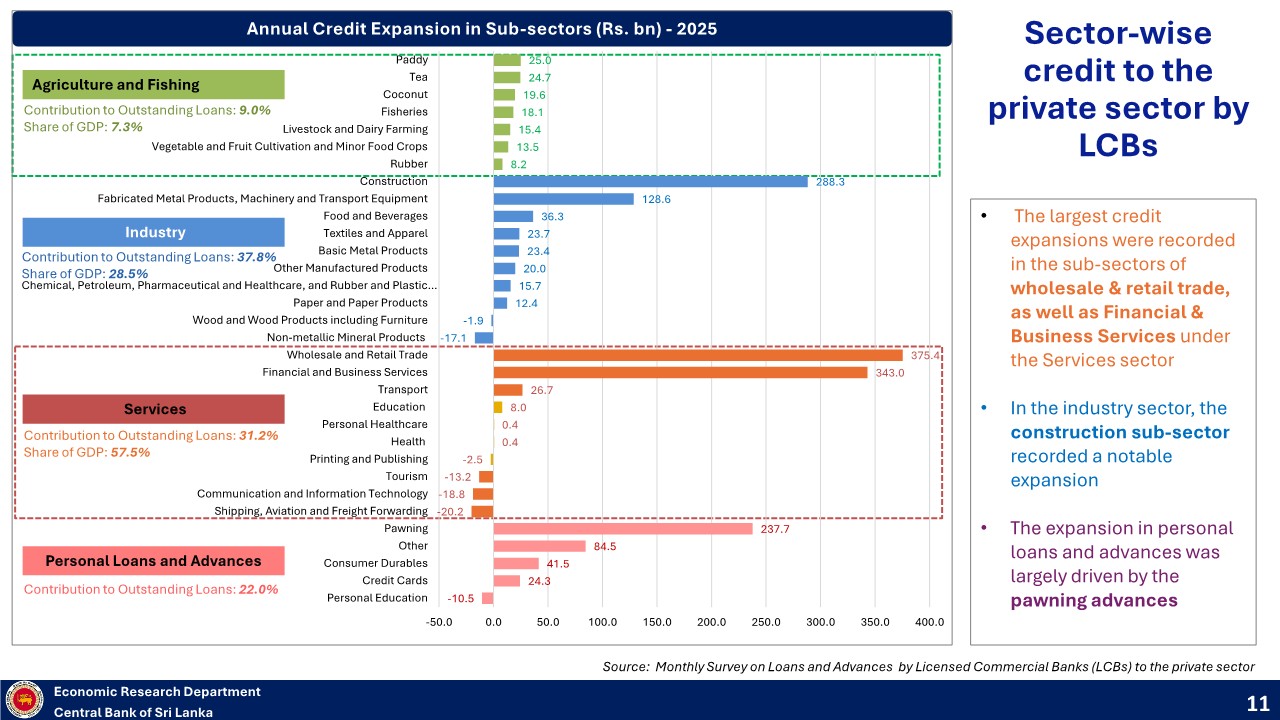
This visualization presents a detailed breakdown of Sri Lanka's annual credit expansion across various sub-sectors in 2025, measured in billions of rupees. The chart displays credit distribution across major economic categories including agriculture and fishing, industry, services, and personal loans and advances, with specific amounts highlighted for key sub-sectors such as wholesale and retail trade (375.4 billion rupees) and financial services (343.0 billion rupees). According to the explanatory text on the right side, the credit expansion was primarily concentrated in wholesale and retail trade along with financial business services, while within the industrial sector, the construction sub-sector demonstrated particularly significant expansion. The data also indicates that personal loans were predominantly driven by pawn shop lending. This comprehensive breakdown, sourced from the Central Bank of Sri Lanka's Economic Research Department survey report, provides valuable insights into which economic segments received the most credit support during 2025.
Read More →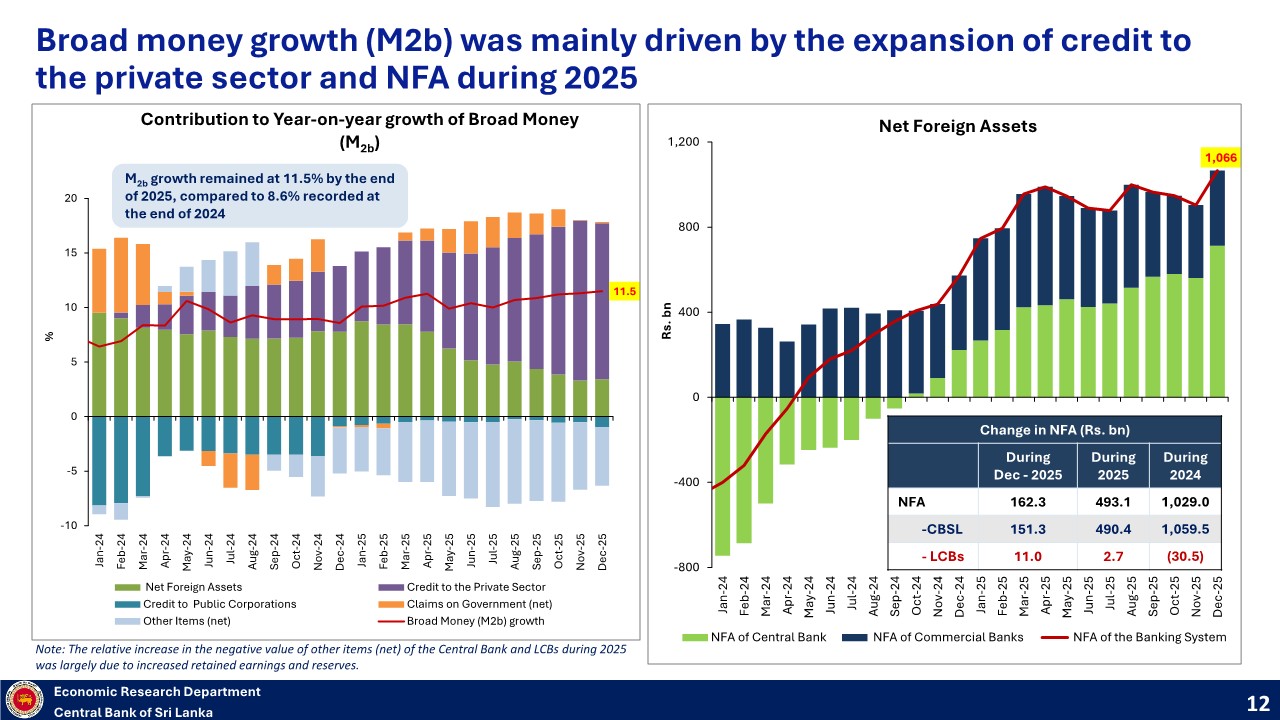
The visualization presents a two-part financial analysis for the year 2025. The left chart, titled "Contribution to Year-on-year growth of Broad Money (M2b)," illustrates the various factors that contributed to a significant 11.5% year-end growth in M2b. On the right, the focus shifts to "Net Foreign Assets" (NFA), displaying both a trend graph and a detailed table below it. This table provides specific numerical changes in NFA, breaking it down into components such as NFA, -CBSL (likely the Central Bank), and -LCBs (likely Licensed Commercial Banks), with comparative data for December 2025, the full year 2025, and the previous year, noting a total NFA of 49.31 billion for 2025. Collectively, the document links the expansion of the money supply to fluctuations in foreign assets, offering a comprehensive snapshot of the country's financial position during that period.
Read More →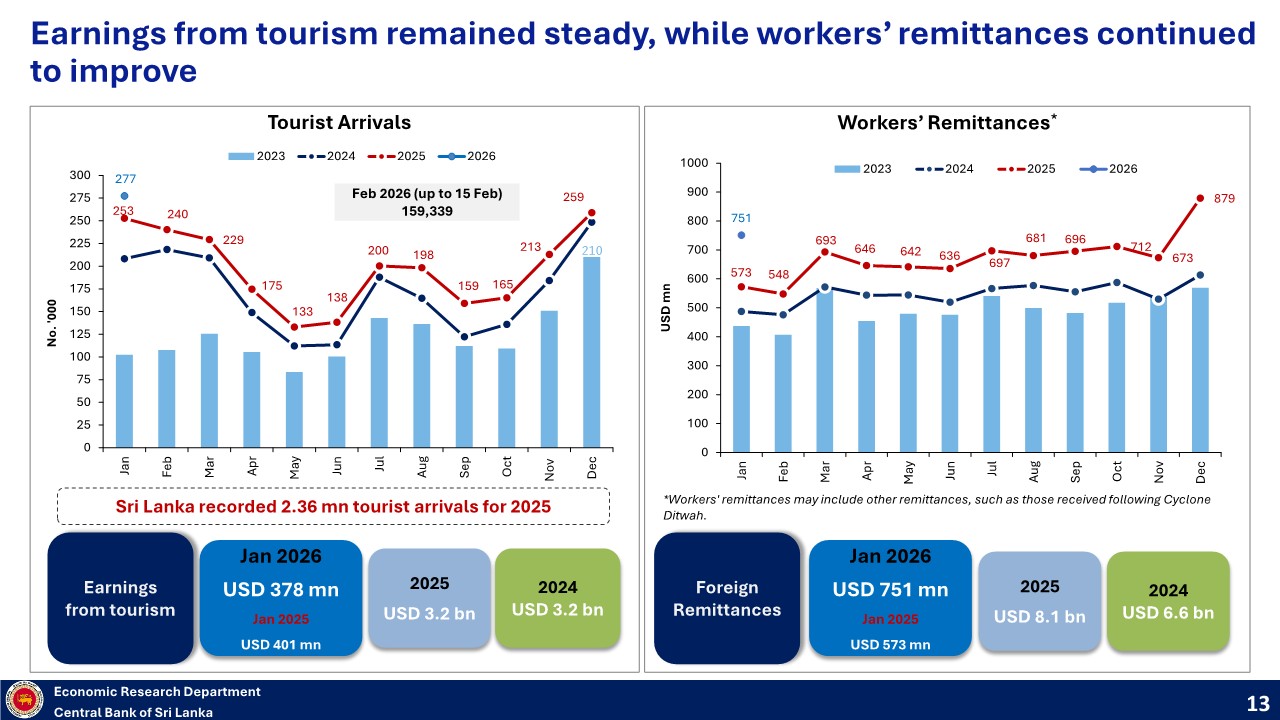
This document illustrates the annual trends and financial contributions of Sri Lanka's tourism sector and workers' remittances. The left chart, "Tourist Arrivals," tracks monthly visitors from 2023 to 2026, highlighting a total of 2.36 million arrivals in 2025, which generated $3.2 billion in revenue for that year. In contrast, the right chart on "Workers' Remittances" depicts a more substantial economic inflow, with a significantly larger total of $8.1 billion in 2025. The data panels at the bottom provide a snapshot for January 2026, showing tourism earnings of $378 million, while remittances for the same period nearly doubled that figure at $751 million. Overall, the document demonstrates that while tourism provides a stable and steady income stream, workers' remittances are a far larger and consistently improving financial pillar for the Sri Lankan economy.
Read More →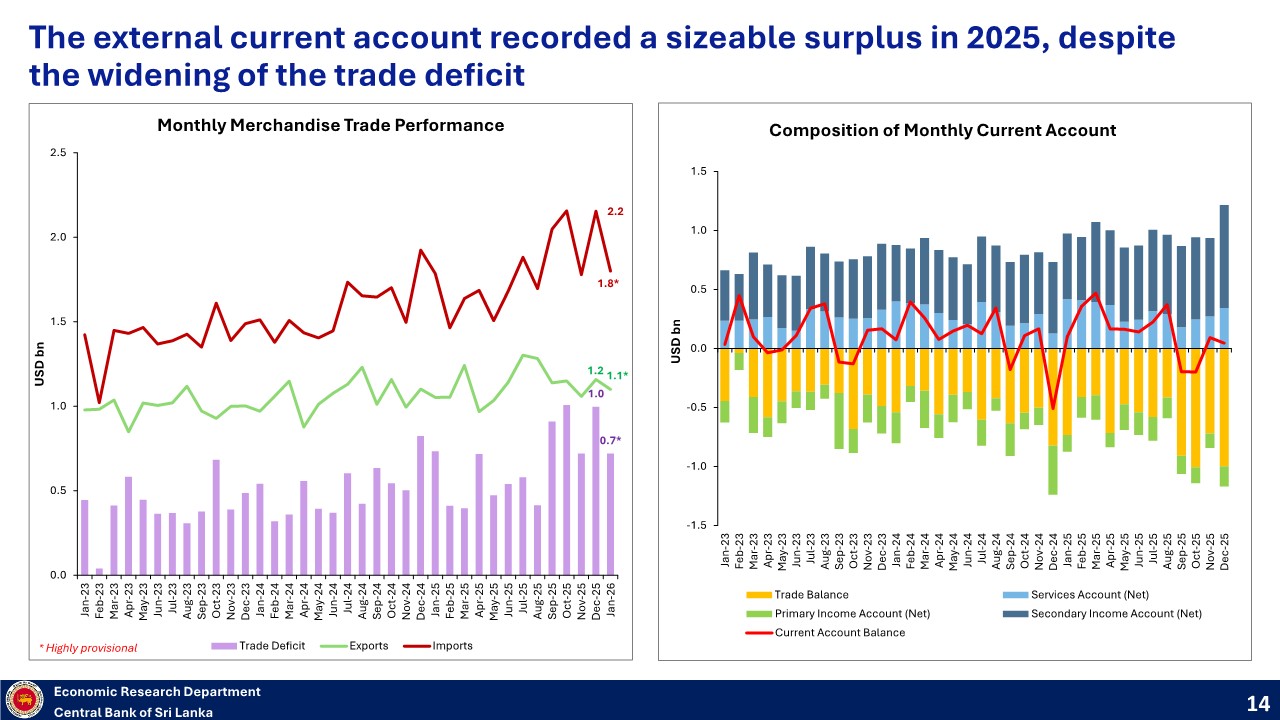
This document presents a compelling economic narrative for 2025, where a sizeable external current account surplus was achieved despite a widening trade deficit. The left chart, "Monthly Merchandise Trade Performance," illustrates the challenge by showing a growing gap between imports (red line) and exports (green line), resulting in a significant trade deficit (purple bars), marked as "highly provisional" with a figure like 1.8*. However, the right chart, "Composition of Monthly Current Account," resolves this paradox by breaking down the current account's components. It reveals that strong surpluses in other areas, particularly the services account (indicated by figures like 1.2), were substantial enough to not only offset the merchandise trade shortfall but also generate an overall surplus for the year. Ultimately, the visual data demonstrates that the strength of the service sector and other non-trade inflows were the key drivers of the positive current account balance, compensating for the deficit in goods trading.
Read More →
This table forecasts a two-stage evolution for Sri Lanka's Treasury bill yields. Initially, for January 2025, a significant and uniform easing is expected across all maturities, with projected cuts ranging from 50 to 88 basis points. The outlook then shifts for January 2026, where the trend diverges sharply: the 91-day bill is projected to reverse course with a 10 bps increase, while the longer 182-day and 364-day bills are expected to continue their decline, albeit at a much slower pace. This indicates a transition from a broad period of monetary easing to a stabilization phase where short-term rates begin to firm up even as longer-term rates remain under pressure.
Read More →
This table provides a forecast of the anticipated yield adjustments for Sri Lanka's Treasury bills across three different maturities. For January 2025, a significant easing is projected, with yields for the 91-day, 182-day, and 364-day bills expected to drop by 88, 50, and 51 basis points respectively. Looking ahead to January 2026, the trend diverges; the shortest-term 91-day bill is anticipated to see a modest increase of 10 bps, while its longer-term counterparts, the 182-day and 364-day bills, are forecast to continue their decline, albeit much more slowly at 1 bps and 9 bps. Overall, the table projects a clear two-phase trajectory: an initial period of substantial rate cuts followed by a stabilization phase where short-term rates begin to rise while longer-term rates continue to flatten or ease slightly.
Read More →
This table outlines the projected adjustments, measured in basis points (bps), for the yields of Sri Lanka's Treasury bills across three different maturities for two future dates. For January 2025, it forecasts a significant and uniform decrease in yields, with the 91-day, 182-day, and 364-day bills expected to fall by 88, 50, and 51 bps respectively. However, the outlook for January 2026 shows a diverging trend: the shortest-term 91-day bill is projected to reverse direction and increase by 10 bps, while the longer-term 182-day and 364-day bills are expected to continue their decline, though at a much slower pace of 1 bps and 9 bps. In essence, the table illustrates a two-stage path where an initial period of substantial rate cuts is followed by a stabilization phase where short-term rates begin to rise as longer-term rates continue to ease or flatten.
Read More →
This table details the projected changes, measured in basis points (bps), for the yields of Sri Lanka's Treasury bills across three maturities for two future dates. For January 2025, it anticipates a significant and uniform decrease in yields, with the 91-day, 182-day, and 364-day bills expected to fall by 88, 50, and 51 bps respectively. However, the forecast for January 2026 shows a diverging trend: the shortest-term 91-day bill is projected to reverse direction and increase by 10 bps, while the longer-term 182-day and 364-day bills are expected to continue their decline, though at a much slower pace of 1 bps and 9 bps. In essence, the table illustrates a two-stage path where an initial period of substantial rate cuts is followed by a stabilization phase where short-term rates begin to rise as longer-term rates continue to ease or flatten.
Read More →
This illustrates the recent upward trend in Sri Lanka's market interest rates by combining a trend chart with a data table. The left chart, "Movements in Selected Market Interest Rates," visually displays the trajectory of various rates over time. The right table provides the specific numerical evidence to support this trend, showing that key rates like the 91-day Treasury bill and the AWCMR (Weighted Average Short-term Money Market Rate) were higher in January 2026 than their lowest points in 2025. For instance, the table quantifies this increase, confirming that despite reaching lower levels during 2025, these rates have risen in recent months, validating the title's assertion that "Some increase in market interest rates was observed in recent months.
Read More →
This illustrates that Sri Lanka's money market is operating with a surplus of liquidity. The left chart, "OPR, AWCMR, Standing Facility Rates and Market Liquidity," visualizes this surplus with the blue-shaded area representing overnight liquidity consistently above zero. It also shows that the AWCMR (red line), which was above the Overnight Policy Rate (OPR, black line) in the latter half of 2025, moderated and moved closer to the OPR in early 2026. The right chart, "Daily Currency in Circulation," displays the cyclical nature of cash demand, which peaks during holidays and then sharply declines. The accompanying text clarifies this pattern, noting that approximately LKR 260 billion returned to the banking system following the festive season. Together, these elements confirm that despite temporary cash withdrawals, the overall banking system remains well-supplied with funds.
Read More →
This chart presents the Central Bank of Sri Lanka's official inflation forecast. The main title states that headline inflation is projected to accelerate gradually and reach the 5% target by the second half of 2026. The "Headline Inflation Projections" line graph visualizes this by showing past "Realised Inflation" and future "Projection" periods, with shaded bands representing the 50%, 70%, and 90% confidence intervals to indicate the uncertainty in the forecast. The text on the right explains that this expected rise is driven by growing economic demand, while importantly, inflation expectations are becoming firmly anchored around the 5% target. This forecast is based on the Central Bank's staff projections from the January 2026 monetary policy meeting.
Read More →
This presents two charts detailing Sri Lanka's inflation dynamics. The left chart, "Movements of Headline and Core Inflation," tracks the trend of both overall consumer price changes (headline) and underlying inflation (core) over time. The right chart, "Contribution to Headline Inflation," breaks down the specific components driving the overall inflation rate. The most prominent piece of data is that headline inflation was recorded at a low 2.1% in December 2025. An explanatory note clarifies that this figure was influenced by rising food prices, which were attributed to two main factors: supply chain disruptions caused by Cyclone Ditwah and a seasonal increase in demand during the festive period.
Read More →
This image presents a dashboard of four leading economic indicators from Sri Lanka's Central Bank, designed to illustrate the economy's resilience. Titled "Despite the slowdown in economic activity following the Cyclone, leading indicators reflect greater resilience," it displays data from 2022 to 2025 for the PMI (Purchasing Managers' Index) of Manufacturing, Services, and Construction, as well as the Industrial Production Index. Each chart uses lines or bars to show the performance trends, with specific high values like a 60.9 PMI for Manufacturing in December 2025, indicating strong sectoral expansion. Collectively, these charts provide evidence that even after a disruptive cyclone, Sri Lanka's core economic activities demonstrated significant strength and a quick recovery.
Read More →
This presents a chart detailing the Sri Lankan Central Bank's key policy interest rates. It tracks three specific rates over time: the Standing Lending Facility Rate, the Standing Deposit Facility Rate, and the most important one, the Overnight Policy Rate (OPR). The central message conveyed is that the Central Bank held the OPR unchanged at 7.75% following its meeting on January 27, 2026. The rationale for this decision, as noted in the accompanying text, is the Board's belief that the current monetary policy is appropriately calibrated to guide inflation towards the 5% target.
Read More →
This illustrates the strengthening of Sri Lanka's external financial position, highlighting key indicators of stability. The "Gross Official Reserves (GOR)" chart shows a positive trajectory, with reserves forecast to reach $6.8 billion in 2025. This build-up is explicitly attributed to two main drivers: the Central Bank's significant net foreign exchange purchases, which amounted to $2.8 billion in 2024, and inflows from multilateral institutions. Consequently, the USD/LKR exchange rate chart demonstrates that the Sri Lankan Rupee has remained stable, with a projected rate of approximately 309.5 per dollar in early 2026, underscoring the success of these measures in bolstering the country's foreign exchange buffers.
Read More →
This illustrates the performance of two key foreign income sources for Sri Lanka. The left chart, "Tourist Arrivals," shows monthly data from 2022 to 2025, indicating that tourism remained steady with the country recording 2.36 million tourist arrivals in 2025. The right chart, "Workers’ Remittances," displays a clear upward trend, with remittances growing from USD 6.6 billion in 2024 to a stronger USD 8.1 billion in 2025. As summarized by the title, the data presents a dual economic story: stable earnings from tourism alongside a significant and continuing improvement in foreign remittances from overseas workers.
Read More →
The document presents two charts from Sri Lanka's Central Bank that together explain the country's external economic outlook. The left chart, "Monthly Merchandise Trade Performance," visualizes a widening trade deficit from 2023 to 2025 using bars, while lines show the values for both exports and imports. The right chart, "Composition of Monthly Current Account," breaks down the various components of the current account, such as services and remittances. The key takeaway from these charts is the paradoxical yet positive projection that despite the growing deficit in merchandise trade, Sri Lanka's overall current account is expected to achieve a considerable surplus in 2025, indicating that other non-trade sectors are performing strongly enough to more than compensate for the trade imbalance.
Read More →
Cyclone Ditwah, which occurred from 27 to 30 November 2025, caused widespread flooding, landslides, and major disruptions across all 25 districts of the country. The disaster affected approximately 490,385 families, involving 1,702,719 persons, and resulted in 643 deaths and 183 people reported missing. Housing damage was significant, with 6,228 houses fully damaged and 101,055 houses partially damaged. The most severely affected sectors included transport infrastructure, telecommunication and electricity services, as well as the food and beverages sector. The cyclone is expected to create near-term inflationary pressures, alongside spillover effects from increased government spending, with possible adverse impacts on the balance of payments (BOP) and GDP growth. However, most affected services have since been partially or fully restored.
Read More →
All sectors recorded positive growth in the third quarter of 2025, marking the ninth consecutive quarter of sustained economic expansion. After a period of subdued performance, agricultural activities rebounded and expanded in both the second and third quarters of 2025. The main contributors to growth in Q3 2025 were construction, financial services, food, beverages and tobacco, and textiles, apparel, leather and related manufacturing. As a result, real GDP grew by 5.4 percent during the quarter, indicating that the economy continues to maintain a strong and positive growth momentum.
Read More →
Headline inflation returned to positive territory in August 2025 and continued to rise thereafter. Inflation movements during the period were mainly driven by changes in food and non-alcoholic beverages, energy and fuel prices, services, and other components of the consumer basket. Overall, both headline and core inflation exhibited a clear upward trend throughout 2025.
Read More →
The monetary policy stance remains accommodative, with the Overnight Policy Rate (OPR) maintained unchanged at the latest monetary policy review. Since June 2023, policy rates have been reduced by approximately 800 basis points, reflecting sustained monetary easing. Meanwhile, the Standing Deposit Facility Rate and the Standing Lending Facility Rate have continued to remain aligned within the established policy rate corridor.
Read More →
In the government securities market, Treasury bill yields remained broadly unchanged as the government utilised available internal buffers for financing. Yield movements indicate a significant decline in 2024, followed by more moderate reductions in 2025 year-to-date, with the 91-day, 182-day, and 364-day Treasury bill yields decreasing by 5.9, 5.4, and 4.0 percentage points in 2024, and by 1.1, 0.9, and 0.9 percentage points, respectively, in 2025. Consistent with these developments, the secondary market yield curve reflects easing across maturities.
Read More →
Domestic credit developments indicate strong expansion, driven primarily by sustained growth in credit to the private sector. Monthly movements in domestic credit during the year were largely influenced by private sector borrowing, while net credit to the government declined. During the period from January to October 2025, domestic credit expanded by Rs. 1,449.7 billion, with private sector credit increasing by Rs. 1,610.7 billion and net credit to the government recording a contraction of Rs. 91.2 billion. As a result, the domestic credit-to-GDP ratio stood at 62.8 percent.
Read More →
Sectoral credit to the private sector has recorded broad-based expansion across all major economic sectors. With the introduction of the Monthly Survey on Loans and Advances by Licensed Commercial Banks from April 2025, credit growth has been observed in agriculture and fishing, industry, services, as well as personal loans and advances. During the period from April to October 2025, total private sector credit expanded by a provisional amount of Rs. 1,325 billion, reflecting widespread recovery in economic activity.
Read More →
Net credit to the government has recently declined, primarily driven by reductions in credit from commercial banks, while Central Bank credit has remained relatively stable. Monthly data throughout 2025 indicate a consistent downward trend in net credit to the government.
Read More →
Tourism and remittances have shown notable developments in 2025. Tourism earnings reached USD 2.9 billion from January to November, slightly below the USD 3.2 billion recorded in 2024, while the country surpassed two million tourist arrivals during the year. In contrast, workers’ remittances increased to USD 7.2 billion over the same period, up from USD 6.6 billion in 2024, providing a significant boost to foreign exchange inflows.
Read More →
Sri Lanka’s reserves and exchange rate developments in 2025 show relative stability. Gross Official Reserves (GOR) were maintained around USD 6 billion, supported by net foreign exchange purchases by the Central Bank of Sri Lanka. The USD/LKR exchange rate depreciated by 5.5 percent during the year, following a 10.7 percent appreciation in 2024. Additionally, Sri Lanka is expected to receive USD 200 million under the IMF’s Rapid Financing Instrument, approved in December 2025.
Read More →
Fiscal balances showed improvement in 2025, driven by revenue-based consolidation measures. Provisional data for January to October indicate a budget deficit of Rs. 456 billion, alongside a primary surplus of Rs. 1,629 billion and a current account surplus of Rs. 112 billion. Tax revenue increased by 34.4 percent, while non-tax revenue rose by 18.6 percent. Government expenditure grew by 11.0 percent, with interest payments increasing by 10.2 percent over the same period.
Read More →Economics and Financial Insights

Colombo Port starts 2026 strong as transshipment surges 15%
The Port of Colombo kicked off 2026 with robust performance metrics, driven by a significant expansion in its core transshipment business and the successful scaling of new deep-water terminal capacity.
Read More →
Pyramid schemes: CBSL declares 24 entities prohibited
The Central Bank of Sri Lanka has determined that I.C.A.N Advertising (Pvt.) Ltd. and its affiliated websites have engaged in a prohibited scheme following an investigation conducted under Section 83C of the Banking Act, No. 30 of 1988.
Read More →
SriLankan Airline bondholders to vote on 85-pct debt restructure in March
ECONOMYNEXT – Holders of defaulted SriLankan Airlines debt are to vote on March 18 on an exchange to government bonds, which can lead to the completion of the process and an improvement in the country's credit profile.
Read More →
Sri Lanka to allow exporters to invest in domestic dollar bonds
ECONOMYNEXT – Sri Lanka's cabinet of ministers has approved submitting to parliament new rules aimed at allowing exporters to invest in domestic dollar-denominated bonds, minister Nalinda Jayatissa said.
Read More →
Overseas Realty records Rs. 9.2bn PBT for Year 2025
Overseas Realty (Ceylon) PLC released the 4th quarter Unaudited Financial Statements for the Year ending 31st December 2025 delivering strong financial performance recording Group Revenue of Rs. 11,944 million, reflecting a 49 percent increase over the previous year and Group Profit Before Tax of Rs 9,266 million.
Read More →
Private borrowings peak at Rs. 262 b in November before Ditwah
Total private sector borrowings in November 2025 peaked to Rs. 262.6 billion, the highest monthly figure yet for 2025, before the devastating Cyclone Ditwah hit the island.
Read More →
UK trade rule shift gives Sri Lanka apparel exporters freer hand on sourcing
A recalibration of Britain’s post-Brexit trade preferences is set to materially alter how Sri Lanka’s exporters, particularly the apparel manufacturers, structure their production and sourcing, highlighting a shift from tariff relief to supply-chain flexibility as the core trade advantage.
Read More →
Chinese firms to invest in dairy farming, export agriculture
Chinese companies are ready to invest in large-scale dairy farming and export-oriented agricultural production in Sri Lanka, with proposals focusing on the use of underutilised State land, according to officials familiar with the discussions.
Read More →
Motor traders push to scrap used vehicle tax break
Sri Lanka’s oldest automotive industry body has stepped up pressure on the government to dismantle what it calls a deeply flawed tax concession on used vehicle imports, warning that the policy is eroding state revenue, distorting competition and undermining foreign exchange discipline.
Read More →
Chinese Foreign Minister Wang Yi expresses optimism that Sri Lanka is on the right path to progress
Minister of Foreign Affairs, Foreign Employment and Tourism Vijitha Herath held productive discussions with his Chinese counterpart Wang Yi today (12/01), during the latter’s brief visit to Sri Lanka.
Read More →
Ceylon Grain Elevators to invest Rs.3bn in Seeduwa poultry processing plant expansion
Ceylon Grain Elevators PLC has announced a strategic investment of Rs.3 billion to expand its chicken processing facility in Seeduwa.
Read More →
LRI and Eighth Wonder acquire 71% stake in Lee Hedges for Rs.3.9bn
Lanka Realty Investments PLC (LRI) and Mauritius-based investment vehicle Eighth Wonder acquired a combined 71 percent stake in Lee Hedges PLC, on January 8, in a major transaction valued at approximately Rs.3.93 billion that has triggered a mandatory offer for the remaining shareholders.
Read More →
Govt. to revive stalled mega developments in Colombo in Q1
The Government yesterday announced plans to restart long-stalled mega mixed-development projects and abandoned high-rise buildings in Colombo by the end of first quarter.
Read More →
Musthapha warns Port City banking amendments risk shadow banking, forex strain
Opposition MP Faiszer Musthapha warned Parliament that amendments to the Colombo Port City Economic Commission Act could create systemic risk, weaken banking regulation, and destabilise the domestic economy if left unchanged.
Read More →
Port City Act amendments: Offshore banks to be operationalised | The Morning
Sri Lankan banks that have been awaiting for the approval from the Central Bank to operate as offshore-banks in the Colombo Port City, will be able to do so once amendments are made to the Colombo Port City Economic Commission Act No. 11 of 2021, Central Bank of Sri Lanka (CBSL) Bank Supervision Department Director R.R.S. De Silva Jayatillake informed the Committee of Public (COPF), on Tuesday (6).
Read More →
WealthTrust Securities to begin trading today
Shares of WealthTrust Securities Limited (WTS), following the completion of its Initial Public Offering (IPO), are set to begin trading today (7) on the Colombo Stock Exchange (CSE) Diri Savi Board under the ticker symbol 'WLTH-N-0000'.
Read More →
Singapore Airlines increases flights to Colombo
Singapore Airlines will commence three daytime flight services between Colombo and Singapore from 6 January 2026, further expanding connectivity between Sri Lanka and the airline's global network.
Read More →
Bill on microfinance issues goes to P'ment
National People's Power (NPP) Parliamentarian Lakshman Nipuna Arachchi announced that a new bill has been submitted to Parliament with the objective of addressing the persistent issues associated with microfinance loans.
Read More →
Durdens Hospital proposes four-for-one share split
Durdens Hospital, or Ceylon Hospitals PLC, yesterday said its Board of Directors has resolved to recommend a subdivision of its ordinary voting and ordinary non-voting shares, subject to regulatory and shareholder approvals.
Read More →
Sri Lanka budget deficit to rise 1.4-pct in 2026 on Cyclone spending
ECONOMYNEXT – Sri Lanka's budget deficit will rise 1.4 percent to 6.5 percent of gross domestic product in 2026 as a result of extra spending related to Cyclone Ditwah relief and recovery, a Finance Ministry document shows.
Read More →
Fixing Sri Lanka's cyclone hit railway tracks to cost over US$330mn :
ECONOMYNEXT – Sri Lanka will have to spend more than 350 million dollars to re-build railway tracks damaged by Cyclone Ditwah, Deputy Minister of Transport Prasanna Gunasena said.
Read More →
FACETS 2026 concludes successfully, showcasing strong international participation and industry confidence
FACETS Sri Lanka 2026, the country's premier international gem and jewellery exhibition, concluded successfully at The Forum, Cinnamon Life – City of Dreams, receiving an overwhelmingly positive response from the stakeholders, exhibitors, international buyers and visitors.
Read More →
Venezuela to export $2 billion worth of oil to US in deal with Washington
HOUSTON/WASHINGTON, Jan 6 (Reuters) - Caracas and Washington have reached a deal to export up to $2 billion worth of Venezuelan crude to the United States, U.S. President Donald Trump said on Tuesday, a flagship negotiation that would divert supplies from China while helping Venezuela avoid deeper oil production cuts.
Read More →
Abnormal trades in new listing spark market halt at Colombo bourse
The Colombo Stock Exchange (CSE) halted trading minutes after the market opened yesterday, cancelling all trades executed during the session.
Read More →
Tea prices close December higher but 2025 underperforms year-on-year
The national tea auction prices edged up in rupee terms in December 2025, even as the dollar returns remained under pressure, amid the currency movements and softer global pricing, the industry data compiled by Forbes & Walker Research showed.
Read More →
SEC, CSE seek faster, cleaner listings through closer advisor collaboration
Sri Lanka's Securities and Exchange Commission (SEC) and the Colombo Stock Exchange (CSE) have stepped up efforts to expedite new listings while tightening the accountability standards for the corporate finance advisors, as the regulators seek to strengthen investor confidence and market integrity.
Read More →
Sri Lanka Customs sets 2026 revenue target at Rs2,207bn, less than last year
ECONOMYNEXT – Sri Lanka Customs has set a revenue target of 2,207 billion rupees for this year, 13.5 percent less than last year as it expects a significant decline in car imports, official data showed.
Read More →
Sri Lanka wants to bring generation costs below Rs25 rupees: Power Minister
ECONOMYNEXT – Sri Lanka's power ministry is planning to bring generation costs to 25 rupees, down from 37 rupees in mid 2025 using competitive bidding, Energy Minister Kumara Jayakoday said.
Read More →
SL's official reserve assets increased to $ 6.82 b
Sri Lanka's official reserve assets have increased by 13.1% to $ 6.825 billion in December 2025, compared to $ 6.034 billion in November 2025, according to the Central Bank of Sri Lanka (CBSL).
Read More →
Hayleys Agriculture partners with Evonik to boost nutritional standards of SL poultry
Hayleys Agriculture Holdings Limited was appointed as the exclusive distributor for Evonik Industries AG's globally recognised specialty nutrient portfolio, marking the first-ever introduction of these advanced animal nutrition solutions to the Sri Lankan poultry industry.
Read More →
CBSL slaps Rs. 9.5 m fine on seven firms for AML/CFT non-compliance
The Central Bank of Sri Lanka (CBSL) yesterday said it has slapped a Rs. 9.5 million combined fine on two non-bank financial institutions (NBFIs), two banks, one casino, and a jewellery company for non-compliance of the provisions of the Financial Transactions Reporting Act (FTRA)..
Read More →
Extended Fund Facility: IMF to disburse $ 350 m
A representative of the International Monetary Fund has announced that Sri Lanka is expected to receive access to approximately $ 350 million, the sixth tranche of the Extended Fund Facility, within two weeks. This pledge comes in the wake of development partners reaffirming their commitment to supporting Sri Lanka during this critical period.
Read More →
Mannar Wind Projects: Two 50MW plants go to two parties
Sri Lanka's Cabinet of Ministers approved the award of contracts for two 50-megawatt wind power plants in Mullikulum, to two parties: the Consortium of Vidullanka PLC and David Pieris Motor Company (Lanka) Limited (DPMC), and WindForce PLC.
Read More →
SL to enter into ADB $ 3Mn grant
The Cabinet of Ministers has granted approval to a proposal to enter into agreements with the Asian Development Bank (ADB) to obtain $ 3 million for ongoing recovery efforts, within its own Asia Pacific Disaster Response Fund..
Read More →
Ditwah recovery aid: UN seeking to mobilise $ 35Mn
The United Nations, along with local and international partners are seeking to mobilise $ 35 million in the next four months to support Sri Lanka's recovery efforts, UN Resident Coordinator in Sri Lanka, Marc-Andre Franche stated.
Read More →
MSMEs offered 3-year loans
Sri Lanka is to introduce loan schemes for Micro, Small and Medium Enterprises, between Rs. 250,000 and Rs. 1,000,000 for a period of three years, at a 3% interest rate, in an effort to rebuild businesses within the segment that have been affected by adverse effects of cyclone Ditwah, a Cabinet decision released yesterday by the Government said.
Read More →
SEC defers Colombo Dockyard suspension as India's Mazagon Dock set for takeover
Colombo Dockyard PLC has secured a critical six-month extension on the trading of its shares, averting an immediate suspension as it finalises a strategic takeover by India's Mazagon Dock Shipbuilders Limited.
Read More →
Cargills Bank to raise Rs. 2.5Bn via Rights to fuel lending growth
Cargills Bank PLC has announced plans to raise approximately Rs. 2.5Bn through a Rights Issue to expand its lending activities and strengthen the capital base. The Board of Directors resolved on December 9, 2025, to recommend the issue of up to 294,200,000 new ordinary voting shares at a price of Rs. 8.50 per share.
Read More →
Govt. to secure US$ 200Mn ADB loan for Mahaweli Water Security Investment Programme
The Cabinet of Ministers this week approved a proposal to enter into a loan agreement with the Asian Development Bank to secure US$ 200Mn for the implementation of the second stage of the Mahaweli Water Security Investment Programme.
Read More →
Govt. to retender prime Colombo 03 land following lease cancellation
The Cabinet of Ministers this week approved a proposal to invite fresh investment proposals for a high-value land plot at Perahera Mawatha, Kollupitiya, following the cancellation of a previous lease agreement due to non-compliance.
Read More →
BYD dominates EV space with top-notch technology & global expansion
In recent years, the worldwide shift to electric vehicles has been one of the most prominent trends in the automobile industry. Environmental factors have driven the growth of zero-emission vehicle technology, and the popularity of cleaner and more environmentally friendly electric vehicles and plug-in hybrid electric vehicles has increased.
Read More →
Disney to invest $1 Bn in OpenAI, license characters for Sora video tool
Walt Disney, opens new tab is investing $1 Bn in OpenAI and will let the startup use characters from Star Wars, Pixar and Marvel franchises in its Sora AI video generator, a deal that could reshape how Hollywood makes content.
Read More →
Apparel exports up 5.42% in first 11 months despite slight dip in November
Sri Lanka's apparel industry has delivered a robust performance during the first 11 months of 2025, with cumulative exports reaching $ 4,571.99 million, marking a 5.42% increase over the same period last year, according to data released yesterday by the Joint Apparel Association Forum (JAAF).
Read More →
IMF sees reserves up 7% in 2025 to $ 6.5 b; current account to turn deficit in 2026
The International Monetary Fund (IMF) has projected Sri Lanka's gross official reserves to grow 7% year-on-year (YoY) to $ 6.55 billion by end-2025, suggesting a year of incremental reserve accumulation rather than a step change, with materially stronger buffers only emerging over the medium term amid continued near-term pressure on the current account.
Read More →
Sri Lanka tourist arrivals exceed 2018 level
ECONOMYNEXT - Sri Lanka's tourist arrivals exceeded the previous high reached in 2018 with Indian visitors being feted for taking the country over the threshold, but the island nation is on track to fall short of the 3 million target set for 2025.
Read More →
Govt. seeks China's support for EV charging network, rail repairs
Foreign Affairs Minister Vijitha Herath yesterday said that Sri Lanka has proposed the establishment of electric vehicle (EV) charging stations across the country, as part of broader discussions with China on post-disaster assistance and infrastructure cooperation.
Read More →
Domestic cargo growth lifts Colombo Port volumes
Total container volumes handled by the Colombo Port rose 7.1% year-on-year (YoY) to 6.92 million Twenty-foot Equivalent Units (TEUs) in the first 10 months of 2025, supported by a strong expansion in domestic container traffic, even as transhipment activity continued to account for the bulk of throughput and remain central to Colombo's regional hub role, data released by the Central Bank of Sri Lanka (CBSL) showed.
Read More →
Active credit cards cross 2.13 m by October; balances edge up to Rs. 166.9 b
Sri Lanka's active credit card base continued to expand through October 2025, while outstanding balances also recorded a modest increase, according to the latest data released by the Central Bank of Sri Lanka (CBSL).
Read More →
WTS Rs. 500 m IPO oversubscribed by 14.9 times
The WealthTrust Securities Ltd., (WTS) Rs. 500 million Initial Public Offering (IPO) has attracted Rs. 7.5 billion worth applications, amounting to a 14.9 times level of oversubscription.
Read More →OPA OFFICE BEARERS
Mr. Jayantha Gallehewa (President)
Mr. Tisara De Silva (President-Elect)
Eng. Ravi Rupasinghe (Gen. Secretary)
Mr. Dharshana Wijemanne (Treasurer)
Mr. Sujeewa Lal Dahanayake (IPP)
Dr. Naresha B. Samarasekera (VP)
Eng. Chamil Edirimuni (VP)
Mr. Bhanu Wijayaratne (VP)
Mr. V. Rameshkumar (VP)
Mr. Priyantha Sahabandu (VP)
Mr. P. Gajendra (VP)
Dr. Sunil Abeyaratne (VP)
Dr. C.S. Dharmaratne (VP)
Mr. Chandrasiri Kalupahana (VP)
ACM. Gagan Bulathsinghala (VP)
Mr. Dhammika Fernando (VP)
Mr. Ajith Gunasekera (VP)
Mr. K.C.N. Perera (Asst. Secretary)
Mr. Indika Ranaweera (Asst. Secretary)
Mr. Ishara Nuwan Balage (Asst. Secretary)
Mr. Priyantha Wickramaratne (Editor)
Mr. Lalith Edirisooriya (Asst. Treasurer)
NATIONAL ISSUES COMMITTEE
Mr. Priyantha Wickramaratne (Convener)
Mr. Jayantha Gallehewa (President)
Mr. Tisara De Silva (President-Elect)
Eng. Ravi Rupasinghe (Gen. Secretary)
Mr. Dharshana Wijemanne (Treasurer)
Mr. Sujeewa Lal Dahanayake (IPP)
Mr. Sarath Gamage (Past President)
Dr. Lalith Wijetunga (Past President)
Mr. Priyantha Sahabandu (Vice President)
Mr. Indika Ranaweera (Vice President)
Mr. P. Gajendra (Vice President)
Mr. V. Rameshkumar (Vice President)
Prof. M.K.D.L. Meegoda
Prof. Chithra Weddikkara
Mr. B.A.H.S. Preena
Mr. Udesh I. W. Seneviratne
Mr. Y. R. Karunaratne
Dr. A.A.P. Keerthi
Mr. Lakshan Dias
Archt. Jayanath Silva
Ms. Mahinda Lokuge
Mr. Asanga Wimalaratne
Capt. Gehan Fernando
Rear Admiral (Rtd) Saman Molligoda
Mr C.T.N. Pathirana
Ms. B.A.H.S Preena
Mr. S Dayarathna
Ms. Aruni Liyanagaunawardena
Mr. P.D. Manamperi
Eng. Janaka Lakmewan
Mr. Lahiru Karunaratne
Ms. Nishadi Rajapakshe
Dr. Sanath Hettige
Dr. Ramesh Dasanayake
Dr. Chinthaka De Silva


Working Committee on Fundraising
Mr. P. Gajendran – Co- Chairman
Ms. Aruni Liyanagaunawardena
Mr. Asanga Wimalaratne
Rear Admiral (Rtd) Saman Molligoda
Mr. Lakshan Dias
Mr. Lahiru Karunaratne
Mr. Y.R. Karunaratne
Mr. C.T.N. Pathirana
Working Committee on Seminars and Technical Sessions
Ms. B.A.H.S Preena–Co- Chairman
Archt. Prof. Chithra Wedikkara
Dr. A.A.P. Keerthi
Mr. Indika Ranaweera
Mr. Mahinda Lokuge
Mr. Udesh Seneviratne
Mr. S Dayarathna
Archt. Jayanath Silva
Working Committee on Publication
Prof. M.K.D.L. Meegoda – Co-Chairman
Mr. Indika Ranaweera
Capt. Gihan Fernando
Mr. P.D. Manamperi
Eng. Janaka Lakmewan
COMMITTEE LOGIN
Access to the Committee Members

Get In Touch
275/75, Prof. Stanley Wijesundera Mawatha, Colombo 07
+94 112 580 268
info@opasrilanka.co
Follow Us
Popular News
Sponsors

© OPA Newsletter. All Rights Reserved.
Design by Publications Committee, OPA